Quick answer
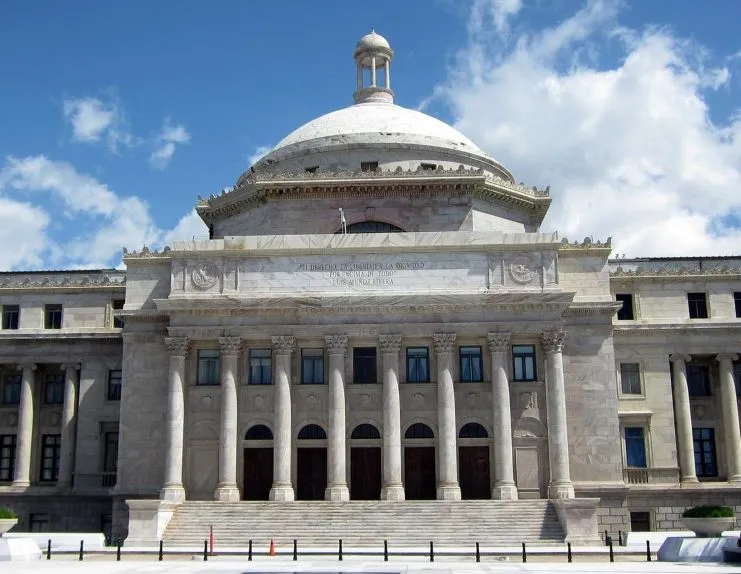
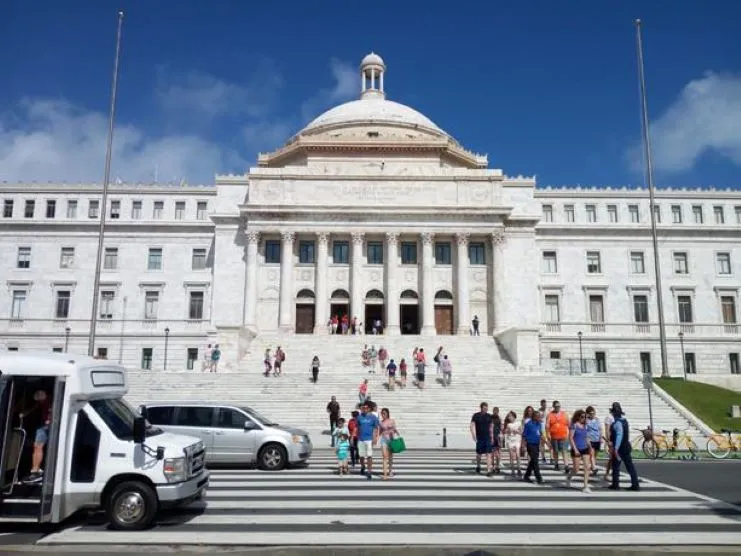
El Capitolio is where Puerto Rico’s Senate and House of Representatives meet. The white-marble building stands in Puerta de Tierra, just east of the Old San Juan walls. Architect Rafael Carmoega designed it; the first stone was laid in 1925 and it opened in 1929.
- The original documents of Puerto Rico’s Constitution are on display in the Rotunda, beneath the central dome.
- Guided tours run Monday to Friday by advance request to the Legislature’s tourism office; details below.
Updated October 13, 2026. Tour rules come from the Capitol tour request form and tourism page of the Legislative Services Office (Oficina de Servicios Legislativos). Building and art details come from the office's Capitol District guide, the House of Representatives' history of the Capitol and the Senate's 95th-anniversary timeline. Dates are checked against the 1977 National Register of Historic Places nomination. Statue details come from Primera Hora (2012).
How to visit
- Book ahead. Visits are arranged by the Tourism Promotion Office (Oficina de Promoción Turística) of the Legislative Services Office. Fill in its Capitol Tour Request Form, linked from the office's tourism page in English and Spanish, and email it to promocionturistica@oslpr.org.
- Tour times: Monday to Friday, 8:30 a.m. to 4:00 p.m., according to the form.
- Questions: call 787-721-5200, extension 301, 311 or 350.
- Language: the form lets you choose English or Spanish.
- Accessibility: the form asks whether anyone in your group has an intellectual, mobility or sensory disability, so say so when you book.
- Cost: the guided visit was free when Listín Diario reported on it in 2017. The office does not publish a fee, but confirm when you book.
Besides individual visits, the office runs historical tours of the wider Capitol District and educational activities for students. The form has fields for group size and school grade, so groups book the same way.
What you'll see in the Rotunda
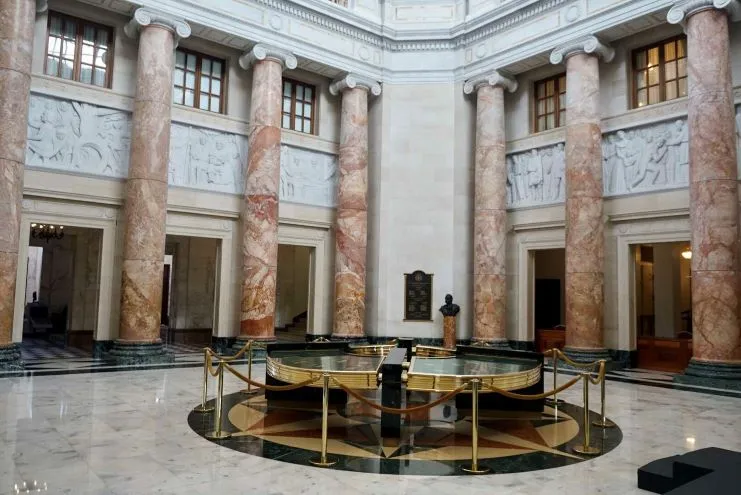
The Rotunda is the reason to go. Stand in the center and look up: the dome rises about 80 feet. At its top, a stained-glass Seal of Puerto Rico lets in light that falls straight onto the Constitution's display case below. Around it, Venetian-glass mosaics show eight muses. They stand for justice, health, science, liberty, agriculture, education, industry and commerce, and the arts and letters. The Legislature's guide says Italian artist Gino Garibaldi completed these mosaics in 1962; the job took two years.
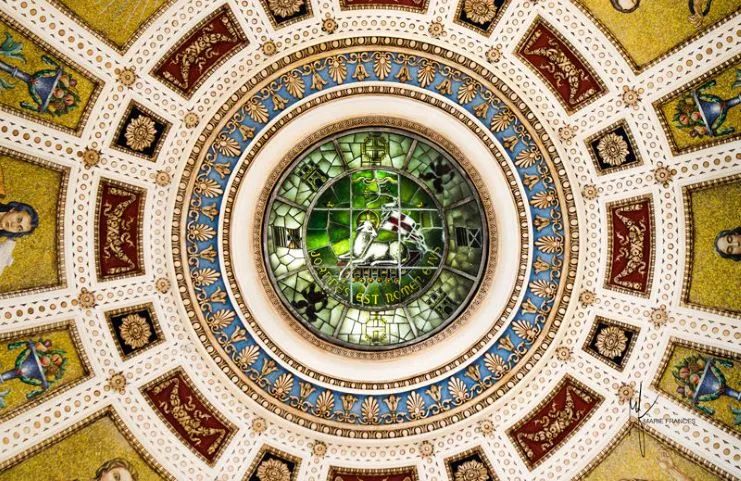
Four larger mosaics fill the curved corners under the dome. Each was designed by a Puerto Rican artist:
- The Discovery (Rafael Ríos Rey): Columbus's arrival on November 19, 1493, on his second voyage.
- The Colonization (José R. Oliver): the Taíno, Spanish and African roots of the Puerto Rican people.
- The Autonomist Movement of 1887 (Jorge Rechani): Luis Muñoz Rivera and Román Baldorioty de Castro with fellow autonomists, El Morro in the background.
- The Abolition of Slavery (Rafael Tufiño): a man breaking his chains. Slavery ended in Puerto Rico on March 22, 1873.
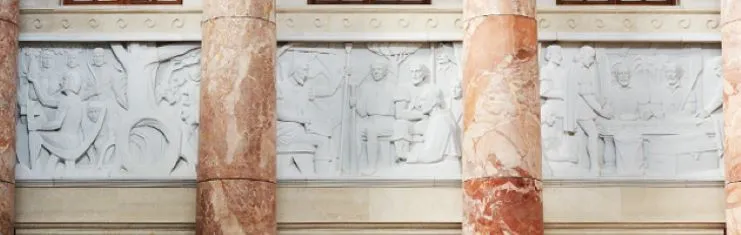
Lower down, between 16 columns of Breccia Pernice marble, four white Carrara marble reliefs run around the Rotunda, one per side, each split into three scenes. Read them as a walk through the island's political history: a Taíno council with the cacique Agüeybaná; early Spanish governors and the Grito de Lares era; the 1871 Provincial Deputation, the first autonomous cabinet of 1898 and U.S. troops landing at Guánica on July 25, 1898; and finally the Foraker Act of 1900, the Jones Act of 1917 and the 1952 Constitution, shown with Luis Muñoz Marín and Antonio Fernós Isern.
The original Constitution
At the very center of the first floor is the display case holding the original documents of the Constitution of Puerto Rico. The Legislature's guide describes them as hermetically sealed behind bulletproof glass. The current case was unveiled on July 24, 1992. According to the Senate's timeline, the first case went on display in 1956 and was taken away in 1982 so the documents could be restored.
Chambers and galleries
- The two chambers are on the second floor. The Senate uses purple and the House uses green, a color scheme the Legislature's guide traces to ancient Rome and the old English House of Commons.
- History galleries: the Senate's opened on August 13, 2000, with photos going back to its first sessions in 1917. The House's opened in 2009, with photos of the Capitol's first 80 years.
- The Sonia Sotomayor Illustrious Women room, beside the Senate chamber, displays oil portraits of notable Puerto Rican women.
- The Dr. Leopoldo Figueroa Carreras Hall on the first floor is now a hearing room. From 1933 to 1955 it housed Puerto Rico's Supreme Court.
A short history of the building
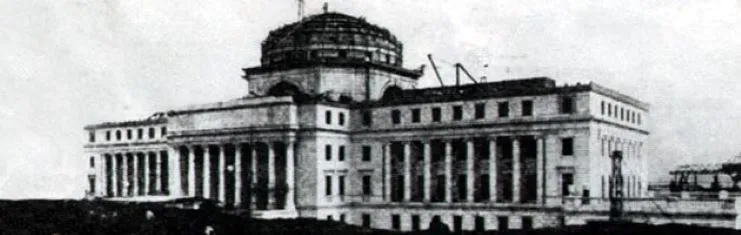
Luis Muñoz Rivera first proposed a capitol on February 7, 1907. At the time, the legislature met in the old Provincial Deputation building in Old San Juan. Muñoz Rivera died in 1916, before work began. The symbolic first stone was laid on July 17, 1925, his birthday. The Capitol opened on February 11, 1929, when the Legislative Assembly held its first session there.
Puerto Rican architect Rafael Carmoega designed it in a neoclassical style. The National Register nomination notes the influence of the Pantheon in Rome and of the U.S. Capitol. The Legislature's guide says construction took four years and cost about $3 million, and that 21 kinds of marble from Italy, the United States and Spain went into it. The main façade faces the Atlantic. The dome itself wasn't completed until 1961. The building joined the National Register of Historic Places in 1977. Between 2021 and 2023 the dome was restored inside and out, along with the Rotunda's Venetian mosaics.
Outside: the plazas and presidents' statues
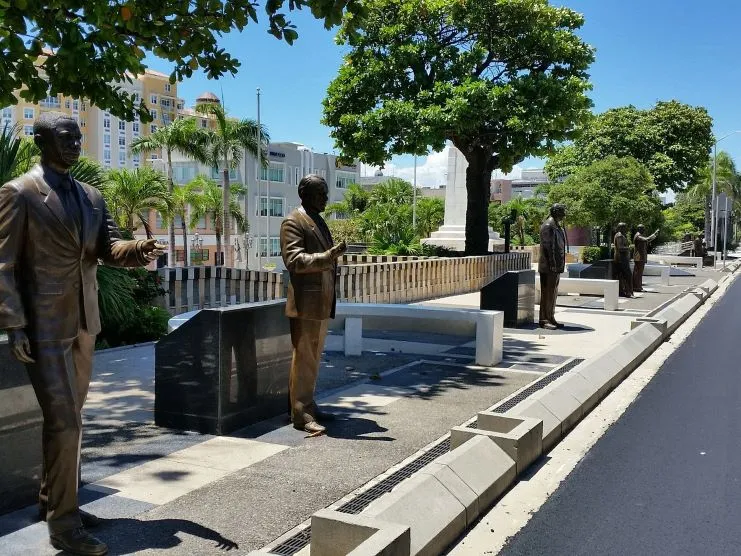
On the south side, along the avenue, stand bronze statues of U.S. presidents who visited Puerto Rico. Barack Obama's and Lyndon B. Johnson's were unveiled in February 2012, joining statues that already included John F. Kennedy, Harry Truman, Herbert Hoover, Dwight Eisenhower and Franklin D. Roosevelt. The plaza on the north side, toward the ocean, is the Plaza de la Democracia, built in 1967–1968.
Getting there and nearby
The Capitol fills the block between Avenida Ponce de León on the south and Avenida Muñoz Rivera on the north, in Puerta de Tierra, just east of Old San Juan. Pair a morning tour with an afternoon in Old San Juan, a walk along the Paseo de la Princesa or a visit to El Morro. For more ideas, see things to do in San Juan, our list of historical sites in Puerto Rico and our guide to the history of Puerto Rico. Guided options are listed in the San Juan tours directory.
Frequently asked questions
What is the Capitol of Puerto Rico used for?
It is the seat of the Legislative Assembly, the two-chamber legislature made up of the Senate and the House of Representatives.
When was El Capitolio built?
The symbolic first stone was laid on July 17, 1925, and the building opened on February 11, 1929. Rafael Carmoega designed it in a neoclassical style influenced by Rome’s Pantheon and the U.S. Capitol. The dome was not finished until 1961.
Can you tour the Capitol?
Yes. Tours run Monday to Friday, 8:30 a.m. to 4:00 p.m., in English or Spanish. Email the Legislative Services Office’s tour request form to promocionturistica@oslpr.org, or call 787-721-5200, ext. 301, 311 or 350.
What can you see inside?
The rotunda beneath the dome. At its center, on the first floor, the original Constitution of Puerto Rico sits in a glass case.
Is the Capitol a historic landmark?
Yes. The building joined the National Register of Historic Places, the federal list of historic places worth preserving, in 1977.
Sources we checked
Checked in October 2026. Where a fact could not be confirmed against a primary source, we removed it or said so.
- Oficina de Servicios Legislativos: tourism office (historical tours of the Capitol District, tour request forms)
- Oficina de Servicios Legislativos: Capitol tour request form (weekday hours, languages, email and phone)
- Oficina de Servicios Legislativos: The Capitol District guide (Rotunda art, Constitution case, chambers, galleries)
- Cámara de Representantes: history of the Capitol (1907 bill, July 17, 1925 first stone, Feb. 11, 1929 opening, mosaics)
- Senado de Puerto Rico: 95 years of El Capitolio timeline (dome, Constitution cases, 2021–2023 restoration)
- National Park Service: National Register of Historic Places nomination, Capitol of Puerto Rico (1977)
- Primera Hora (Feb. 2012): Obama statue unveiled on the Capitol's presidents' walk
Originally published on PuertoRico.com (2023-01-21). Reviewed and updated October 2026: facts were checked against the sources above.