
Quick answer
Go on a dark night near the new moon. The glow is there all year, but moonlight and city light wash it out.
- Next new moons (US Naval Observatory, Atlantic Standard Time): Nov 9 and Dec 8, 2026; Jan 7, Feb 6 and Mar 8, 2027.
- In the days after a full moon, the moon rises later each night, so early-evening tours can still be dark.
- La Parguera closes for three full-moon days every lunar cycle (DRNA order, June 2023).
- Heavy rain can dim the glow, and no operator can guarantee it.
This is due to the moon rise/set times and moon phase.
In this article, I will explain when the best time is to see bioluminescence in Puerto Rico, and how the moon affects its visibility. I will also cover the following topics:
– What is bioluminescence & bioluminescent bays?
– When is the best time to go to the bioluminescent bays in Puerto Rico?
– How does the moon affect the visibility of the bioluminescence?
– Does the rain affect the visibility of the bioluminescence?
What is bioluminescence & bioluminescent bays?
Bioluminescence is the term used to describe when a living organism emits light.
A bioluminescent bay is a shallow bay of water connected to the sea that contains a very high concentration of bioluminescent plankton called “Dinoflagellates”.
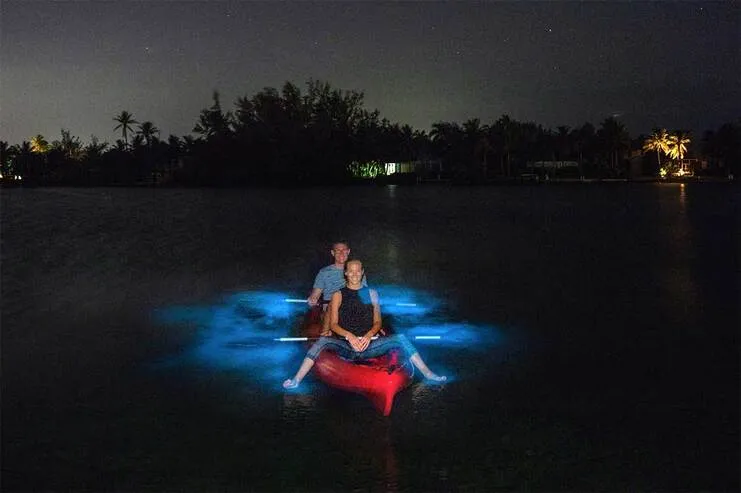
All over the sea, there are single-celled plankton called “Dinoflagellates”. When pressure is applied to the cell-wall of these Dinoflagellates, a chemical reaction occurs inside the cell, which causes them to emit light.
In regular sea water, you can’t see bioluminescence from these Dinoflagellates because they are in a low concentration. However, in Puerto Rico’s bioluminescent bays, there is a very high concentration of these plankton, which means that when you move the water, you can see bright light (bioluminescence).
These Dinoflagellates naturally drift into these bioluminescent bays since they are connected to the sea. Once they enter these bio bays, they get trapped as the entrance is very narrow, meaning that they can’t escape. They start to multiply inside the bay, which leads to an abnormally high concentration of plankton.
It is this high concentration of plankton that allows humans to see the bioluminescence.
When is the best time to go to the bioluminescent bays in Puerto Rico?
The bays glow all year. What changes is how easy the glow is to see: it is best on dark nights, so plan around the moon first and the weather second.
| New moon (darkest skies) | Full moon |
|---|---|
| Oct 10, 2026 | Oct 26, 2026 |
| Nov 9, 2026 | Nov 24, 2026 |
| Dec 8, 2026 | Dec 23, 2026 |
| Jan 7, 2027 | Jan 22, 2027 |
| Feb 6, 2027 | Feb 20, 2027 |
| Mar 8, 2027 | Mar 22, 2027 |
| Apr 6, 2027 | Apr 20, 2027 |
| May 6, 2027 | May 20, 2027 |
| Jun 4, 2027 | Jun 18, 2027 |
| Jul 3, 2027 | Jul 18, 2027 |
Rain matters too. Heavy rain can dim the glow, and tours may be cancelled in storms. If you travel during the Atlantic hurricane season (June 1 to November 30), keep your dates flexible and check our hurricane tracker.
How does the moon affect the visibility of the bioluminescence?
One of the most common misconceptions about bioluminescence is that the moon phase is the primary factor that affects the visibility.
This isn’t true most of the time.
The most important factor that affects the visibility of the bioluminescence is the moon rise & set times, not the moon phase.
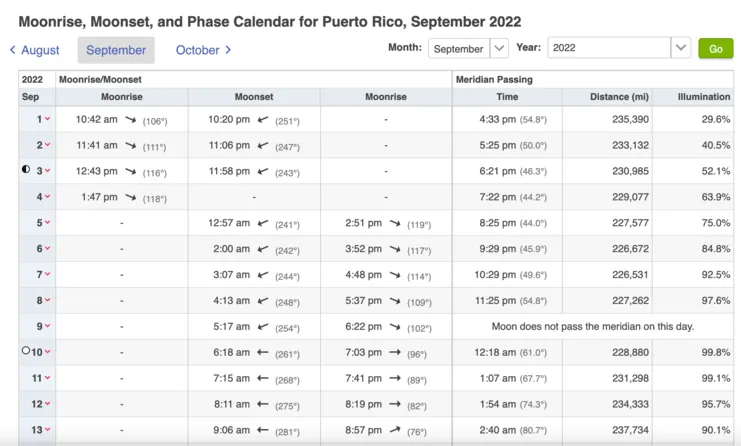
It can be a Full Moon, but if the Full Moon is not in the night sky at the time that you are in the bioluminescent bay, then it will still be pitch black, and you will be able to see the bioluminescence as if it were a New Moon.
The best conditions to see the bioluminescence is when it is pitch black, and there is no light being reflected from the moon. If there is lots of light in the surrounding environment (such as from the moon), then you can’t see the bioluminescent light being emitted from the Dinoflagellate plankton.
The reason why the moon phase doesn’t matter most of the time is because if the moon isn’t in the night sky at the time that you are in the bioluminescent bay, then it doesn’t matter what the moon phase is, as there will be zero light being reflected by the moon at the specific time, meaning that it is pitch black, which is what you want to ensure optimal viewing.
The glow is easiest to see when the sky is dark. Around the new moon the moon is down for the whole evening. In the days after the full moon, the moon rises later each night, so early-evening tours can still be dark; around the full moon itself, the moon is up all night and the glow is much harder to see. Since June 2023, a DRNA order closes La Parguera’s bay for three full-moon days every lunar cycle.
Before you book, ask the operator what time the tour starts and whether the moon will be up at that time. Para la Naturaleza, which runs tours at Laguna Grande, notes that the glow depends on the moon and the concentration of organisms and can’t be guaranteed.
Does the rain affect the visibility of the bioluminescence?
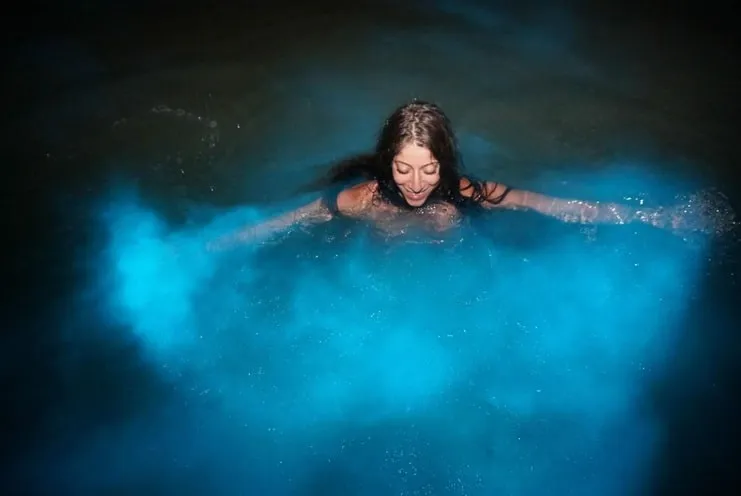
Heavy rain can negatively affect the visibility of the bioluminescence.
The concentration of the Dinoflagellate plankton in the bioluminescent bays can decrease when there is heavy rainfall.
Rain and storms can also cancel tours, and the Atlantic hurricane season runs from June 1 to November 30.
Frequently asked questions
When is the best time to see bioluminescence in Puerto Rico?
On dark nights near the new moon. Upcoming new moons: Nov 9 and Dec 8, 2026, and Jan 7, Feb 6 and Mar 8, 2027 (US Naval Observatory, Atlantic Standard Time).
Can you see bioluminescence during a full moon?
It is much harder, because the moon is up all night. La Parguera’s bay also closes for three full-moon days each lunar cycle.
Does rain affect bioluminescence?
Yes. Heavy rain can dim the glow for a while, and storms can cancel tours.
Can you see the bio bays all year?
Yes, the glow is present all year, but it is never guaranteed on a given night.
Which bio bay is the brightest?
Mosquito Bay on Vieques, which Guinness World Records lists as the world’s brightest.
Final thoughts
Pick a night near the new moon, check the forecast, and book a licensed tour that starts before moonrise. Then choose your bay: Mosquito Bay for the brightest glow, Laguna Grande for the easiest trip from San Juan, or La Parguera in the southwest — browse Fajardo bio-bay and kayak tours.
Sources we checked
Checked in October 2026. Where a fact could not be confirmed against a primary source, we removed it or said so.
- US Naval Observatory: dates and times of the primary moon phases (UT; converted to Atlantic Standard Time)
- Metro Puerto Rico (June 8, 2023): DRNA Administrative Order 2023-02 closes La Parguera’s bio bay for three full-moon days every lunar cycle
- Para la Naturaleza: “Bioluminiscencia y contaminación lumínica” night tour at Cabezas de San Juan, Fajardo — trolley and boardwalk over Laguna Grande, no kayak; visibility not guaranteed
- Guinness World Records: brightest bioluminescent bay — Mosquito Bay, Vieques (2006; up to 700,000 Pyrodinium bahamense per gallon)
- NOAA National Hurricane Center: Atlantic hurricane season runs June 1 to November 30
Originally published on PuertoRico.com (2022-09-30). Reviewed and updated October 2026: facts were checked against the sources above.