Updated October 12, 2026. History from the National Park Service (San Juan National Historic Site), the U.S. National Register of Historic Places listings and published histories of each site. The ghost stories are folklore: we tell them as legends, not as fact.
Puerto Rico's ghost stories cling to real places: Spanish forts, a 1940s Art Deco hotel, a 19th-century theater and an old railway tunnel. Below are the ten best-known legends, what history actually records about each spot, and whether you can visit today.
The 10 at a glance
| # | Place or legend | Where | Can you visit? |
|---|---|---|---|
| 1 | El Morro | Old San Juan | Yes, NPS fee |
| 2 | Castillo San Cristóbal and the Garita del Diablo | Old San Juan | Yes, same NPS ticket |
| 3 | Normandie Hotel | Puerta de Tierra, San Juan | Outside only (closed) |
| 4 | Teatro Tapia | Old San Juan | During performances |
| 5 | The Chupacabras | Canóvanas (1995) | It's a legend |
| 6 | Oso Blanco prison | Río Piedras, San Juan | No, demolished 2015 |
| 7 | Guajataca Tunnel | Isabela–Quebradillas | Yes, outdoor site |
| 8 | Pozo de Jacinto | Isabela coast | Yes, outdoor site |
| 9 | Teatro de Guayama | Guayama | Check reopening |
| 10 | The "desmembrados" of PR-116 | Lajas | It's a road legend |
1. Castillo San Felipe del Morro (El Morro)
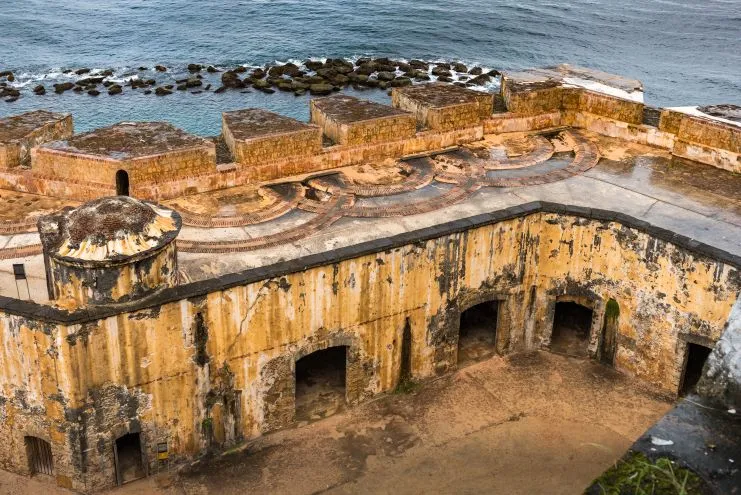
El Morro guards the mouth of San Juan Bay. Spanish troops began building here in 1539, and most of the walls you see date from a burst of construction in the 1760s to 1780s. It has been attacked five times, including by Sir Francis Drake in 1595, and was captured once, by English troops in 1598, who left after six weeks when dysentery swept through their ranks.
The legend: a woman in a white dress, face never seen, drifts along the ramparts at night, and visitors talk of cries from the "dungeons" below.
What history says: the National Park Service points out that no dungeon was ever purpose-built here. Vaulted rooms were used to hold prisoners at times, which is where the stories took root. The fort sits beside the Santa María Magdalena de Pazzis Cemetery, which the Park Service calls a safe, worthwhile visit, and many people link the two.
Visit: El Morro and San Cristóbal are part of San Juan National Historic Site. One ticket ($10 per adult, under 16 free) covers both forts for 24 hours. See our El Morro guide and the cemetery guide.
2. Castillo San Cristóbal and the Garita del Diablo
San Cristóbal protected the city from a land attack. It covers about 27 acres, and the Park Service calls it the largest fort Spain built in the Americas. Its oldest piece is a seaside sentry box from 1634: the Garita del Diablo, the "Devil's sentry box."
The legend: soldiers posted in that garita vanished overnight, leaving only their uniform and rifle, and people said the devil had carried them off.
What history says: there are no records of missing sentries. There is, however, a real curiosity: a room off one of San Cristóbal's tunnels has ship drawings scratched into its walls, tied by tradition to mutineers who seized the fort's cannon in 1855.
Visit: same NPS ticket as El Morro. The walk between the two forts is just under a mile and takes 15 to 20 minutes.
3. Normandie Hotel
This Art Deco landmark in Puerta de Tierra opened on October 10, 1942, styled after the French ocean liner SS Normandie. It was built by engineer Félix Benítez Rexach, reportedly as a gift for his wife, the French performer Lucienne D'Hotelle, and it hosted the island's top entertainers.
The legend: a woman threw herself from an upper floor in the hotel's early years, and staff and guests later heard a woman weeping in the halls.
What history says: the Normandie has closed and reopened several times. It ran as a boutique hotel after a 2005 reopening, shut again around 2010, and was sold in 2022 to new owners who announced plans to restore it. It has been on the National Register of Historic Places since 1980.
Visit: it's closed, so admire the curved, ship-like facade from the street. It's a short walk from Escambrón beach; see things to do in San Juan.
4. Teatro Tapia
Facing Plaza de Colón in Old San Juan, the theater was built in the 1820s as San Juan's municipal theater and is described as the oldest free-standing theater building in the city. It took the name of playwright Alejandro Tapia y Rivera in 1937, and San Juan's mayor Felisa Rincón de Gautier saved it from demolition after years of neglect in the 1940s.
The legend: a woman in old-fashioned dress appears in one of the boxes during shows and vanishes in seconds. Staff talk of footsteps and voices on an empty stage after closing.
Visit: buy a ticket to a play or concert. That is the only way inside, and the best way to see the horseshoe-shaped hall.
5. The Chupacabras
In 1995, farmers across Puerto Rico reported goats, sheep and other animals found dead with puncture wounds. That August, a Canóvanas resident described a spiny, red-eyed creature, and the "goat-sucker" became a worldwide legend. Most accounts credit the name to Silverio Pérez, a local comedian who came up with it on his radio show.
What investigators found: researcher Benjamin Radford concluded after a five-year investigation that the original eyewitness description closely matched the alien in the 1995 film Species, which she had seen. Later "chupacabras" in the U.S. and Mexico turned out to be dogs and coyotes with severe mange. No physical evidence of the creature has ever been verified.
Visit: there is nothing to visit, but you will spot chupacabras on T-shirts and in local humor everywhere.
6. Oso Blanco (Río Piedras State Penitentiary)
Opened in 1933, the "White Bear" prison held many of the island's most dangerous inmates. It was the scene of a 1991 helicopter escape. The government emptied it in 2004 because modernizing it was too expensive.
The legend: in the years it stood empty, people claimed to hear voices and see figures in the cell blocks.
What happened next: despite objections from Puerto Rico's College of Architects, the building was demolished in 2015 to make room for a science and technology park. There is nothing left to visit, so be wary of any "Oso Blanco ghost tour."
7. Guajataca Tunnel
This railway tunnel links Isabela and Quebradillas above the Guajataca River canyon. The American Railroad Company began building it around 1904, and the government declared it a historic monument in 2000.
The legend: workers died building it, and some locals say you can still hear a train approaching, decades after passenger service ended, along with voices calling for help.
What history says: railway construction of that era was dangerous, but the specific accident stories that circulate online aren't backed by records we could find, so we don't repeat them.
Visit: the tunnel is open-air and free, by the beach of the same name. That beach has heavy surf and dangerous currents; enjoy it from the sand. More in our Guajataca Tunnel guide.
8. Pozo de Jacinto, Isabela
A blowhole in the rocks on Isabela's coast, near Jobos Beach. The legend: a farmer named Jacinto kept his cow tied to him on a rope; one day the cow slipped into the hole and dragged him down with her. Shout "¡Jacinto, dame la vaca!" (Jacinto, give me the cow!) and the sea is said to answer with a spray of water.
Visit: it's an easy stop on an Isabela beach day; stay back from the edge, as waves surge through the rocks. See things to do in Isabela.
9. Teatro de Guayama
Guayama, on the south coast, is nicknamed the Ciudad de los Brujos ("city of witches"), and its Art Deco theater gets its share of the lore. The building opened in 1938 as the Teatro Calimano cinema, was renamed Teatro Guayama when the town restored it in 1989, and is listed on the National Register of Historic Places. The legend: staff and performers swap stories of unexplained noises and a presence backstage.
Visit: hurricanes Irma, María and Fiona damaged the theater, and the municipality began a full rehabilitation in 2024. Check with the town for reopening and events before you go.
10. The "desmembrados" of PR-116, Lajas
A road legend from southwest Puerto Rico. Drivers on a stretch of PR-116 in Lajas tell of seeing broken figures walking or crawling along the shoulder at night, said to be victims of crashes on that road. The real takeaway: it's a dark rural road, so drive it slowly.
Want a spooky evening of your own?
Walk the walls of Old San Juan at sunset, then join a guided night history walk. Many local guides weave the legends above into their stories. Our guide to things to do at night has more ideas, and our historical sites guide covers the real history behind several of these places. For more on local traditions, see public holidays and celebrations.
Originally published on PuertoRico.com (2023-03-26); last updated 2026-10-12.