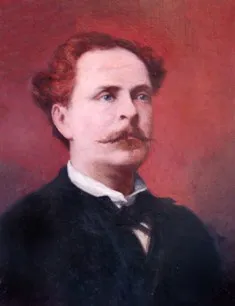
Alejandro Tapia y Rivera: biography
Early life and family
Alejandro Tapia y Rivera was born in San Juan to a father from Murcia, Spain, and a mother from Arecibo. He received his first education in a school on Luna Street in Old San Juan under educator Rafael Cordero, where he met lifelong friend José Julián Acosta. Later he studied at the school of Juan Basilio Núñez and the drawing school of Juan Cleto Noa. He continued at the Liceo de San Juan run by the Escolapios and then the Seminario Conciliar de San Ildefonso. In 1846 he helped found La Filarmónica society to organize dances, gatherings and concerts. 1 2
Exile in Spain and return
In 1849 Tapia fought a duel in Cataño against a Spanish artillery captain after refusing to yield the sidewalk. In Spain from 1850 to 1852 he studied literature in Madrid and co-founded the Sociedad Recolectora de Documentos Históricos de San Juan Bautista de Puerto Rico. There he collected and organized 16th- and 17th-century documents about Puerto Rico from libraries and collections. 1 2
Governor Fernando de Norzagaray pardoned him in 1852. Tapia returned to Puerto Rico and settled in Ponce. In 1870 he founded Puerto Rico's first Gabinete de Lectura in Ponce, which became the precursor of the Ponce Municipal Library. He moved back to San Juan around 1874. 1 2
Literary career and major works
Tapia published his first major work, Biblioteca Histórica de Puerto Rico, in 1854 after organizing historical documents in Spain. He wrote biographies including José Campeche in 1854, Vasco Núñez de Balboa in 1872 and Ramón Power in 1873. His dramatic works include Roberto D'Evreux from 1848, later modified and staged in 1856, La cuarterona in 1867, Camoens in 1868 and La parte del león in 1880. 1 2
Narrative works comprise Póstumo el transmigrado in 1872 and its sequel Póstumo el envirginado in 1882, which use humor and allegory to critique society while advancing feminist ideas. His long poem La Sataniada appeared in 1874 under the pseudonym Crisófilo Sardanápalo. He also wrote the novel Roberto Cofresí in 1876, the libretto Guarionex premiered in 1854, and the essay collection Misceláneas in 1880. 1 2
Advocacy, institutions and death
Tapia belonged to the Progressive Action Political Party and the Puerto Rican Intellectual Protective Society. He served as director of the Youth Museum in Ponce and became the founder and first president of the Ateneo Puertorriqueño, which he helped establish with Manuel Elzaburu, Francisco de Paula Acuña and José Julián Acosta. The institution aimed to defend Puerto Rican cultural values. His writings promoted abolition, women's rights and equality, featuring strong female characters who challenge patriarchal limits, as seen in La parte del león. 1 2
Tapia died in San Juan on 19 July 1882 from a cerebral hemorrhage while delivering a lecture at the Ateneo Puertorriqueño. 1 2
Legacy and ties to Puerto Rico
The Teatro Tapia in Old San Juan is named after him as the island's main dramatic stage. Schools and avenues in Puerto Rico also carry his name. In 2008 the Archivo Nacional de Teatro y Cine del Ateneo Puertorriqueño announced a documentary on his life as part of Jornadas en Honor y Memoria de Alejandro Tapia y Rivera. 1 2
He received the Medal of the Royal Knight and the Royal and Distinguished Order of Carlos III from Spain. 1 2
Questions about Alejandro Tapia y Rivera
When was Alejandro Tapia y Rivera born?
Alejandro Tapia y Rivera was born on November 12, 1826 in San Juan, Puerto Rico.
Why is Alejandro Tapia y Rivera called the father of Puerto Rican literature?
He compiled the first historical library of Puerto Rican documents, wrote foundational biographies, plays and novels, and founded the Ateneo Puertorriqueño to promote national culture.
What feminist ideas appear in Tapia y Rivera's works?
His plays such as La parte del león feature bold female characters who challenge patriarchal norms and male characters who advocate gender equality.
Which institution did Tapia y Rivera found in Ponce?
He established the first Gabinete de Lectura in 1870, the precursor to the Ponce Municipal Library, and later served as first president of the Ateneo Puertorriqueño.
When did Alejandro Tapia y Rivera die?
Alejandro Tapia y Rivera died on July 19, 1882 in San Juan, Puerto Rico, aged 55.
Sources
- Wikipedia: Alejandro Tapia y Rivera
- Wikipedia (español): Alejandro Tapia y Rivera
- Wikidata: Q4714689
- Primera Hora (cited by Wikipedia)
- Library of Congress (cited by Wikipedia)
Photo: Tapia Y Rivera.jpg, Unknown author (Public domain). Resized and converted to WebP.
Reviewed November 18, 2026. Original biography by PuertoRico.com. Editorial policy