Emilio Navarro: biography
Early life and family
Emilio Navarro was born on September 26, 1905, in Patillas, Puerto Rico, to Botello and Pepa Navarro. His father, a shoemaker, died when Navarro was six years old. His mother then moved the family to Ponce, where she had relatives. From a young age Navarro sold newspapers, peanuts and ice to help support the household. He attended Castillo Public School in Ponce and worked after classes shining shoes and delivering meals prepared by his mother. Navarro first encountered baseball while watching his school team. Lacking money for a ticket to a game between the Castillo and Reina teams, he jumped a fence in the outfield. When a Castillo player fell ill, the coach asked Navarro to fill in. He agreed and continued playing baseball from that point. After graduating from Ponce High School he received a scholarship offer to the University of Puerto Rico in Mayagüez but declined it to continue helping his family financially. He felt ready to play in the major leagues in the United States. 1 2
Negro leagues and international career
In the racially segregated United States of the 1920s, Navarro's skin color barred him from the major leagues. Navarro recorded a .337 batting average over two seasons with the Cuban Stars. The experience proved bittersweet; he encountered discrimination because of his skin color and limited English, especially in the South. After his Negro leagues stint Navarro played in the Dominican Republic and Venezuela. By the time major league baseball integrated in the late 1940s he had returned to Puerto Rico. His experience and knowledge contributed to his success as one of the founders of the Leones de Ponce baseball team in Ponce. He played, coached and contributed in multiple roles for the Leones, dedicating nearly 20 years of his life to the team. 1 2
Later career and retirement
He then served as administrator of Francisco "Paquito" Montaner Stadium in Ponce for ten years. He also worked as a physical education teacher in public schools in Ponce and Caguas. From 1952 to 1978 he worked at the Puerto Rico racetrack for 26 years. Later he owned a sporting goods store and founded a business distributing gaming machines called Schuffley Alley, where he continued as controller in his final years even as his children managed daily operations. 2
Awards and honors
In 1938 sportswriter Emilio Huike named Navarro the Ideal Professional Baseball Player. He was elected to the Puerto Rico Baseball Hall of Fame in 1992 and the Puerto Rican Sports Hall of Fame in 2004. On June 7, 2005, the Senate of Puerto Rico presented him with Resolution 1026 for his contributions to baseball. On December 29, 2006, he was inducted into the Hispanic Heritage Baseball Museum Hall of Fame; former Astros player José "Cheo" Cruz presented the plaque. On June 6, 2008, Major League Baseball held a ceremonial Negro leagues draft in which the New York Yankees selected Navarro. He was honored at a game during the final homestand at the old Yankee Stadium on September 18, 2008. In 2010 Experience Works recognized him as America's Outstanding Oldest Worker. Navarro became a centenarian on September 26, 2005. 1 2
Later years, death and legacy
On April 27, 2011, Navarro was hospitalized at Hospital San Lucas in Ponce after a minor heart attack. The next day he suffered a stroke and was moved to intensive care. He died on April 30, 2011, at age 105 in Ponce. He was survived by four children, eleven grandchildren, nine great-grandchildren and one great-great-grandchild. On May 1, 2011, the New York Yankees observed a moment of silence for him before their game against the Toronto Blue Jays. In 2011 Ponce named its new sports complex Ciudad Deportiva Millito Navarro. His remains rest at Cementerio La Piedad in Ponce. 1 2
Questions about Emilio Navarro
When was Emilio Navarro born?
Emilio Navarro was born on September 26, 1905 in Patillas, Puerto Rico.
Which teams did Millito Navarro play for in the Negro leagues?
Navarro played two seasons with the Cuban Stars, recording a .337 batting average, and also played for the Cuban Giants.
What roles did Navarro hold with the Leones de Ponce?
He was one of the founders, played for nearly 20 years, coached the team and contributed in various other capacities.
What honors did the New York Yankees give Navarro in 2008?
The Yankees selected him in the ceremonial Negro leagues draft on June 6, 2008, and honored him at a game during the final homestand at the old Yankee Stadium on September 18, 2008.
When did Emilio Navarro die?
Emilio Navarro died on April 30, 2011 in Ponce, Puerto Rico, aged 105.
Sources
- Wikipedia: Millito Navarro
- Wikipedia (español): Millito Navarro
- Wikidata: Q2635890
- NotiCel (cited by Wikipedia)
- WAPA (cited by Wikipedia)
- Primera Hora (cited by Wikipedia)
- Baseball-Reference (cited by Wikipedia)
- Society for American Baseball Research (cited by Wikipedia)
- ESPN (cited by Wikipedia)
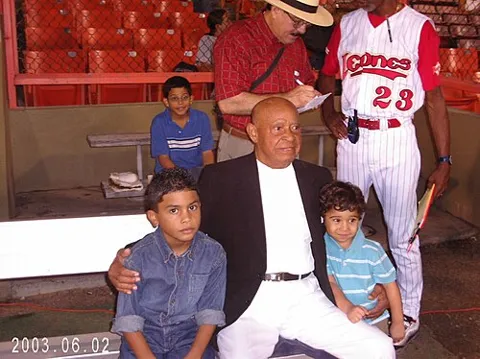
Photo: Emilio and great grandsons.jpg, Ericnavarro at English Wikipedia (CC BY 2.5). Resized and converted to WebP.
Reviewed November 18, 2026. Original biography by PuertoRico.com. Editorial policy