Enrique Laguerre: biography
Early life and family
He attended rural public schools in Isabela and Aguadilla, where he studied under educator Carmen Gómez Tejera, who became his first literary mentor. 1 2
Education and teaching career
In 1924 Laguerre took teaching courses in rural education in Aguadilla. He obtained a teaching license in 1927 and worked as an educator for seven years in western towns. He earned a normal-school degree from the University of Puerto Rico in 1936 and a master's degree in Hispanic studies from the same institution in 1941. He later completed doctoral studies in letters at Columbia University between 1949 and 1951. Laguerre taught at elementary and university levels from 1925 until 1988, including as a professor at the University of Puerto Rico. In 1970 he was named emeritus professor by that university. 1 2
Literary career
Laguerre used several pen names, including Tristán Ronda, Luis Urayoán, Motial and Alberto Prado. He published essays and articles in periodicals such as Ámbito, Ateneo Puertorriqueño, Brújula, Horizontes, Isla, La Democracia and Paliques, a magazine he helped found. From 1959 to 1988 he wrote the weekly column "Hojas Libres" for El Mundo and from 1999 onward the column "Comentario" for El Vocero. Mentored by Antonio S. Pedreira, he published his first novel La Llamarada in 1935. The work depicts the hardships of sugarcane workers during the Great Depression and became required reading in Puerto Rican literature courses. Subsequent novels include Solar Montoya (1941), El 30 de febrero (1942), La resaca (1949), Los dedos de la mano (1950), La ceiba en el tiesto (1956), El laberinto (1959), Cauce sin río (1962), El fuego y su aire (1970), Los amos benévolos (1976), Infiernos privados (1986), Por boca de caracoles (1990), Los gemelos (1992), Proa libre sobre mar gruesa (1995) and Contrapunto de soledades (1999). His play La resentida premiered at the University of Puerto Rico theater on April 12, 1944, and was published in 1960. It is set in the period after the Spanish-American War of 1898 and centers on sedition against Spanish coffee-plantation owners. In 1978 actress Madeline Willemsen adapted Los dedos de la mano into a telenovela broadcast on WIPR-TV. 1 2
Public service and recognitions
Laguerre served on the board of directors of the Institute of Puerto Rican Culture beginning in 1954 and again from 1973, when he became its president. In 1976 he helped found the Center for Advanced Studies on Puerto Rico and the Caribbean in San Juan and was later named an emeritus member. He wrote more than two hundred articles on education, over four hundred fifty on sociology, nearly two hundred on individuals, and many others on politics, history, literature, ecology and urban planning. He received dozens of honors, including an honorary doctorate from the Pontifical Catholic University of Puerto Rico in 1969, the Puertorriqueñidad Award at Fordham University in 1970, the National Medal of Culture from the Institute of Puerto Rican Culture in 1975, the Literature Award from the same institute that year, the Alejandro Tapia y Rivera Medal in 1983, and the Premio General Fernando Chardón in 1997. Several universities awarded him honorary degrees between 1969 and 1999. In 1998 former governors Rafael Hernández Colón and Luis A. Ferré joined peers in advocating for his Nobel Prize in Literature nomination. Although he did not receive the prize, the nomination recognized his contributions to Puerto Rican letters. His complete works fill multiple volumes yet represent only a portion of his output. 1 2
Later years and legacy
Laguerre continued writing and making public appearances into the late 1990s. The Palacete Los Moreau, the restored hacienda featured in La Llamarada, became the site of literary events and exhibitions dedicated to his work. He was buried on the grounds of the Palacete Los Moreau in Moca. His novels remain central to Puerto Rican literature curricula, and his portrayals of rural life and social conditions during the early twentieth century continue to be studied for their realistic style and focus on national identity. 1 2
Questions about Enrique Laguerre
When was Enrique Laguerre born?
Enrique Laguerre was born on July 15, 1905 in Moca, Puerto Rico.
How many novels did Enrique Laguerre publish?
Laguerre published at least fifteen novels between 1935 and 1999, beginning with La Llamarada and ending with Contrapunto de soledades.
What is the setting of Laguerre's play La resentida?
The play is set in the years immediately after the Spanish-American War of 1898 and focuses on sedition against Spanish coffee-plantation owners.
Where is Enrique Laguerre buried?
He was buried on the grounds of the Palacete Los Moreau, the restored hacienda featured in La Llamarada, in his native town of Moca.
When did Enrique Laguerre die?
Enrique Laguerre died on June 16, 2005 in Carolina, Puerto Rico, aged 99.
Sources
- Wikipedia: Enrique Laguerre
- Enciclopedia de Puerto Rico: Enrique Laguerre
- Wikidata: Q5379739
- Library of Congress: Enrique Laguerre
- Fundación Nacional para la Cultura Popular (cited by Wikipedia)
- Yale University (cited by Wikipedia)
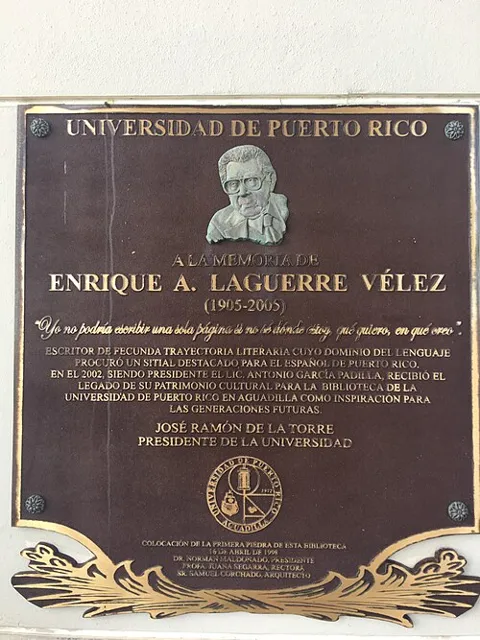
Photo: Placard of Enrique A Laguerre Velez at the library's entrance.jpg, Prof.D.H.R. (CC BY-SA 4.0). Resized and converted to WebP.
Reviewed November 18, 2026. Original biography by PuertoRico.com. Editorial policy