Helen Rodríguez Trías: biography
Early life and family
Her family returned to Puerto Rico shortly after her birth and moved back to New York when she was ten. There she faced racism and was initially placed in a class for students with learning disabilities despite good grades and English fluency. A poem recital revealed her abilities and she was transferred to a class for gifted children. Her mother worked as a school teacher in Puerto Rico but could not obtain a teaching license in New York and supported the family by taking in boarders. 1
Education and activism in Puerto Rico
After high school Rodríguez Trías moved to Puerto Rico for better scholarship opportunities to study medicine. She earned a BA from the University of Puerto Rico in 1948. She joined the student faction of the Puerto Rican Nationalist Party and participated in a strike after the chancellor blocked Pedro Albizu Campos from speaking on campus. She reinserted herself as a student activist on issues such as freedom of speech and Puerto Rican independence. She received her medical degree in 1960. 1
Medical career in Puerto Rico and New York
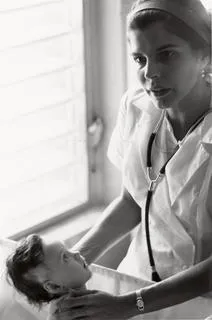
During her residency at University Hospital in San Juan, Rodríguez Trías created the first center for newborn care in Puerto Rico. The hospital's newborn death rate fell by 50 percent within three years. She established a pediatrics practice on the island. She directed the pediatrics department at Lincoln Hospital in the South Bronx, where she advocated for worker input in administration and patient care. She pushed staff to address cultural needs of the Puerto Rican community. She also served as associate professor at Albert Einstein College of Medicine and taught at Columbia and Fordham universities. 1
Women's rights and public health advocacy
Rodríguez Trías became interested in women's rights after an abortion conference at Barnard College. In Puerto Rico she learned of U.S. government sterilization campaigns that targeted women of color without informed consent. She co-founded the Committee to End Sterilization Abuse in 1970 and the Women's Caucus of the American Public Health Association in 1971. In 1979 she helped create the Committee for Abortion Rights and Against Sterilization Abuse. She testified before federal officials and drafted guidelines requiring written consent in the patient's language and a waiting period before sterilization. She supported neonatal care for low-income and minority populations and expanded public health services for women and children in the United States, Central and South America, Africa, Asia and the Middle East. 1
In the 1980s she served as medical director of the New York State Department of Health AIDS Institute, focusing on women from minority groups with HIV. In the 1990s she was health co-director of the Pacific Institute for Women's Health. 1
Later years and recognition
Rodríguez Trías cited her mother, aunts, sisters and medical school professor José Sifontes as inspirations. On January 8, 2001 President Bill Clinton awarded her the Presidential Citizens Medal for her work with women, children, people with HIV and AIDS, and poor communities. In 2019 New York City announced plans for a statue of her in St. Mary's Park near Lincoln Hospital in the Bronx. 1
Questions about Helen Rodríguez Trías
Where is Helen Rodríguez Trías from?
Helen Rodríguez Trías was born in New York City, New York.
What did Helen Rodríguez Trías accomplish in neonatal care in Puerto Rico?
During her residency at University Hospital in San Juan she established the first center for newborn care on the island. The hospital's newborn death rate decreased by 50 percent within three years.
How did Helen Rodríguez Trías influence U.S. sterilization policy?
She drafted federal guidelines requiring written consent in a language the woman understood and a waiting period between consent and the procedure. She testified before the Department of Health, Education, and Welfare in support of these rules.
Which award did President Clinton give Helen Rodríguez Trías?
On January 8, 2001 she received the Presidential Citizens Medal for her work on behalf of women, children, people with HIV and AIDS, and poor communities.
When did Helen Rodríguez Trías die?
Helen Rodríguez Trías died on December 27, 2001 in Santa Cruz, California.
Sources
- Wikipedia: Helen Rodríguez Trías
- Wikidata: Q16015265
- The New York Times (cited by Wikipedia)
- Library of Congress (cited by Wikipedia)
Photo: Helen-rodriguez-trias-taking-care-of-a-newborn.jpg, Jim Hansen (Public domain). Resized and converted to WebP.
Reviewed November 18, 2026. Original biography by PuertoRico.com. Editorial policy