Juan Antonio Corretjer: biography
Early life and family
Juan Antonio Corretjer Montes was born on March 3, 1908, in Ciales, Puerto Rico, to a family active in the independence cause. His parents were Diego Corretjer Hernández and María Brígida Montes González. His father and uncles took part in the Ciales Uprising of August 13, 1898, against Spanish forces. As a child he joined them at political rallies and absorbed stories of patriotic struggle from family members. 1 2
He completed primary and secondary studies in Ciales before attending school in Vega Baja after expulsion from the local high school. At age 12 he wrote his first poem, Canto a Ciales. In 1924 he published his earliest booklet of poems, and by 1925 his verses appeared in magazines such as Puerto Rico Ilustrado. 1 2
Nationalist Party leadership and imprisonment
Corretjer moved to San Juan in 1927 and worked as a journalist for La Democracia. He later lived in Ponce, where he published the poetry books Agüeybaná in 1932 and Ulises in 1933. In 1935 he traveled to Cuba, Haiti and the Dominican Republic seeking support for Puerto Rican independence and joined anti-Batista efforts in Cuba. 1 2
After the Río Piedras massacre of 1935 he was named Secretary General of the Puerto Rican Nationalist Party. Federal charges of sedition were brought against Corretjer, Albizu Campos and others for organizing the Cadets of the Republic. 1 2
He later joined the Puerto Rican Communist Party with his wife Consuelo but was expelled in 1948 for advocating armed revolution. 1 2
Participation in 1950 revolts and the Gag Law era
The U.S.-appointed governor signed the Ley de la Mordaza on June 10, 1948, which criminalized display of the Puerto Rican flag, patriotic songs and organizing for independence. Corretjer continued political and literary work with the Unión del Pueblo Pro-Constituyente. 1
During the Puerto Rican Nationalist Party Revolts of October 1950 in towns including Ponce, Mayagüez, Utuado, San Juan and Jayuya, Corretjer was among hundreds of Nationalists arrested by mid-November. The uprisings opposed the Estado Libre Asociado status and were suppressed by U.S. military, National Guard, FBI, CIA and insular police forces. 1
Poetry, essays and major works
Corretjer's poetry and essays centered on Puerto Rican independence, Taino revolutionary legacy and anti-colonial themes. His 1953 epic Alabanza en la Torre de Ciales is regarded as a key work of the neocriollismo movement. He also wrote Yerba Bruja in 1957. The Puerto Rican Athenaeum named him National Poet. 1 2
Other poetry volumes include Amor a Puerto Rico and Cántico de Guerra from 1937, El Leñero in 1944, and Tierra Nativa in 1951. Roy Brown Ramírez set several poems to music, among them Boricua en la luna, En la vida todo es ir, Distancias and Diana de Guilarte. Later artists including Joan Manuel Serrat, Mercedes Sosa, Antonio Cabán Vale, Fiel a la Vega and Lucecita Benítez recorded versions. 1
His essays and prose works cover historical topics such as Llorens, Juicio Histórico, La Revolución de Lares, Nuestra Bandera and La lucha por la independencia de Puerto Rico from 1949. In 1965 he published Albizu Campos and the Ponce Massacre in English to inform U.S. readers. Additional titles include Imagen de Borinquen IV Yerba Bruja in 1970, Aguinaldo escarlata in 1974, Prisionero 70495 in 1976, Pausa para el Amor in 1976, Paso a Venezuela in 1977, El Cumplido in 1979 and Los días de conta dos in 1984. 1 2
Later years and ties to Puerto Rico
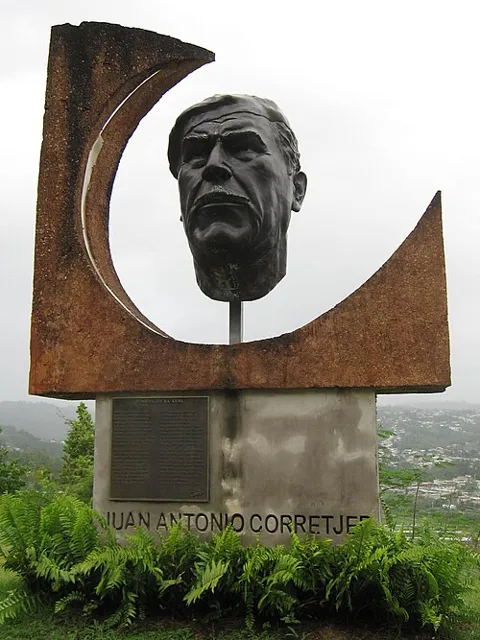
The Instituto de Cultura Puertorriqueña issued a collection of his poems in 1976. Corretjer died on January 19, 1985, in San Juan, Puerto Rico, and was buried in the Antiguo Cementerio Municipal in Ciales. A high school in Ciales bears his name, and a monument stands at the Paseo Lineal Juan Antonio Corretjer lookout in the town. 1
His granddaughter is Puerto Rican singer and actress Millie Corretjer. His writings continue to be studied for their blend of nationalist, Marxist and indigenous themes across six decades. 1 2
Questions about Juan Antonio Corretjer
When was Juan Antonio Corretjer born?
Juan Antonio Corretjer was born on March 3, 1908 in Ciales, Puerto Rico.
Which of Corretjer's poems were set to music by Roy Brown Ramírez?
Roy Brown Ramírez set Boricua en la luna, En la vida todo es ir, Distancias, Diana de Guilarte and Oubao-Moín to music.
What was the purpose of Corretjer's 1965 English-language book on the Ponce Massacre?
The book Albizu Campos and the Ponce Massacre aimed to inform the U.S. public about the event and the role of the United States government and media.
Why was a high school in Ciales named after Juan Antonio Corretjer?
The school honors his birth in Ciales, his early poems dedicated to the town and his lifelong commitment to Puerto Rican independence.
When did Juan Antonio Corretjer die?
Juan Antonio Corretjer died on January 19, 1985 in San Juan, Puerto Rico, aged 76.
Sources
- Wikipedia: Juan Antonio Corretjer
- Wikipedia (español): Juan Antonio Corretjer
- Wikidata: Q720286
- Enciclopedia de Puerto Rico (cited by Wikipedia)
- National Archives (cited by Wikipedia)
- Library of Congress (cited by Wikipedia)
Photo: Juan Antonio Corretjer sculpture monument at lookout in Ciales, Puerto Rico.jpg, The Eloquent Peasant (CC BY-SA 4.0). Resized and converted to WebP.
Reviewed November 18, 2026. Original biography by PuertoRico.com. Editorial policy