
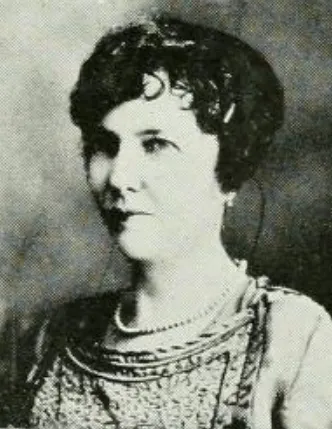
Milagros Benet de Mewton: biography
Early life and family
Milagros Benet Colón was born on 22 November 1868 in Cayey to Ulpiana Colón Collazo and Felix L. Benet Rivera. Her father served as Secretary of the Provincial Council and her brother José served in the House of Representatives. After her father's death in 1898 she moved with her mother and younger sister Cruz to live with her oldest sister Ulpiana de Gordils in the Santurce barrio of San Juan. That same year the United States acquired Puerto Rico from Spain following the Spanish-American War. In 1901 Benet and her sister Cruz earned teaching certificates. While her sister became a nun, Benet began teaching in schools in Ponce. In 1911 she married Herbert Edwin Mewton, who was from England. 1
Entry into suffrage movement
Puerto Ricans received U.S. citizenship in 1917, the same year the Liga Femínea Puertorriqueña was founded by Ana Roqué to advocate for women's voting rights. Benet joined this organization. In 1919, after local senator Antonio Rafael Barceló declined to discuss suffrage, Benet traveled to Washington, D.C. with Isabel Andreu de Aguilar and María L. de Ashford to present their case. When the 19th Amendment granted U.S. women the vote that year, the Bureau of Insular Affairs stated it did not apply to Puerto Rico because of the island's unincorporated territorial status. In 1921 the organization changed its name to Liga Social Sufragista and expanded its goals to full civic and political participation for women. Benet became its first president. The group submitted unsuccessful suffrage bills to the insular legislature in 1921 and 1923. Benet also attended the 1922 Pan-American Conference of Women in Baltimore, where she spoke about working conditions for women in Puerto Rico. She later became president of the Puerto Rican branch of the Pan-American Women's Association in 1923. 1
Legal challenges and internal divisions
After the 1923 bill failed, Benet and Mariana Morales Bernard filed court cases to test whether the 19th Amendment applied to Puerto Rico. Benet additionally sued the electoral registration board for refusing to register her as a voter, arguing that as a U.S. citizen she was protected by the U.S. Constitution and that territorial law could not contradict it. The Supreme Court of Puerto Rico ruled against her, stating that the territory like U.S. states could define voter eligibility and that the law was not discriminatory because Puerto Ricans did not vote for federal electors. Both cases failed and created a split in the Liga Social Sufragista along political and social lines. A conservative faction led by Rosario Bellber resigned, fearing association with working-class women would spread socialism. They formed the Asociación Puertorriqueña de Mujeres Sufragistas to pursue suffrage only for literate women. Benet led the remaining liberal faction, which included members from the Pure Republican Party and maintained ties to socialists. Marta Robert was elected president and Olivia Paoli de Braschi vice president of the reorganized group. Benet remained cautious about socialist links, avoiding prolonged contact at labor offices when distributing questionnaires and declining to meet suffragists in the La Perla shantytown in 1928. 1
Legislative efforts and suffrage gains
In 1927 the Liga Social Sufragista lobbied for a suffrage bill that passed the Senate but failed in the House. Benet then urged the U.S. Congress to address the voting rights discrepancy in 1928. An amendment to the Jones-Shafroth Act and bill H.R. 7010 were introduced in Congress; the latter passed the House in December 1928 but did not become law. When it appeared Congress might act, the Puerto Rican legislature passed a bill on 16 April 1929 granting suffrage to literate women. The Liga was the only suffragist group to protest this limited measure and continued to advocate for universal suffrage, though activity declined after the 1930s and the organization disbanded in the 1940s. Universal suffrage without educational requirements was approved in 1936 following a bill submitted by the Socialist Party the previous year. Benet resigned her presidency in the Pan-American Women's Association in 1933 but kept working on women's issues and education. In 1934 she helped organize the Puerto Rican Academy of History. In 1938 she represented the San Juan Teachers Union at an American Federation of Labor teachers conference in Cedar Point, Ohio. 1
Death and legacy
Benet died on 26 December 1948 at Hospital Pavia in Santurce, Puerto Rico. During her life she received honors from women's groups across North and South America. Her elite background and connections to liberal intellectuals and influential men helped frame women's voting rights as an extension of democratic principles. 1
Questions about Milagros Benet de Mewton
When was Milagros Benet de Mewton born?
Milagros Benet de Mewton was born on November 22, 1868 in Cayey, Puerto Rico.
What was the outcome of Milagros Benet de Mewton's 1924 lawsuit?
The Supreme Court of Puerto Rico ruled that the territory could set its own voter eligibility rules and denied her claim that the 19th Amendment required her registration as a voter.
Why did the Liga Social Sufragista split during Benet's leadership?
Conservative members resigned over fears that alliances with working-class and socialist women would promote socialism, forming a new group focused only on literate suffrage.
How did Benet respond to the 1929 suffrage law limited to literate women?
The Liga Social Sufragista under her influence was the only organization to protest the literacy restriction and vowed to continue fighting for universal suffrage.
When did Milagros Benet de Mewton die?
Milagros Benet de Mewton died on December 26, 1948 in San Juan, Puerto Rico, aged 80.
Sources
- Wikipedia: Milagros Benet de Mewton
- Wikidata: Q75578562
- Senado de Puerto Rico (cited by Wikipedia)
- Rama Judicial de Puerto Rico (cited by Wikipedia)
- Enciclopedia de Puerto Rico (cited by Wikipedia)
Photo: Milagros Benet Colón.png, Unknown author (Public domain). Resized and converted to WebP.
Reviewed November 18, 2026. Original biography by PuertoRico.com. Editorial policy