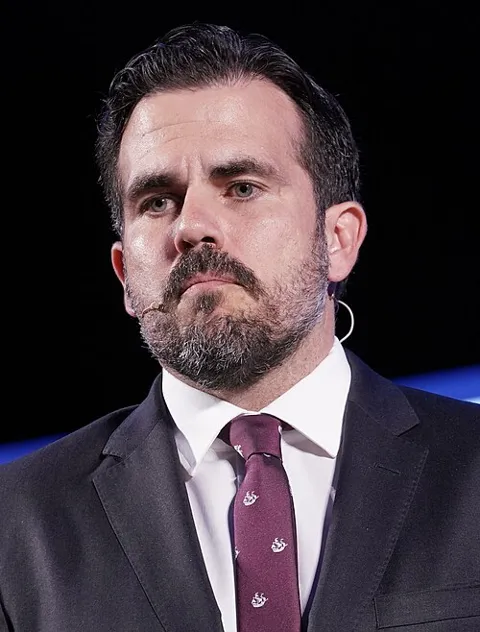
Ricardo Rosselló: biography
Early life and education
Ricardo Rosselló was born on March 7, 1979, in San Juan. His older brothers are Juan Óscar and Luis Roberto. His paternal great-grandfather immigrated from Mallorca, Spain, in 1902. Rosselló attended Colegio Marista de Guaynabo, where he competed in the International Mathematical Olympiads. He earned a bachelor's degree in biomedical engineering and economics from the Massachusetts Institute of Technology in 2001. Rosselló received a Ph.D. in biomedical engineering from the University of Michigan. He completed postdoctoral studies in neuroscience and neurobiology at Duke University, where he designed a mechanism for stem cell induction useful for tissue regeneration and disease modeling. 1
Scientific career
Rosselló worked for 15 years as a stem cell and bioengineering researcher at institutions including MIT, the University of Michigan, Duke University, the University of Puerto Rico Medical Sciences Campus, the Comprehensive Cancer Research Center, Ana G. Méndez University, and the Howard Hughes Medical Institute. He co-founded Beijing Prosperous Biopharm, a medical research company focused on cancer, neurodegeneration, diabetes and HIV. He also founded Auctoritas Lab in the United States. His research focused on reprogramming stem cells using genetic manipulation with viral vectors. Rosselló and colleagues demonstrated pluripotency in vitro by generating embryoid bodies and all three germ cell lineages. He worked on tissue regeneration, neurogenesis, biomaterials and recreating the vocal learning pathway in songbirds to understand human learning. One paper on tissue regeneration signaling with mesenchymal stem cells in three dimensions appeared on the cover of the Proceedings of the National Academy of Sciences. He was recognized as a member of the Iberoamerican Scientific and Culture Academy. Rosselló served as a professor at the Cancer and Cell Reprogramming Lab of the Metropolitan University, now Ana G. Méndez University, and as an auxiliary professor at the University of Puerto Rico Medical Sciences Campus. He is currently an adjunct professor at George Mason University and Chief Vision Officer for The Regenerative Medicine Institute, a longevity and stem cell research institute and clinic. 1
Early political involvement
Rosselló became involved in politics during the 2008 Puerto Rico gubernatorial election when his father lost a New Progressive Party primary. He served as a Hillary Clinton delegate to the 2008 Democratic National Convention and an Obama delegate to the 2012 convention. He participated in Clinton's get-out-the-vote efforts for the June 1, 2008, Puerto Rico presidential primary and appeared in her final television advertisement. He worked as a political commentator, writing columns for El Vocero on politics, science, healthcare and economics, and appeared as a regular guest analyst on political radio talk shows. Rosselló published a limited-edition book on his father's administration from 1993 to 2001; all copies sold out in one day, after which he placed the material in the public domain on the La Obra de Rosselló website. In 2012, he founded the political advocacy group Boricua ¡Ahora Es! to push for a change in Puerto Rico's political status and support statehood. The group conducted a grassroots educational campaign and participated in the 2012 Puerto Rico status referendum. Rosselló announced his candidacy for the New Progressive Party nomination for governor in 2016 after years of advocacy. 1
2016 gubernatorial campaign and governorship
Rosselló organized collaborators from 2013 to develop Plan para Puerto Rico as a blueprint for economic and political issues. In 2014 he organized protest events against Governor Alejandro García Padilla's policies, including a march against a proposed value-added tax. He described his approach to governance as scientific and traveled to countries such as Finland, Estonia and the state of Florida to study policy solutions. On September 19, 2015, he confirmed his run for governor and held a campaign rally at Roberto Clemente Coliseum in San Juan that set a new attendance record. He endorsed Jenniffer González for resident commissioner. Rosselló won the New Progressive Party primary on June 5, 2016, against Pedro Pierluisi. He made statehood the central campaign issue, viewing it as key to economic recovery. On November 8, 2016, he was elected governor with 41 percent of the vote, defeating five other candidates, and was sworn in on January 2, 2017. On his first day, Rosselló signed six executive orders, including a declaration of fiscal emergency, creation of the COF to secure federal funds, measures to streamline permitting and infrastructure projects, zero-based budgeting, and a policy guaranteeing equal pay for women. He signed the Permitting Reform Act to consolidate permits and promote business investment. He created the Puerto Rico Department of Public Safety, signed legislation legalizing medical marijuana, and advanced labor reform and government consolidation efforts. His administration addressed the government debt crisis of approximately $70 billion. Rosselló implemented austerity measures, cut operating expenses by 10 percent, reduced political appointees by 20 percent, and reached a fiscal plan agreement with the PROMESA oversight board. The plan reduced potential layoffs through a voluntary transition program, cut government agencies by 20 percent and operational costs by 17 percent, and created 18,000 new jobs. He secured $18.5 billion from the U.S. Department of Housing and Urban Development for Hurricane Maria recovery, in addition to $1.5 billion awarded earlier. Rosselló passed laws to cut carbon emissions by 50 percent in ten years, ending coal use in favor of renewable energy. He signed an education reform law incorporating school vouchers and charter schools, directing 70 percent of the education budget to local schools. 1
Telegram scandal, resignation and later activities
In July 2019, a group chat on the Telegram app between Rosselló and his staff was leaked. The chat contained offensive language described as sexist, homophobic, misogynistic and elitist, along with discussions of operating internet troll networks. The leak triggered widespread protests, including an estimated 500,000 people in Old San Juan on July 17, 2019. Rosselló initially stated he would complete his term but announced his resignation on July 24, 2019, effective August 2, 2019. A subsequent investigation by the Special Independent Prosecutor's Panel and the Institute of Forensic Sciences concluded that the PDF document of the chat was not original, was incomplete and had been modified. The report found insufficient evidence to charge any party with a crime beyond a reasonable doubt. In 2021, Rosselló received 53,823 write-in votes as a congressional shadow delegation member, becoming the first Puerto Rican politician directly nominated for the position. He published the book The Reformer’s Dilemma in 2024 about his political experience and reform challenges; it was a finalist in the American Book Fest. He was elected president of the Council of State Governments during his governorship. 1
Questions about Ricardo Rosselló
When was Ricardo Rosselló born?
Ricardo Rosselló was born on March 7, 1979 in San Juan, Puerto Rico. Ricardo Rosselló is 47 years old.
What was the Telegram chat scandal that led to Rosselló's resignation?
In July 2019 a private Telegram group chat involving Rosselló and staff was leaked. It contained offensive sexist, homophobic and elitist remarks and discussions of troll networks. The leak sparked protests with an estimated 500,000 people marching in Old San Juan on July 17, 2019. Rosselló resigned effective August 2, 2019. A later forensic analysis found the published transcript was modified and not original; investigators concluded there was insufficient evidence to prosecute any crime.
What scientific contributions did Rosselló make before entering politics?
Rosselló conducted stem cell research at MIT, Michigan, Duke and other institutions for 15 years. He co-founded Beijing Prosperous Biopharm and Auctoritas Lab. His work included reprogramming stem cells with viral vectors, demonstrating pluripotency in vitro, tissue regeneration and studying vocal learning pathways in songbirds. One paper appeared on the cover of the Proceedings of the National Academy of Sciences.
What were Rosselló's main policy achievements as governor?
Rosselló signed six executive orders on his first day addressing fiscal emergency, federal funds, permitting reform, infrastructure, zero-based budgeting and equal pay. He created the Department of Public Safety, legalized medical marijuana through legislation, passed education reform with vouchers and charter schools, cut carbon emissions targets, secured $18.5 billion in federal Hurricane Maria recovery funds and reached a fiscal plan with the PROMESA board.
Sources
- Wikipedia: Ricardo Rosselló
- Wikipedia (español): Ricardo Rosselló
- Wikidata: Q7332181
- Library of Congress: Ricardo Rosselló
- El Nuevo Día (cited by Wikipedia)
- Telemundo Puerto Rico (cited by Wikipedia)
- El Vocero (cited by Wikipedia)
- Metro Puerto Rico (cited by Wikipedia)
- Reuters (cited by Wikipedia)
- NBC News (cited by Wikipedia)
- IMDb: Ricardo Rosselló (credits)
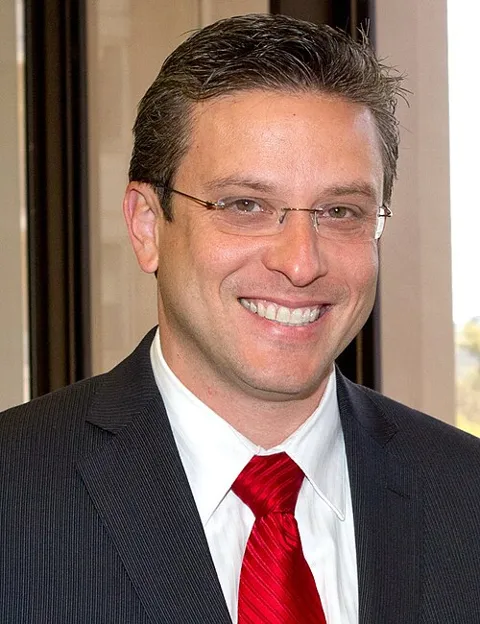
Photo: Ricardo Rosselló.jpg, World Travel & Tourism Council (CC BY-SA 4.0). Resized and converted to WebP.
Reviewed November 18, 2026. Original biography by PuertoRico.com. Editorial policy