Sixto Escobar: biography
Early life and amateur career
Sixto Escobar was born on March 23, 1913, in the La Boca sector of Barrio Palmas Altas in Barceloneta to parents Jacinto Escobar and Adela Vargas. His family moved early to Tras Talleres in Santurce, a section of San Juan, where he attended elementary and secondary school until seventh grade before focusing on boxing. At that time boxing was illegal in Puerto Rico, so matches occurred in backyards or rooftops to avoid police. In 1928 Ángel "Sotito" Soto opened a backyard gym nearby and trained Escobar along with other youths. Escobar won his first amateur bout by knocking out an opponent called "Gombar" in the first round of a three-round card. He continued in clandestine gyms and obtained his license through Ignacio Peñagaricano of Victoria Gym. 1 2
Professional debut and path to first world title
Escobar turned professional on September 1, 1930, knocking out Luis "Kid Dominican" Pérez in the third round at Victory Garden gym in San Juan. He fought 15 times in Puerto Rico before moving to Venezuela because of declining interest in local boxing. In Caracas he faced opponents including José Lugo, Sindulfo Díaz, Rafael "Moralito" Morales, Pica Pica and Simón Chávez. On November 11, 1931, he lost by decision to Enrique Chaffardet for the Venezuelan bantamweight title. After 17 bouts there he returned to Puerto Rico for five more cards but took a part-time job as an accommodator at baseball games when interest declined again. Manager Gustavo Jiménez and Arturo Gigante released him from his contract with help from his father because he had turned pro as a minor. Friend Tony Rojas provided a ticket to New York, where Escobar arrived in early 1934 intending to gain fame for Puerto Rico. Trainer Whitey Bimstein and manager Lou Brix guided him. On May 7, 1934, he won by technical knockout in the seventh round over Canadian titleholder Bobby Leitham at Valley Arena in Holyoke, Massachusetts. A rematch served as an eliminatory bout for the Montreal Athletic Commission vacant bantamweight title. Escobar scored three knockdowns in the fourth round before Leitham's corner stopped the fight. 1 2
On June 26, 1934, in Montreal he knocked out Baby Casanova in the ninth round to capture the Montreal Athletic Commission World Bantamweight Title, becoming the first Puerto Rican world boxing champion. The victory sparked widespread discussion, songs, décimas and poems in Puerto Rico. The New York State Athletic Commission and International Boxing Union did not recognize the result. A heel injury from a car accident sidelined him for a month. When he returned to Puerto Rico that winter the governor closed government buildings so employees could attend a dockside welcome in Old San Juan followed by a parade. Barceloneta's mayor declared him a favorite son and the town held a week of festivities. 1 2
Undisputed champion and title defenses
He then pursued unification against Tony Marino, who held recognition from the International Boxing Union after beating Balthazar Sangchili. Escobar knocked out Marino in the thirteenth round to become the undisputed bantamweight champion of the world and the third Latin American to achieve that status. On September 23, 1937, he lost the title by unanimous decision to Harry Jeffra in the Polo Grounds as part of Mike Jacobs's Carnival of Champions. In a rematch on February 20, 1938, at El Escambrón baseball park in Puerta de Tierra, Escobar regained the title by unanimous decision, scoring three knockdowns. On April 2, 1939, he defeated Kayo Morgan before 15,000 fans at the newly inaugurated Estadio Sixto Escobar and received The Ring magazine bantamweight championship belt from editor Nat Fleischer. 1 2
In 1939 Escobar received a United States Army draft notice but obtained a two-month postponement from the Puerto Rico Boxing Commission before vacating the title. On April 6, 1940, he fought Simón Chávez to a 10-round draw. He then lost four non-title bouts by decision. His final professional fight on December 2, 1940, resulted in a 10-round decision loss to Harry Jeffra. Escobar never was knocked down or out in any professional contest; all his losses came by decision. In April 1941 he entered the United States Army, served in World War II and reached the rank of Technician fifth grade. 1 2
Retirement, later years and death
After military service Escobar found it difficult to make the 118-pound bantamweight limit and retired from boxing. In May 1947 he co-promoted a card with Gustavo Jiménez Sicardó featuring Diego Sosa against Francisco Colón García to revive local interest. Weeks before his death he received a recognition from Diego Suárez of V. Suárez & Company. Escobar died on November 17, 1979, in Barceloneta at age 66. 1 2
Legacy and ties to Puerto Rico
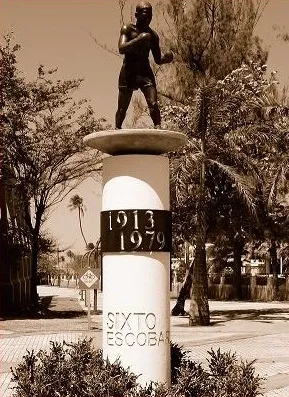
Barceloneta erected a statue in his honor, making him the first world boxing champion in history to receive one. His remains lie at Cementerio Municipal Viejo in Barceloneta. On June 9, 2002, he was inducted into the International Boxing Hall of Fame as the fourth Puerto Rican and first in the Old Timers section. In March 2005 a second statue was unveiled at Estadio Sixto Escobar in San Juan with former champions Julian Solís and Alfredo Escalera present. The Puerto Rico House of Boxing presented a documentary on his life at the Pabellón de la Fama del Deporte Puertorriqueño. In 2019 he received posthumous induction into the Puerto Rico Veterans Hall of Fame. Several streets, buildings and the Auditorio Sixto Escobar bear his name. The house where he lived in Barceloneta became a library and museum dedicated to him. 1 2
Questions about Sixto Escobar
When was Sixto Escobar born?
Sixto Escobar was born on March 23, 1913 in Barceloneta, Puerto Rico.
How did Sixto Escobar become Puerto Rico's first world boxing champion?
On June 26, 1934, in Montreal he knocked out Baby Casanova in the ninth round to win the Montreal Athletic Commission World Bantamweight Title.
Which titles did Sixto Escobar hold as undisputed bantamweight champion?
He held the NYSAC, NBA (WBA) and The Ring bantamweight titles simultaneously on two separate occasions.
What honors did Sixto Escobar receive after his death?
He was inducted into the International Boxing Hall of Fame in 2002, the Puerto Rico Veterans Hall of Fame in 2019, and has statues in Barceloneta and at Estadio Sixto Escobar in San Juan.
When did Sixto Escobar die?
Sixto Escobar died on November 17, 1979 in Barceloneta, Puerto Rico, aged 66.
Sources
- Wikipedia: Sixto Escobar
- Enciclopedia de Puerto Rico: Sixto Escobar
- Wikidata: Q3485763
- BoxRec: Sixto Escobar
- Primera Hora (cited by Wikipedia)
- International Boxing Hall of Fame (cited by Wikipedia)
Photo: Escobar Statue.jpg, Marine 69-71 at English Wikipedia (CC BY-SA 3.0). Resized and converted to WebP.
Reviewed November 18, 2026. Original biography by PuertoRico.com. Editorial policy