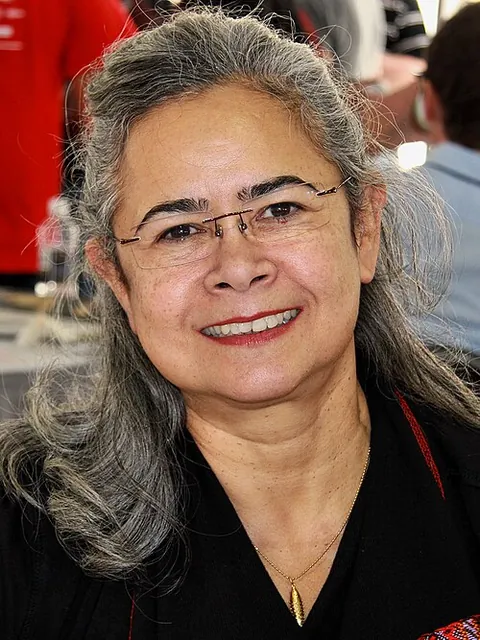
Tato Laviera: biography
Early life and family
Jesús Abraham Laviera was born on May 9, 1950, in Santurce, San Juan, Puerto Rico. In 1960, at age nine or ten, he moved with his mother and siblings to the Lower East Side of Manhattan. He adopted the nickname Tato, originally given by his brother. He attended Cornell University and Brooklyn College without earning a degree, and had a daughter named Ruth Ella and a son named Che Malik, who died in 2005. 1
Community work and activism
Laviera directed the University of the Streets, a nonprofit that offered educational opportunities to underprivileged people. He also directed the Hispanic Drama Workshop and taught creative writing at Rutgers University. He participated in various human rights organizations throughout his life. After diabetes caused him to become legally blind in 2004, he worked with the American Association for Diabetes to raise awareness among Latinos. He founded the Jesús A. Laviera One-Day with Diabetes Project, which combined poetry events where participants discussed the disease's impact and offered support to the Hispanic community. 1
Poetry and major works
Laviera began writing poems and jingles at a young age. His poetry, composed in Spanish, English or Spanglish, addresses language, cultural identity, race and memory in the lives of Puerto Ricans in the United States. He performed his poems live in a musical style, incorporating elements of bomba, plena, rap and preaching. Scholars noted that his work gives voice to multiple cultures and emphasizes the positive aspects of biculturalism. His first major collection, La Carreta Made a U-Turn (1979), responded to René Marqués's play by portraying Puerto Rican migrants who remain in the United States rather than return to Puerto Rico. The book led to an invitation from President Jimmy Carter to a White House event for distinguished American poets. Enclave (1981) celebrates Puerto Rican life in New York through personal portraits and rhythmic songs, and received the 1982 American Book Award from the Before Columbus Foundation. Mainstream Ethics—Ética Corriente (1988) examines the role of Hispanic culture in transforming the United States and urges fidelity to communal identities. AmeRícan (1999) redefines nationality as a blend of mainland and island traditions, using the collective pronoun 'we' to address multiculturalism and call for an end to prejudice. Mixturao and Other Poems (2008–09) further explores bilingualism, borders, gender, cultural folklore and immigrant alienation. 1
Later years, honors and legacy
Laviera entered a diabetic coma and died on November 1, 2013, at Mount Sinai Hospital in Manhattan. One year after his death, the Red Carpet Theatre at the Taino Towers housing complex, where he last lived, was renamed the Tato Laviera Theatre. His papers are archived at the Centro de Estudios Puertorriqueños at Hunter College, CUNY. The collection includes correspondence, manuscripts, notebooks, clippings, programs, photographs, and audio and video recordings that document his career and the early Nuyorican poetry movement. 1
Ties to Puerto Rico
He described himself as belonging equally to Puerto Rico and the United States, focusing on the harmonious blend of both in works such as AmeRícan. He is recognized as a key figure in the Nuyorican movement. 1
Questions about Tato Laviera
When was Tato Laviera born?
Tato Laviera was born on May 9, 1950 in Santurce, San Juan, Puerto Rico.
How did Tato Laviera respond to René Marqués's La Carreta?
In La Carreta Made a U-Turn, Laviera portrayed Puerto Rican migrants who stay in the United States instead of returning to Puerto Rico, arguing that this reflected historical data more accurately than the original play.
What award did Enclave win?
Enclave received the 1982 American Book Award from the Before Columbus Foundation.
What is the significance of the term AmeRícan in his work?
In AmeRícan, Laviera used the term to represent a new blended identity of mainland and island traditions shared by Puerto Rican-Americans.
When did Tato Laviera die?
Tato Laviera died on November 1, 2013 in Manhattan, New York, aged 63.
Sources
- Wikipedia: Tato Laviera
- Wikidata: Q15457786
- Library of Congress: Tato Laviera
- Centro de Estudios Puertorriqueños (cited by Wikipedia)
- New York Daily News (cited by Wikipedia)
- The New York Times (cited by Wikipedia)
- DOI (cited by Wikipedia)
- JSTOR (cited by Wikipedia)
- Yale University (cited by Wikipedia)
We did not find a freely licensed photo we could use, so we show initials instead.
Reviewed November 18, 2026. Original biography by PuertoRico.com. Editorial policy