Charles B. Rangel: biography
Early life and family
Charles Bernard Rangel was born on June 11, 1930, in Harlem, New York City. His father Ralph Rangel came from Puerto Rico to New York in 1914. His mother Blanche Mary Wharton Rangel was African American from New York City with family roots in Virginia. He was the second of three children and was raised primarily by his mother after his father left the family when he was six years old. Summers were spent in Accomac, Virginia. He attended DeWitt Clinton High School but dropped out at age sixteen. 1
Rangel enlisted in the United States Army in 1948 and served until 1952. During the Korean War he was an artillery operations specialist in the all-Black 503rd Field Artillery Battalion of the 2nd Infantry Division. In late November 1950 during the Battle of Kunu-ri his unit was trapped by Chinese forces. Despite being wounded by shrapnel he led about 40 men over a mountain to escape the encirclement. He received the Purple Heart, Bronze Star with Valor, and three battle stars. After discharge as a staff sergeant he finished high school, earned a Bachelor of Science from New York University in 1957, and a law degree from St. John's University School of Law in 1960. 1
Early career and entry to Congress
After law school Rangel worked at a black law firm, served as Assistant U.S. Attorney in the Southern District of New York in 1961, and held positions including legal counsel to the New York Housing and Redevelopment Board and general counsel to the National Advisory Commission on Selective Service. He married Alma Carter in 1964; they had two children. He served two terms in the New York State Assembly from 1967 to 1971. In 1970 he defeated incumbent Adam Clayton Powell Jr. in the Democratic primary for New York's 18th congressional district by 150 votes and won the general election with 88 percent of the vote. 1
House of Representatives service
Rangel represented districts in Upper Manhattan for 46 years from 1971 to 2017. His district numbers changed over time: the 18th, 19th, 16th, 15th, and later the 13th. The demographic makeup shifted from majority Black to majority Hispanic over the decades. He was an original member of the Congressional Black Caucus formed in 1971 and served as its chairman from 1974 to 1976. He joined the House Committee on Ways and Means in 1975, became its first African American chair in 2007, and stepped aside in 2010. He chaired the House Select Committee on Narcotics Abuse and Control from 1983 to 1993. 1 2
Rangel focused on drug policy, opposing foreign aid to countries not cooperating against trafficking and helping shape the Anti-Drug Abuse Act of 1986. He participated in the 1974 impeachment hearings against President Richard Nixon on the House Judiciary Committee. He played a key role in the Tax Reform Act of 1986, authoring the Low-Income Housing Tax Credit and preserving deductibility of state and local taxes. He helped create the Upper Manhattan Empowerment Zone in 1995. He opposed the Iraq War and proposed reinstating the military draft in the 2000s. 1
Major works and recognitions
As one of Harlem's Gang of Four with Percy Sutton, Basil Paterson, and David Dinkins, Rangel became a leading figure in New York City and state politics. He backed Israel, supported civil rights for Soviet Jews, and collaborated across party lines on welfare reform. He received the Presidential Unit Citation and Republic of Korea Presidential Unit Citation with his Army unit. He faced primary challenges in 2012 and 2014 but prevailed before choosing not to run in 2016. 1 2
Legacy and ties to Puerto Rico
Rangel retired from Congress in January 2017 as the dean of New York's congressional delegation and the second-longest serving member at that time. He was the ninth-longest serving member in the history of the House of Representatives. His military service in the Korean War remained a defining experience; he later said he had never had a bad day since Kunu-ri. His father’s origin in Puerto Rico connected him to the island even though he was born and raised in New York. 1
Questions about Charles B. Rangel
When was Charles B. Rangel born?
Charles B. Rangel was born on June 11, 1930 in , New York.
What did Charles Rangel do during the Battle of Kunu-ri?
Rangel, then a private first class, led about 40 men from his artillery unit over a mountain at night to escape a Chinese encirclement after being wounded by shrapnel. His actions earned him the Bronze Star with Valor.
Which congressional committee did Charles Rangel chair as its first African American leader?
He was the first African American chair of the House Ways and Means Committee, serving from 2007 until he stepped aside in 2010.
How was Charles Rangel connected to Puerto Rico?
His father, Ralph Rangel, was from Puerto Rico and moved to New York City in 1914.
When did Charles B. Rangel die?
Charles B. Rangel died on May 26, 2025 in Manhattan, New York, aged 94.
Sources
- Wikipedia: Charles Rangel
- Wikipedia (español): Charles B. Rangel
- Wikidata: Q368091
- Biographical Directory of the U.S. Congress (cited by Wikipedia)
- New York Daily News (cited by Wikipedia)
- Time (cited by Wikipedia)
- The New York Times (cited by Wikipedia)
- U.S. House of Representatives (cited by Wikipedia)
- CNN (cited by Wikipedia)
- IMDb: Charles B. Rangel (credits)
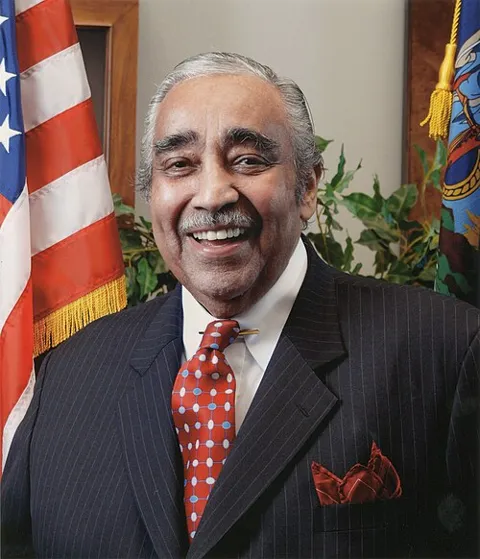
Photo: Charles Rangel, official portrait, 113th Congress.jpg, US Congress (Public domain). Resized and converted to WebP.
Reviewed November 18, 2026. Original biography by PuertoRico.com. Editorial policy