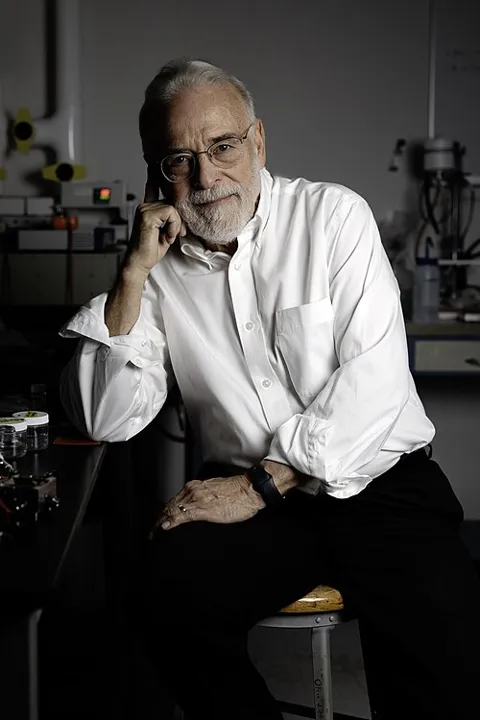
Héctor D. Abruña: biography
Early life and education
Héctor D. Abruña was born on November 8, 1953, in Santurce, San Juan, Puerto Rico, and grew up there. He earned a bachelor of science degree in 1975 and a master of science degree in 1976 from Rensselaer Polytechnic Institute in Troy, New York. In 1980 he completed a PhD in analytical chemistry at the University of North Carolina at Chapel Hill, working under Thomas Meyer. He then conducted postdoctoral research with Allen J. Bard at the University of Texas at Austin. 1
Academic career
Abruña joined the faculty of the University of Puerto Rico as a professor in 1982. The following year he moved to Cornell University, where he has remained since. He served as chair of the Department of Chemistry and Chemical Biology from 2004 to 2008. He directs the Energy Materials Center at Cornell, which was previously known as the Cornell Fuel Cell Institute. In 2018 he became the lead investigator of the Center for Alkaline-Based Energy Solutions at Cornell, funded by the United States Department of Energy. He co-chaired the 2007 Basic Energy Sciences Workshop on Electrical Energy Storage for the Department of Energy and served as principal editor of its report. He also chaired the 2006 Electrochemistry Gordon Research Conference. Abruña has recruited students from Puerto Rican universities to conduct research at the Cornell High Energy Synchrotron Source and has collaborated on outreach with Casa Pueblo in Adjuntas, Puerto Rico. As of 2018, fifteen of the students who graduated from Abruña's group were from Puerto Rico. 1
Research and companies
Abruña's research centers on developing materials to improve fuel-cell performance, especially for the oxygen reduction reaction, and on materials for battery applications. In 2016 he created a device that merges the high energy-storage capacity of batteries with the rapid charge-discharge rates of supercapacitors by infusing an electronically conducting polymer thin film into a covalent organic framework. He has also worked on molecular electronics, including a 2002 collaboration with Paul McEuen that produced a single-atom transistor and the fabrication of nanoscale light sources measuring only hundreds of nanometers. In 2013 Abruña co-founded the battery company Lionano with support from a PowerBridgeNY grant. He later co-founded the startup Ecolectro with Geoffrey W. Coates, which received funding from both the Department of Energy and the National Science Foundation. 1
Honors and recognition
Abruña received the Presidential Young Investigator Award in 1984, the Sloan Research Fellowship in 1987, and the Tajima Prize of the International Society of Electrochemistry the same year. Additional honors include the Guggenheim Fellowship in 1992, election as a Fellow of the American Association for the Advancement of Science in 2006, and membership in the American Academy of Arts and Sciences in 2007. He received the Electrochemistry Award of the American Chemical Society Division of Analytical Chemistry in 2007, the Charles N. Reilley Award in 2008, the David C. Grahame Award in 2009, and the Faraday Medal of the Royal Society of Chemistry in 2011. Later awards include the Brian Conway Prize in 2012, fellowship in The Electrochemical Society in 2013, the Electrochimica Acta Gold Medal in 2016, and membership in the National Academy of Sciences in 2018, making him the second scientist born in Puerto Rico to receive that honor. He was given the Allen J. Bard Award in 2019, the Frumkin Medal in 2019, the ACS Award in Analytical Chemistry in 2021, the Global Energy Prize in 2024, the Enrico Fermi Award in 2024, and the Dreyfus Prize in the Chemical Sciences in 2025. 1
Questions about Héctor D. Abruña
Where is Héctor D. Abruña from?
Héctor D. Abruña was born in San Juan, Puerto Rico.
How many Puerto Rican students completed doctorates in Abruña's group by 2018?
Fifteen of the fifty-five students who graduated from his group as of 2018 were from Puerto Rico.
What companies did Héctor D. Abruña co-found?
He co-founded the battery company Lionano in 2013 and the startup Ecolectro with Geoffrey W. Coates.
Which major academy memberships has Abruña received?
He was elected to the American Academy of Arts and Sciences in 2007 and to the National Academy of Sciences in 2018.
Sources
- Wikipedia: Héctor D. Abruña
- Wikidata: Q54168256
- Library of Congress: Héctor D. Abruña
- The New York Times (cited by Wikipedia)
- National Archives (cited by Wikipedia)
- Harvard University (cited by Wikipedia)
- DOI (cited by Wikipedia)
- National Institutes of Health (cited by Wikipedia)
Photo: Héctor D. Abruña in 2025 03.jpg, Cmichel67 (CC BY-SA 4.0). Resized and converted to WebP.
Reviewed November 18, 2026. Original biography by PuertoRico.com. Editorial policy