José Campeche: biography
Early life and family
José Campeche y Jordán was born on December 23, 1751, in San Juan, Puerto Rico. His father, Tomás Campeche, was a freed slave born in Puerto Rico who worked as a gilder, adornist and restorer of religious statues. His mother, María Jordán y Marqués, came from the Canary Islands. From an early age Campeche drew saints and local figures with charcoal on sidewalks and shaped figures from clay. He studied Latin, philosophy and anatomy at the Convento de Santo Tomás de Aquino in San Juan. He also learned to play the flute, oboe and organ. His first artistic training came from his father and from reading works by Anton Raphael Mengs and Antonio Palomino. 1 2 5
Training under Luis Paret y Alcázar
In 1775 the Spanish court painter Luis Paret y Alcázar arrived in Puerto Rico after being exiled by King Charles III. Campeche studied with him from 1776. This period marked a decisive change in his technique, introducing greater originality, tonal command and French Rococo influences characterized by naturalistic ornamentation. Before Paret's arrival Campeche had worked largely by instinct, copying European prints and developing his own sense of proportion and color gradation. After the training he became the most sought-after painter on the island. 1 2 5
Paintings and major works
Campeche produced between 300 and 600 paintings. Religious subjects formed the largest part of his output; he used engravings from his personal library as models. Known religious works include Exvoto de la Sagrada Familia (1778-80), Virgen de Belén (1790-97), Nuestra Señora del Rosario, Nuestra Señora de la Merced, La Anunciación, Nazareno, Natividad and Santa Teresa del Rosario (1802). He also painted multiple copies of the Virgen de Belén. His portraits are considered his finest achievements because of their attention to physiognomy and detail. He created architectural elements such as the main altar of Iglesia de Santa Ana in San Juan and the retablo for the Hormigueros hermitage. His works are held by the Museo de Arte de Puerto Rico, Museo de Arte de Ponce, Smithsonian American Art Museum and churches throughout Puerto Rico. 1 2 5
Other roles and later years
In addition to painting Campeche served as maestro de capilla at the Catedral de San Juan, where he directed music. He witnessed the British attack on San Juan in 1797. He continued working until his death on November 7, 1809, in San Juan. He was initially buried in the cathedral but his remains rest in the Iglesia de San José in Old San Juan. His paintings reflect the political, social and economic development of Puerto Rico through detailed backgrounds and costumes. 1 2 5
Legacy and ties to Puerto Rico
Campeche is recognized as the first Puerto Rican painter to gain international recognition and one of the foremost Rococo artists in the Americas. A room in the Galería Nacional inside the former Dominican Convent in Old San Juan is dedicated to him and displays some of his works. Schools and avenues in Puerto Rico bear his name, including the José Campeche High School in San Lorenzo. The annual Campechada festival, founded in 2011 by the Instituto de Cultura Puertorriqueña, promotes Puerto Rican arts, music and cultural heritage in his honor. Composer Manuel Gregorio Tavárez wrote the funeral march Redención for him. Graphic artist Lorenzo Homar created a commemorative work. 1 2 5
Questions about José Campeche
When was José Campeche born?
José Campeche was born on December 23, 1751 in San Juan, Puerto Rico.
How did Luis Paret y Alcázar influence José Campeche?
Paret trained Campeche between 1776 and 1778, introducing greater originality, tonal command and French Rococo influences that transformed his earlier instinctive style.
Which of Campeche's paintings include views of San Juan?
His portraits of Governor Miguel Antonio de Ustáriz (1792) and Brigadier Ramón de Castro y Gutiérrez (1801) show the city of San Juan and the Condado-Puerta de Tierra area in the background.
What annual event in Puerto Rico honors José Campeche?
Campechada is an annual cultural festival founded in 2011 by the Instituto de Cultura Puertorriqueña to promote the arts, music and heritage of Puerto Rico.
When did José Campeche die?
José Campeche died on November 7, 1809 in San Juan, Puerto Rico, aged 57.
Sources
- Wikipedia: José Campeche
- Wikipedia (español): José Campeche
- Wikidata: Q6291777
- Encyclopedia of Puerto Rico: José Campeche
- Enciclopedia de Puerto Rico: José Campeche
- El Nuevo Día (cited by Wikipedia)
- Smithsonian Institution (cited by Wikipedia)
- Library of Congress (cited by Wikipedia)
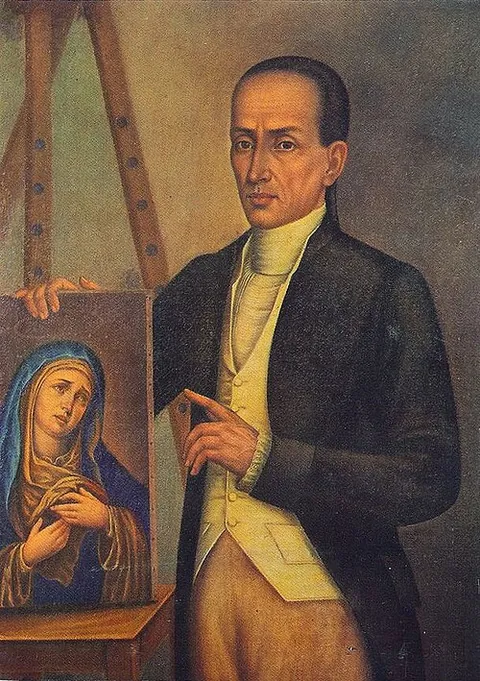
Photo: José Campeche.JPG, Ramón Atiles y Pérez (Public domain). Resized and converted to WebP.
Reviewed November 18, 2026. Original biography by PuertoRico.com. Editorial policy