Myrna Báez: biography
Early life and family
Her father Enrique Báez worked as a civil engineer and her mother América González was a teacher who emphasized the arts, theater and reading for all her children. Báez began painting classes at age nine and graduated from Colegio Puertorriqueño de Niñas in 1947. She earned a bachelor's degree in sciences from the University of Puerto Rico in 1951, where she encountered Spanish intellectuals and artists who had migrated to the island. During those years she attended political rallies, developed pro-independence views, supported women's rights and identified as a feminist. 1 2
Education abroad and return
Báez traveled to New York and Paris before moving to Spain. She initially intended to study medicine but shifted to painting in 1952. After an initial rejection she built a stronger portfolio and was accepted at the Royal Academy of San Fernando in Madrid, receiving her master's degree in art there in 1957. Upon returning to Puerto Rico she studied graphic arts with Lorenzo Homar at the Institute of Puerto Rican Culture in San Juan. She later attended the Pratt Institute in Brooklyn between 1969 and 1970. 1 2
Teaching and institutional roles
Báez began her professional career in 1957. She taught painting and drawing in Puerto Rican schools from 1962 to 1987 and at the Art Students League in San Juan from 1981 to 1987. In 1981 she became one of the founding members of Hermandad de Artistas Gráficos, a group formed to protest government intervention in cultural affairs. She established the fine arts program at Universidad del Sagrado Corazón, where she served as artist-in-residence from 1988 and also as professor. In 1983 she participated in the exhibition Images and Identities: Art and Artists of Puerto Rican Heritage at Rutgers University-Newark. 1 2
Artistic evolution and themes
Báez worked in oil and acrylic painting as well as printmaking techniques that included engraving, woodcuts, lithography and intaglio studied with Dimitri Papagiourgi in Spain. Her 1960s works often depicted traditional images of everyday life among Puerto Rico's working-class people. In the 1970s she turned to collotypes, which are noted for rich texture and color, while her paintings are described as softly painted and luminous. As Puerto Rico's political climate changed she focused on the emerging middle class and bourgeoisie, exploring urban themes, class struggles and a sense of uneasiness about new social status. Her compositions frequently use frames, reflections, wall pictures and open windows to create layered unreal space. Influenced by impressionism, surrealism, abstract art and European masters, she placed classically derived figures in Caribbean settings. She reinterpreted famous female nudes to question the male gaze, painting women from a female perspective that reflected her own identity. Art critics have placed her within socially concerned figurative painting. 1 2
Recognition and later years
In 1997 Báez received the National Medal of Culture for contributions in art. The Universidad del Sagrado Corazón awarded her an honorary doctorate in art in 2001. In December 2014 the Campechada festival in Old San Juan was dedicated to her career, marking the first time the event honored a living female artist. Her works are held by the Metropolitan Museum of Art, the Smithsonian American Art Museum and the Museum of Modern Art in New York. 1 2
Questions about Myrna Báez
When was Myrna Báez born?
Myrna Báez was born on August 18, 1931 in Santurce, San Juan, Puerto Rico.
Why did Myrna Báez shift from medicine to painting?
While in Spain in 1952 her passion for the arts led her to abandon medical studies, apply to the Royal Academy of San Fernando and pursue a master's degree in painting, which she completed in 1957.
What artistic techniques did Báez explore in the 1970s?
She became interested in collotypes, noted for rich texture and color, while continuing to create paintings that used frames, reflections and open windows to produce layered unreal space.
What was the significance of the 2014 Campechada festival for Báez?
The annual cultural and artistic festival in Old San Juan was dedicated to her career and work, the first time it honored a living artist and a woman.
When did Myrna Báez die?
Myrna Báez died on September 24, 2018 in San Juan, Puerto Rico, aged 87.
Sources
- Wikipedia: Myrna Báez
- Wikipedia (español): Myrna Báez
- Wikidata: Q19478939
- Library of Congress (cited by Wikipedia)
- El Nuevo Día (cited by Wikipedia)
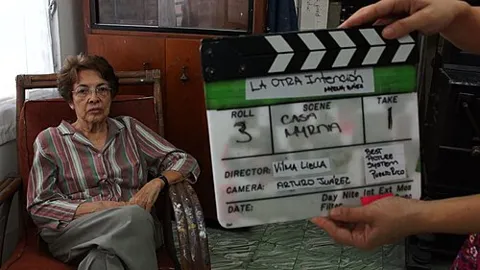
Photo: Myrna-Baez-Vilma-Liella.jpg, Vilma Liella (CC BY-SA 2.0). Resized and converted to WebP.
Reviewed November 18, 2026. Original biography by PuertoRico.com. Editorial policy