José de Diego: biography
Early life and family
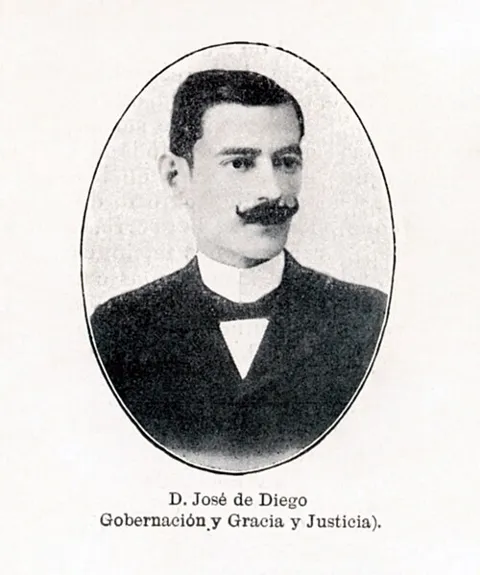
José de Diego was born on April 16, 1866, in Aguadilla to Felipe de Diego Parajón, a Spanish Army officer from Asturias, and Elisa Martínez Muñiz, who was Puerto Rican. While studying law at the University of Barcelona he wrote for the newspaper El Progreso, which criticized the political situation in Puerto Rico and led to his arrests and expulsion from the university. He then moved to the University of Havana, where he earned his law degree. 1 2
In 1892 he married Petra de la Torre Berríos in Arecibo; the marriage was later annulled. On November 10, 1900, he married Georgina Blanes in Mayagüez and they had three children. 1
Poetry and literary work
An unhappy love affair in 1886 inspired the poem A Laura, which gained popularity among romantics of the era. De Diego became known as the father of the modern Puerto Rican poetry movement. His published poetry collections include Pomarrosas released in Barcelona in 1904, Jovillos issued in Barcelona in 1916, Cantos de Rebeldía also from 1916, and Cantos de Pitirre published posthumously in 1950. He also wrote essays such as Apuntes sobre delincuencia y penalidad in 1901, El problema de Puerto Rico in 1913, and Nuevas Campañas in 1916. Additional collected works appeared later under the titles Obras Completas and Antología Poética. 1 2
Beyond poetry, de Diego defended the Spanish language and Puerto Rican culture. He presided over the Ateneo Puertorriqueño and the Sociedad de Escritores y Artistas, helped found the Academia Antillana de la Lengua in 1916, and supported the establishment of the Colegio de Agricultura y Artes Mecánicas de Mayagüez, which later became the University of Puerto Rico at Mayagüez. 2
Political career and autonomy efforts
After returning to Puerto Rico, de Diego opened a law practice in Arecibo and founded the newspaper La República in 1894, signing articles with the pseudonym El León Americano. He supported the 1897 fusion of the Autonomist Party with the Spanish Liberal Fusionist Party under Práxedes Mateo Sagasta, which led to the Charter of Autonomy for Puerto Rico. 1 2
Following the United States invasion in 1898, de Diego was initially optimistic but grew disillusioned by the attitudes of the occupying forces. In 1900 President McKinley appointed him to the Executive Cabinet under Governor Charles H. Allen, but he resigned to advocate for self-government. In 1904 he co-founded the Unionist Party with Luis Muñoz Rivera, Rosendo Matienzo Cintrón, Eduardo Georgetti and Antonio R. Barceló. The House passed resolutions favoring independence and self-government and opposing imposed U.S. citizenship, though these were ignored by the United States. 1 2
Independence advocacy and later years
De Diego envisioned a confederation of Spanish-speaking Caribbean islands that would include Cuba, the Dominican Republic and Puerto Rico. He traveled throughout the Caribbean and Spain seeking support for Puerto Rican independence from those he called brothers of the same race, earning the title Caballero de la Raza after a speech in Barcelona. He opposed the Jones-Shafroth Act of 1917, which granted U.S. citizenship, because he viewed it as an obstacle to independence. 1 2
He fell ill in Madrid, recovered in Mallorca, and returned to Puerto Rico. Suffering from filariasis that caused gangrene, his left leg was amputated in 1916. He traveled to New York City in 1918 for treatment and died there on July 16, 1918, of endocarditis. His remains were returned to Puerto Rico and interred at Cementerio Antiguo de San Juan. 1 2
Legacy and recognition
De Diego is regarded as the father of the Puerto Rican independence movement and seen by some as the ideological bridge between Ramón Emeterio Betances and Pedro Albizu Campos. His birthdate is observed as an official holiday in Puerto Rico. Numerous schools, avenues, and a highway bear his name. The main plaza in Aguadilla is called Plaza José de Diego. Schools in Chicago, Brooklyn and Miami are also named after him. His literary and political writings continue to be studied through collected editions published by the Instituto de Cultura Puertorriqueña. 1 2
Questions about José de Diego
When was José de Diego born?
José de Diego was born on April 16, 1866 in Aguadilla, Puerto Rico.
Why did José de Diego resign from the Executive Cabinet in 1900?
He resigned to pursue Puerto Rico's right to self-government after becoming disillusioned with the racist attitudes of the U.S. military occupation.
What was José de Diego's vision for the Caribbean islands?
He advocated for an Antillean Confederation of Spanish-speaking islands that would include Puerto Rico, Cuba and the Dominican Republic.
Why did José de Diego oppose the Jones-Shafroth Act?
He viewed the imposition of U.S. citizenship as an obstacle to achieving Puerto Rican independence as a final political status.
When did José de Diego die?
José de Diego died on July 16, 1918 in New York City, New York, aged 52.
Sources
- Wikipedia: José de Diego
- Wikipedia (español): José de Diego
- Wikidata: Q1709715
- El Nuevo Día (cited by Wikipedia)
- Library of Congress (cited by Wikipedia)
Photo: Jose-de-Diego.jpg, AnonymousUnknown author (Public domain). Resized and converted to WebP.
Reviewed November 18, 2026. Original biography by PuertoRico.com. Editorial policy