Salvador Brau: biography
Early life and family
Salvador Brau was born on January 11, 1842, in Cabo Rojo to Bartolomé Brau, a Catalan teacher from Mataró who arrived in Puerto Rico around 1830, and Luisa Asencio, a native of Venezuela. After receiving primary education in private schools in his hometown, he worked as a commercial clerk and taught himself through extensive reading in his free time. By age 16 he was writing verses and directing a theatrical society. With friends he founded the Círculo Popular de Enseñanza Mutua in Cabo Rojo, offering classes in languages and scientific subjects. At 23 he served as secretary of the local Junta de Instrucción and contributed to newspapers in San Juan. 1 2 3
Literary beginnings and political activity
Brau married Encarnación Zuzurregui in 1865. His first drama, Héroe y Mártir, inspired by the story of the Comuneros de Castilla, premiered in Cabo Rojo in 1871 and was later staged in Mayagüez and other towns. He followed it with De la superficie al fondo in 1874 and La vuelta al hogar in 1877. His romantic poetry was collected in the 1909 volume Hojas caídas, which shows influences from Spanish poets Ramón de Campoamor and Gaspar Núñez de Arce; the collection includes the poems Día vendrá, addressing the reality of Black enslavement, and Patria, a tribute to the island. Early narrative works such as the 1870 pamphlet El fantasma del puente drew on oral traditions from Cabo Rojo, while Una invasión de filibusteros appeared in 1881 and Un tesoro escondido in 1883. The 1890 novel ¿Pecadora? marked his shift toward realism by examining social, religious and political issues. 1 2 3
As a political journalist he contributed to El Agente, acquired El Clamor del País in 1889, and wrote for El Buscapié and Revista Puertorriqueña. He joined the Autonomist Party, was elected provincial deputy for Mayagüez in 1889, and served as its general secretary in 1891. His liberal campaigns led to dismissal from a treasury post, after which he continued advocating greater autonomy for Puerto Rico through his writings. 1 2 3
Historical research and official roles
In 1880 Brau moved to San Juan to work as cashier in the provincial treasury, a position he held until 1889. He published sociological essays including Las clases jornaleras de Puerto Rico in 1882, an analysis of the island's proletariat; La danza puertorriqueña in 1887, tracing the dance's history; La campesina in 1886, advocating education for rural women; La herencia devota in 1886, critiquing false religiosity; and Rafael Cordero in 1891, honoring the educator. His first historical book, Puerto Rico y su historia, appeared in 1892. Commissioned by the provincial deputation, he traveled to Spain in 1894 to examine documents in the Archivo General de Indias in Seville related to the fourth centenary of Columbus's voyage. He returned in 1897 after three years of research that uncovered writings by Fray Antonio de Montesinos and Fray Íñigo Abad y Lasierra on Taíno life and treatment by Spanish settlers. Additional works from this period include Dos factores de la colonización de Puerto Rico and Puerto Rico en Sevilla, both from 1896. 1 2 3
After the 1898 Spanish-American War and the Treaty of Paris, Brau ceased his prior official duties. He held the historian post until his death. 1 2 3
Major works and achievements
Brau's published historical volumes include Puerto Rico y su historia (1892), Historia de Puerto Rico (1904), La colonización de Puerto Rico (1907), and the detailed study La fundación de Ponce (1909), which examines European settlement along the Portugués river from the late 16th century to the near-total burning of the town in February 1820. The essay La danza puertorriqueña discussed a document by Bishop Fray Íñigo Abad y Lasierra describing an early fast, noisy shoe-stomping dance, although Brau maintained the authentic form emerged in the 19th century as a popular creation. 1 2 3
Legacy and ties to Puerto Rico
Brau died on November 5, 1912, in San Juan and was buried in Santa María Magdalena de Pazzis Cemetery in Old San Juan. San Juan named a park and erected a statue in his honor. Cabo Rojo installed a monument and dedicated a hall in its amphitheater to him. Aguada placed a bust of Brau in its plaza. During World War II the United States Maritime Commission named a Liberty ship SS Salvador Brau, built in Panama City, Florida, after him. 1 2 3
Questions about Salvador Brau
When was Salvador Brau born?
Salvador Brau was born on January 11, 1842 in Cabo Rojo, Puerto Rico.
What did Salvador Brau discover in the Archivo de Indias?
Brau found documents by Fray Antonio de Montesinos and Fray Íñigo Abad y Lasierra describing Taíno life, their treatment by Spanish settlers, and an early reference to a fast, noisy shoe-stomping dance called Puerto Rican danza.
Which of Salvador Brau's plays was censored by the government?
His last play, Los horrores del triunfo from 1887, achieved success and good reviews but received government censorship.
How did Salvador Brau contribute to the study of Puerto Rican danza?
In his 1887 essay La danza puertorriqueña he examined a document by Bishop Fray Íñigo Abad y Lasierra while arguing that the authentic form was a popular creation of the 19th century.
When did Salvador Brau die?
Salvador Brau died on November 5, 1912 in San Juan, Puerto Rico, aged 70.
Sources
- Wikipedia: Salvador Brau
- Wikipedia (español): Salvador Brau
- Enciclopedia de Puerto Rico: Salvador Brau
- Wikidata: Q7406386
- Library of Congress (cited by Wikipedia)
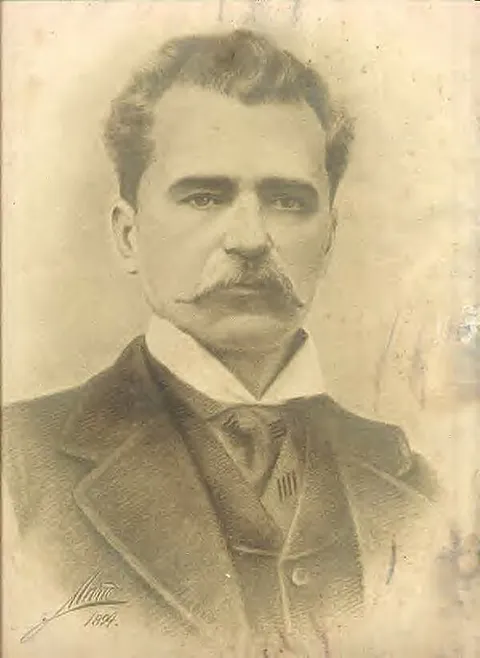
Photo: Salvador Brau.jpg, Mario Brau (his son) (Public domain). Resized and converted to WebP.
Reviewed November 18, 2026. Original biography by PuertoRico.com. Editorial policy