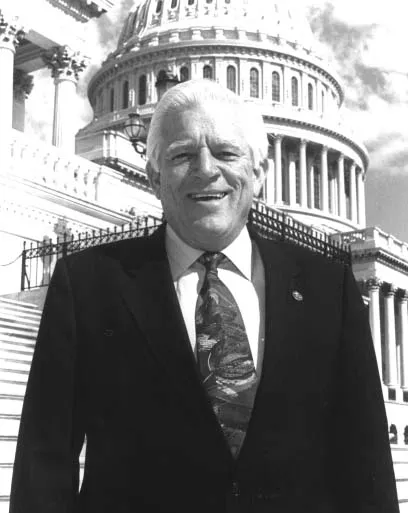
Carlos Romero Barceló: biography
Early life and family
Carlos Antonio Romero Barceló was born on September 4, 1932, in San Juan. He was the son of Antonio Romero Moreno, a lawyer and engineer who later served as a superior court judge, and Josefina Barceló Bird. 1
With her he had two more children, Juan Carlos and Melinda Kathleen. Their daughter Melinda Romero Donnelly later served eight years in the House of Representatives of Puerto Rico and won a special election in 2009 to become a state senator. 1 2
Education
He attended Academia Perpetuo Socorro and Colegio Saint Johns in Puerto Rico before moving to the mainland. Romero Barceló graduated from Phillips Exeter Academy in New Hampshire in 1949. He earned a B.A. in political science and economics from Yale University in 1953. That year he returned to Puerto Rico and enrolled at the University of Puerto Rico Law School in Río Piedras, graduating and becoming a licensed lawyer in 1956. 1 2
Mayor of San Juan
Romero Barceló joined the Partido Estadista Republicano in 1965. In 1965 he participated in Ciudadanos pro Estado 51. He helped found Estadistas Unidos with Luis Ferré in 1967 and became one of the founding members of the New Progressive Party that same year. In 1968 he was elected Mayor of San Juan, the first chosen directly by voters rather than by the city council. He won re-election in 1972 and served until 1977. 1 2
As mayor he brought San Juan into President Lyndon Johnson's Model Cities Program, which transformed the El Fanguito slum area. He also established the first municipal institution of higher education in Puerto Rico, the Colegio Universitario de San Juan. In 1973 he became the first Hispanic vice-president of the National League of Cities and served as its president in 1974. 1 2
Governor of Puerto Rico
In 1976 Romero Barceló defeated incumbent Governor Rafael Hernández Colón and took office in 1977. He focused on economic measures that emphasized tourism, fiscal discipline and budget management. Unemployment fell from 19 percent in 1975 to 17 percent in 1979. He won a second term in 1980 by a margin of 3,037 votes over Hernández Colón in one of the closest elections in Puerto Rican history. The result required a recount and intervention by the Supreme Court of Puerto Rico. The New Progressive Party lost control of both houses of the legislature in that election. 1 2
During his governorship the Minillas Tunnel, the Centro de Bellas Artes Luis A. Ferré and the Puerto Rico Federal Affairs Administration were created. He sought a third term in 1984 but lost to Hernández Colón. When asked about the defeat by a reporter, he replied "¿Derrota, qué derrota?" explaining that he viewed it as an electoral loss rather than a personal defeat that would stop him from continuing to fight for his beliefs. 1 2
Later career, Resident Commissioner and shadow senator
In 1986 he was elected to fill a vacancy in the Senate of Puerto Rico but did not run for re-election in 1988. He returned to private law practice, merging his firm with Del Toro & Santana. In 1992 he was elected Resident Commissioner of Puerto Rico to the 103rd United States Congress and was re-elected twice, serving until 2001. He advocated for statehood, proposed the repeal of the Section 936 tax code, and supported the Young Project for a status referendum. He lost his bid for a third term in 2000 to Aníbal Acevedo Vilá and lost the 2003 primary for the same post to Luis Fortuño. 1 2
On July 3, 2017, Governor Ricardo Rosselló appointed him as Puerto Rico's first shadow United States Senator under the Tennessee Plan. In this non-voting role he continued to advocate for the island's admission as the 51st state. He remained active in the New Progressive Party, the Puerto Rico Democratic Party and the national Democratic Party into his later years. 1 2
Questions about Carlos Romero Barceló
When was Carlos Romero Barceló born?
Carlos Romero Barceló was born on September 4, 1932 in San Juan, Puerto Rico.
What infrastructure projects did Carlos Romero Barceló complete as mayor of San Juan?
He oversaw the Roberto Clemente Coliseum, the transformation of El Fanguito through the Model Cities Program, the San Juan Natatorium, the Puerto Rico Coliseum, numerous condominium projects and the founding of the Colegio Universitario de San Juan.
How many times was Carlos Romero Barceló elected governor of Puerto Rico?
He was elected governor twice, in 1976 and 1980, serving from 1977 to 1985. He lost his bid for a third term in 1984.
What positions did Carlos Romero Barceló hold in the United States Congress?
He served eight years as Resident Commissioner of Puerto Rico from 1993 to 2001 and was later appointed as the island's first shadow United States Senator in 2017.
When did Carlos Romero Barceló die?
Carlos Romero Barceló died on May 2, 2021 in San Juan, Puerto Rico, aged 88.
Sources
- Wikipedia: Carlos Romero Barceló
- Wikipedia (español): Carlos Romero Barceló
- Wikidata: Q2183412
- Biographical Directory of the U.S. Congress (cited by Wikipedia)
- Library of Congress (cited by Wikipedia)
- National Archives (cited by Wikipedia)
- Orlando Sentinel (cited by Wikipedia)
- NotiCel (cited by Wikipedia)
- El Vocero (cited by Wikipedia)
Photo: Carlos Antonio Romero-Barceló.jpg, Unknown author (Public domain). Resized and converted to WebP.
Reviewed November 18, 2026. Original biography by PuertoRico.com. Editorial policy