Eddie Palmieri: biography
Early life and family
He had an older brother, Charlie Palmieri, a noted pianist and bandleader nine years his senior. He attended New York City public schools where he absorbed jazz influences, particularly from Thelonious Monk and McCoy Tyner. At fourteen he formed his first informal band, and during the 1950s he played in orchestras led by Tito Rodríguez, Vicentico Valdés and others. 1 2
La Perfecta and the 1960s
In 1961 Palmieri founded Conjunto La Perfecta, featuring singer Ismael Quintana. At a time when charanga ensembles with violins and flute were popular, he substituted trombones for violins, creating a heavier sound his brother Charlie named "trobanga." The group released albums such as La Perfecta (1962), El Molestoso (1963), Lo Que Traigo Es Sabroso (1964), Echando Pa' Lante (1964), Azúcar Pa' Ti (1965) and Mambo Con Conga Is Mozambique (1965). The latter introduced the Cuban mozambique rhythm. Palmieri also recorded two albums with Cal Tjader: El Sonido Nuevo (1966) and Bamboleate (1967). 1 2
He experimented with jazz elements and the Cuban descarga format, opening arrangements for soloists. In 1968 the original La Perfecta disbanded. Palmieri then collaborated with Cuban trumpeter Alfredo "Chocolate" Armenteros, timbalero Nicky Marrero, conguero Eladio Pérez, bongocero Tomás "Choki" López and bassist Andy González. This lineup produced the 1970 album Superimposition, which included the well-known instrumentals "17.1" and "Helado De Chocolate." 1
1970s recordings and first Grammys
In 1971 Palmieri recorded Vamonos Pa'l Monte with his brother Charlie on organ; it marked the first time a salsa pianist used the Fender Rhodes electric piano on record. That year he also released a live album recorded at the University of Puerto Rico. The Sun of Latin Music (1975), featuring new singer Lalo Rodríguez and arranged in part by René Hernández and Barry Rogers, won the first Grammy Award in the Best Latin Recording category in 1976. Its follow-up Unfinished Masterpiece (1976) earned a second consecutive Grammy. 1 2
Palmieri performed at the 1979 Amandla Festival with artists such as Bob Marley. He continued to incorporate jazz aesthetics while maintaining Afro-Cuban rhythms. After leaving Coco Records he recorded for Epic and returned to working with Ismael Quintana and Cheo Feliciano. 1 2
Later career, collaborations and honors
In 1987 Palmieri produced and recorded The Truth (La Verdad) with singer Tony Vega. He participated in projects with the Fania All-Stars and Tico All-Stars. In 1992 he produced Llegó La India via Eddie Palmieri. He received an honorary doctorate from Berklee College of Music in 1998 and was named Chubb Fellow at Yale University in 2002. 1 2
He formed La Perfecta II in 2002 and released Ritmo Caliente (2003). The 2006 album Simpático, a collaboration with trumpeter Brian Lynch featuring artists including Phil Woods, Giovanni Hidalgo and Dafnis Prieto, won a Grammy for Best Latin Jazz Album in 2007. In 2013 he received the NEA Jazz Masters award and a Latin Grammy for Musical Excellence. In 2024 New York City proclaimed Eddie Palmieri Day. 1 2
Legacy and ties to Puerto Rico
Palmieri never used the term salsa for his music, preferring to emphasize its Afro-Caribbean and Latin jazz roots. His innovations influenced bandleaders such as Willie Colón and Manny Oquendo. He appeared in the 2022 documentary Santos - Skin to Skin and performed in Spike Lee's 2025 film Highest 2 Lowest, his final screen appearance. Palmieri died on August 6, 2025, at his home in Hackensack, New Jersey. His parents' origins in Ponce and frequent performances in Puerto Rico, including the University of Puerto Rico concert and the 2005 Bayamón tribute, maintained his connection to the island throughout his career. 1 2
Questions about Eddie Palmieri
When was Eddie Palmieri born?
Eddie Palmieri was born on December 15, 1936 in The Bronx, New York.
What was Eddie Palmieri's innovation with La Perfecta?
He replaced violins with trombones in the charanga format, creating the heavier "trobanga" sound that influenced later salsa groups.
How many Grammy Awards did Eddie Palmieri win?
Palmieri won nine Grammy Awards, beginning with the first ever Best Latin Recording Grammy in 1976 for The Sun of Latin Music.
Which Puerto Rican venues did Eddie Palmieri perform at?
He recorded a live album at the University of Puerto Rico in 1971 and held a 50-year career tribute concert at the Rubén Rodríguez Coliseum in Bayamón in 2005.
When did Eddie Palmieri die?
Eddie Palmieri died on August 6, 2025 in Hackensack, New Jersey, aged 88.
Sources
- Wikipedia: Eddie Palmieri
- Wikipedia (español): Eddie Palmieri
- Wikidata: Q1282931
- Encyclopaedia Britannica: Eddie Palmieri
- Biography.com (cited by Wikipedia)
- Fundación Nacional para la Cultura Popular (cited by Wikipedia)
- Library of Congress (cited by Wikipedia)
- Recording Academy (Grammy) (cited by Wikipedia)
- The New York Times (cited by Wikipedia)
- The New Yorker (cited by Wikipedia)
- IMDb: Eddie Palmieri (credits)
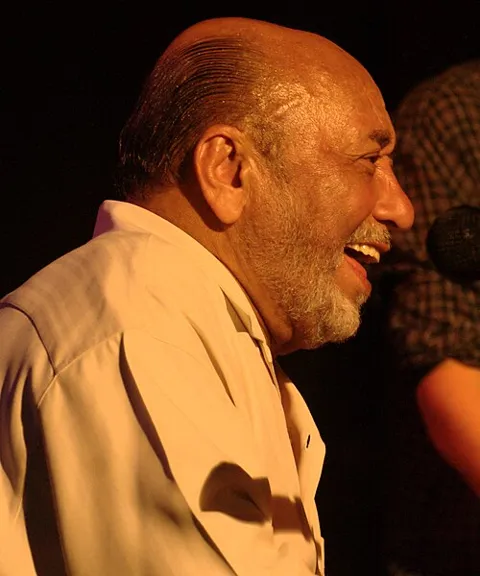
Photo: Eddie Palmieri mit Bassist Luques Curtis (cropped) (2).jpg, Jens Vajen (CC BY-SA 4.0). Resized and converted to WebP.
Reviewed November 18, 2026. Original biography by PuertoRico.com. Editorial policy