Jaquira Díaz: biography
Early life and family
Jaquira Díaz was born in Puerto Rico. Her family lived in government housing projects known locally as el caserío that carried a dangerous reputation. After periods in Humacao and Fajardo her family moved to Miami. She grew up in Miami Beach amid what she called the city's urban blight. Her adolescence included periods of drug use, suicide attempts and legal troubles. She has described herself as a closeted queer girl in a place where gay people faced harassment and attacks. Her father had studied at the University of Puerto Rico, loved poetry and literature, and later sold drugs to support the family. Her memoir details her experiences as a queer Afro-Latina woman in a turbulent and homophobic environment. 1 2
Literary career
Díaz earned a B.A. from the University of Central Florida and an M.F.A. from the University of South Florida. Her fiction and essays, often set in Puerto Rico and Miami, focus on the personal experiences of young women. Critics have called the work lyrical and urgent. She has also written on crime, politics, sexuality, race, music and culture. In 2017 critic Walton Muyumba placed her among a group of gifted writers that included Ta-Nehisi Coates, Isabel Wilkerson, Carol Anderson, Claudia Rankine, Terrance Hayes, Kiese Laymon, Rachel Kaadzi Ghansah, Junot Díaz and Jelani Cobb. The same year she appeared on lists of notable Latinx music journalists. In 2018 Ivelisse Rodriguez named her among writers changing Puerto Rican literature and highlighted her essays on sexual desire and threat. She has contributed to The Atlantic, Time, The Best American Essays, Tin House, The Sun, The Fader, Rolling Stone, The Guardian and Longreads. Her essays have been selected as notable in multiple editions of The Best American Essays and reprinted in anthologies including Waveform, Pushcart Prize volumes and Best American Experimental Writing. 1 2
She has taught in the M.F.A. programs at Colorado State University, Randolph College, the University of Wisconsin–Madison, Kenyon College and currently serves as assistant professor of writing at Columbia University. 1 2
Major works
In 2018 Díaz signed a two-book deal with Algonquin Books. She has called the book an anti-memoir because it does not follow a traditional chronological structure. The work explores girlhood, trauma, identity and coming of age in Puerto Rican housing projects and the streets of Miami. It received the 2020 Whiting Award in Nonfiction, the 2020 Florida Book Awards Gold Medal, a Lambda Literary Award finalist designation in Lesbian Memoir, a Barnes & Noble Discover Prize finalist honor, Indie Next Pick and Indies Introduce Selection. Earlier essays such as "Ordinary Girls," "Girl Hood," "My Mother and Mercy," "Beach City," "Baby Lollipops," "Monster Story," "You Do Not Belong Here" and "La Otra" earned notable essay mentions in The Best American Essays between 2012 and 2019. Her short stories include "Section 8," "Ghosts" and "A Fairy Tale Set in Florida, in 10 Parts," the last written with collaborators including Laura van den Berg, Karen Russell and Lauren Groff. She has also published journalism pieces such as "Who Is the Real Kali Uchis?" in The Fader, "Inside the Brutal Baby Lollipops Murder Case" in Rolling Stone, "Puerto Rico's Last Political Prisoner" in The Guardian and "Rescue From Dead Dog Beach" in The Guardian. Her second book, the novel This Is the Only Kingdom, is scheduled for publication in 2025. 1 2
Legacy and ties to Puerto Rico
She lives in New York and continues to teach at Columbia University. 1 2
Questions about Jaquira Díaz
Where is Jaquira Díaz from?
Jaquira Díaz was born in Humacao, Puerto Rico.
What awards did Ordinary Girls receive?
Ordinary Girls received the 2020 Whiting Award in Nonfiction, the 2020 Florida Book Awards Gold Medal, and was a finalist for the Lambda Literary Award in Lesbian Memoir and the Barnes & Noble Discover Prize.
Which universities has Jaquira Díaz taught at?
She has taught at the University of Wisconsin–Madison, Kenyon College, Colorado State University, Randolph College, Old Dominion University and currently teaches at Columbia University.
What is the setting and focus of Ordinary Girls?
The memoir focuses on her experiences as a queer Afro-Latina woman growing up in Puerto Rican housing projects in Humacao and Fajardo and on the streets of Miami.
Sources
- Wikipedia: Jaquira Díaz
- Wikipedia (español): Jaquira Díaz
- Wikidata: Q47461968
- Rolling Stone (cited by Wikipedia)
- The Guardian (cited by Wikipedia)
- NPR (cited by Wikipedia)
- The New York Times (cited by Wikipedia)
- Library of Congress (cited by Wikipedia)
- Los Angeles Times (cited by Wikipedia)
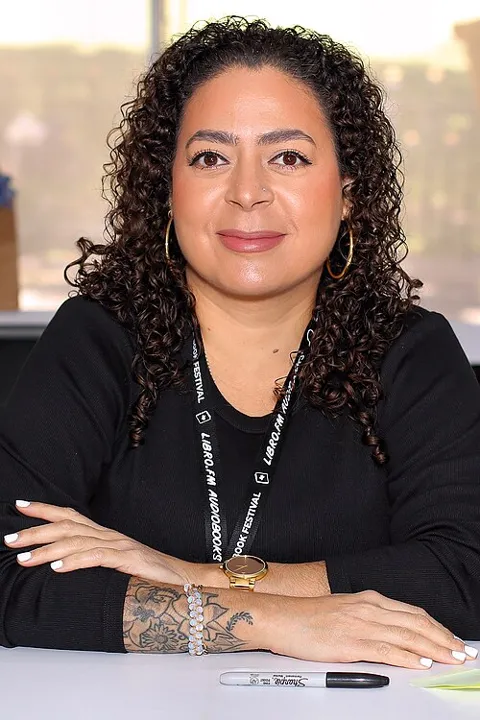
Photo: Jaquira Diaz 2025 Texas Book Festival.jpg, Larry D. Moore (CC BY 4.0). Resized and converted to WebP.
Reviewed November 18, 2026. Original biography by PuertoRico.com. Editorial policy