Roque Salas Rivera: biography
Early life and family
Roque Raquel Salas Rivera was born in 1985 in Mayagüez, Puerto Rico. At six months old the family moved to Madison, Wisconsin. During childhood Salas Rivera lived in California, Nebraska, Alabama and Texas before returning to Puerto Rico in the teenage years. Salas Rivera moved to Philadelphia for graduate studies. The grandfather Sotero Rivera Avilés belonged to the Guajana Generation of Puerto Rican poets. The mother, Yolanda Rivera Castillo, is a linguist. Salas Rivera earned an undergraduate degree at the University of Puerto Rico at Mayagüez. There the poet played an instrumental role in organizing the 2010 student protests on campus. Later a Ph.D. in Comparative Literature and Literary Theory was completed at the University of Pennsylvania. 1 2
Poetry and themes
Salas Rivera's poetry centers on movement, the migrant experience in the United States, Puerto Rico's colonial relationship with the United States and non-binary gender identity. The writer prefers to compose in Spanish and sometimes produces English versions afterward. At public readings the poet frequently presents work only in Spanish, describing the choice as a political act that mirrors the discomfort immigrants face when they do not yet understand the language of their new country. The book lo terciario/the tertiary examines the Puerto Rican debt crisis and the effects of the 2016 PROMESA law that placed the island's finances and debt under an external control board. Individual poems open with quotations from Marx, functioning as both critique and subversion of Marxist terminology. The term buchipluma was adopted as a neologism meaning non-binary feathered butch. The Puerto Rican Latin trap artist Bad Bunny is cited as one source of inspiration. The work acknowledges the historical absence of transgender voices in literature and seeks to address that absence by writing from a transgender perspective. 1 2
Philadelphia Poet Laureate and activism
In 2018 Salas Rivera was selected as the fourth Poet Laureate of Philadelphia by the Free Library of Philadelphia. The selection committee noted the poet's commitment to using poetry to address diversity and the city's Puerto Rican community. During the laureate term the multilingual festival We (Too) Are Philly was created, drawing its name from Langston Hughes's poem I, Too. The 2018 summer event was co-organized with Ashley Davis, Kirwyn Sutherland and Raena Shirali. It featured Philadelphia poets of color and chose venues meaningful to neighborhoods that rarely host poetry readings. The stated aim was to diversify the poetry scene and promote mixing or desegregation of audiences. After Hurricane Maria in 2017, Salas Rivera and Allison Harris raised thousands of dollars to support lesbian, gay, bisexual and transgender people in Puerto Rico. The funds helped bring five queer and transgender individuals to the United States and provided further assistance through the Mazzoni Center. That same year Salas Rivera co-edited the bilingual pamphlet series Puerto Rico en mi corazón with Erica Mena, Ricardo Alberto Maldonado and Carina del Valle Schorske. All proceeds were donated to the community organization Taller Salud for hurricane recovery efforts. 1 2
Major works and awards
The artist book Gringo Death Coloring Book was created with Erica Mena and Mariana Ramos Ortiz. Editorial projects include the anthology #27: Indigenous Futures and Imagining the Decolonial co-edited with BBP Hosmillo and Sarah Clark, the co-edited Puerto Rico en mi corazón and the journal The Wanderer from 2016 to 2018. Work has appeared in the Revista del Instituto de Cultura Puertorriqueña, Apiary, Apogee, BOAAT and Boston Review. lo terciario/the tertiary was longlisted for the 2018 National Book Award for Poetry. Additional honors include the 2018-2019 Kimmel Center Jazz Residency, the 2019 Sundance Institute Theater Program Playwright Fellowship, the 2020 Norwegian Festival of Literature residency, the 2020 MacDowell Colony residency, the 2018 CantoMundo Poetry Workshop fellowship, the 2019 Laureate Fellowship from the Academy of American Poets, a 2019-2021 Writer position with the Art for Justice Fund at the University of Arizona Poetry Center and a 2020 PEN America Open Book Award longlist for while they sleep (under the bed is another country). 1 2
Legacy and ties to Puerto Rico
Questions about Roque Salas Rivera
Where is Roque Salas Rivera from?
Roque Salas Rivera was born in Mayagüez, Puerto Rico.
What inspired the title sections of lo terciario/the tertiary?
Each section takes its name from Marxist economic concepts in Karl Marx's Das Kapital. The poems begin with quotations from Marx as a form of critique and subversion.
How did Salas Rivera support Puerto Ricans after Hurricane Maria?
With Allison Harris, thousands of dollars were raised to aid LGBTQ Puerto Ricans. Five queer and transgender individuals were brought to the United States with support from the Mazzoni Center. The co-edited pamphlet series Puerto Rico en mi corazón donated all proceeds to Taller Salud.
What was the purpose of the We (Too) Are Philly festival?
The multilingual poetry festival aimed to diversify Philadelphia's poetry scene, promote mixing of audiences and feature poets of color in neighborhood venues that rarely host readings.
Sources
- Wikipedia: Roque Salas Rivera
- Wikipedia (español): Roque Raquel Salas Rivera
- Wikidata: Q61852721
- Library of Congress: Roque Salas Rivera
- The Hollywood Reporter (cited by Wikipedia)
- NPR (cited by Wikipedia)
- Poetry Foundation (cited by Wikipedia)
- JSTOR (cited by Wikipedia)
- Yale University (cited by Wikipedia)
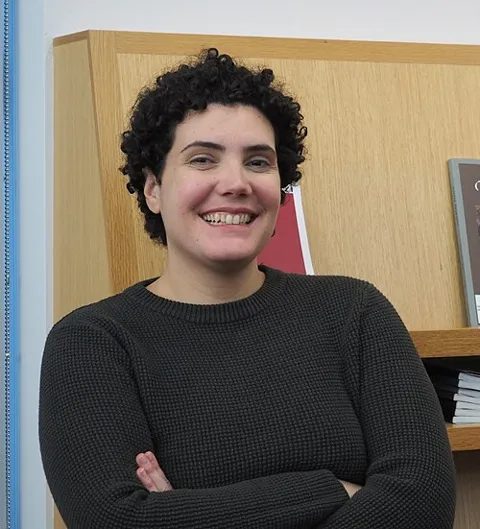
Photo: Raquel Salas Rivera 3022140.jpg, Slowking4 (CC BY-SA 2.5). Resized and converted to WebP.
Reviewed November 18, 2026. Original biography by PuertoRico.com. Editorial policy