Modesto Cartagena: biography
Early life and family
Modesto Cartagena was born into a poor family and raised in the mountains of Cayey during the Great Depression. He enlisted in the United States Army in San Juan in 1940 and was assigned to the 65th Infantry Regiment, known as the Borinqueneers because it consisted primarily of Puerto Rican enlisted men. He received a Bronze Star for Valor for these actions. He was discharged in 1945 after the regiment returned to Puerto Rico. 1 2
Korean War service
Cartagena reenlisted in 1947. He took part in Operation PORTREX in Vieques before the Korean War began. Assigned to Company C, 65th Infantry Regiment, 3rd Infantry Division, he was among the first infantrymen to engage the enemy in Korea. The regiment fought daily against Chinese People's Liberation Army units after November 1950 and suffered from lack of adequate winter clothing. The unit participated in Operation Killer in January 1951, becoming the first regiment to cross the Han River in South Korea, and later took part in the Uijonbu Corridor drives. On April 19, 1951, near Yonch'on on Hill 206, Cartagena left his covered position and charged into heavy enemy fire. He destroyed two enemy emplacements with grenades, was knocked down twice by exploding grenades, then assaulted three more positions before being wounded. He earned the nickname "One Man Army." After the action, 33 dead Chinese soldiers were found in the machine-gun and automatic-weapon emplacements and 15 more in the positions Cartagena had destroyed. He lost a large amount of blood and was evacuated by helicopter to Taegu, then to the 128th Station Hospital in Japan, where he spent 62 days recovering. He was initially awarded the Silver Star, which was upgraded to the Distinguished Service Cross. 1 2
Distinguished Service Cross citation
The citation states that on April 19, 1951, Company C was ordered to capture Hill 206, a key terrain feature. When the unit met intense resistance, Cartagena led his squad forward but the group was pinned down. He located the most dangerous emplacements, left cover and charged through devastating fire, destroying the first with a grenade. Ordering his men to stay under cover, he single-handedly assaulted the second position. Despite being knocked down by grenades, he repeated the action three more times until wounded. His actions allowed the company to secure the objective with minimal casualties. 1
Later years and military awards
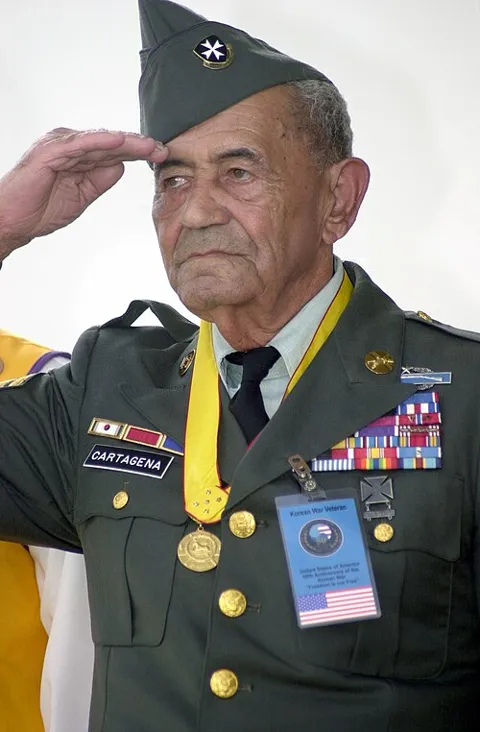
Cartagena completed 20 years of service and retired as a sergeant first class in 1971. He remained active around the 65th Infantry headquarters in Puerto Rico and had family in El Paso, Texas. His relatives petitioned Congress for the Medal of Honor, supported by the Republican Veterans Committee. They argued that Army segregation policies and limited English proficiency among company members contributed to the award of the Distinguished Service Cross instead. His decorations include the Distinguished Service Cross, Bronze Star for Valor, Congressional Gold Medal awarded to the 65th Infantry Regiment in 2014, Puerto Rico Legislative Medal of Honor, Greece's Gold Bravery Medal awarded to the regiment, rifle marksmanship badge and two overseas service bars. He was posthumously inducted into the Puerto Rico Veterans Hall of Fame in 2019. 1 2
Death, legacy and ties to Puerto Rico
Cartagena died on March 2, 2010, in Guayama of a heart attack after a long battle with stomach cancer. He was survived by sisters María and Virginia and children Modesto Jr., Luis Antonio, Fernando, Sara, Wilma and Víctor. He received military honors at burial in the Puerto Rico National Cemetery in Bayamón. Puerto Rico Secretary of State Kenneth McClintock attended, delivered a letter from Governor Luis Fortuño and stated that in their hearts they were burying him with the Medal of Honor he deserved, committing to seek it posthumously. No federal officials attended. January 4, 2007, was declared SFC Modesto Cartagena Day in Hartford, Connecticut, by Mayor Eddie A. Perez. An avenue in Cayey is named after him. On April 14, 2021, the U.S. Army Garrison Fort Buchanan dedicated its Visitor Control Center building in his honor. Cartagena is recognized as the most decorated Hispanic soldier of the Korean War and the most decorated Puerto Rican soldier of that conflict. 1 2
Questions about Modesto Cartagena
When was Modesto Cartagena born?
Modesto Cartagena was born on July 21, 1921 in Cayey, Puerto Rico.
How did Modesto Cartagena earn the nickname One Man Army?
On April 19, 1951, near Yonch'on on Hill 206 in Korea, he single-handedly destroyed five enemy emplacements by charging into heavy fire and hurling grenades despite being knocked down twice.
Why was Cartagena awarded the Distinguished Service Cross instead of the Medal of Honor?
His family and supporters argued that Army segregation policies and limited English proficiency among his company members when filling out forms led to the second-highest award rather than the Medal of Honor.
What honors were given to Modesto Cartagena after his death?
He was buried with military honors in the Puerto Rico National Cemetery in Bayamón. In 2019 he was posthumously inducted into the Puerto Rico Veterans Hall of Fame, and in 2021 the Visitor Control Center at Fort Buchanan was named for him.
When did Modesto Cartagena die?
Modesto Cartagena died on March 2, 2010 in Guayama, Puerto Rico, aged 88.
Sources
- Wikipedia: Modesto Cartagena
- Wikipedia (español): Modesto Cartagena
- Wikidata: Q6889207
- National Archives (cited by Wikipedia)
- The New York Times (cited by Wikipedia)
- U.S. Army (cited by Wikipedia)
- Primera Hora (cited by Wikipedia)
Photo: Modesto Cartagena.JPEG, Lonnie D. Tague (Public domain). Resized and converted to WebP.
Reviewed November 18, 2026. Original biography by PuertoRico.com. Editorial policy