Neil deGrasse Tyson: biography
Early life and family
Born in Manhattan on October 5, 1958, Tyson grew up in the Bronx in the Castle Hill neighborhood and then in Riverdale. He was the second of three children born to Cyril deGrasse Tyson, a sociologist who served as human resource commissioner under Mayor John Lindsay and directed Harlem Youth Opportunities Unlimited, and Sunchita Maria Tyson, a gerontologist with the U.S. Department of Health, Education and Welfare. His mother was of Puerto Rican descent while his father was African American. Tyson has a brother, Stephen Joseph Tyson, and a sister, Lynn Antipas Tyson. His middle name comes from his paternal grandmother Altima de Grasse, who was born on the island of Nevis. 1
Tyson attended public schools in the Bronx, including PS 36, PS 81, Riverdale Kingsbridge Academy and The Bronx High School of Science, from which he graduated in 1976. He served as captain of the wrestling team and editor-in-chief of the Physical Science Journal. His interest in astronomy started at age nine after a visit to the Hayden Planetarium sky theater. During high school he took astronomy courses at the planetarium, an experience he described as the most formative period of his life. At age 14 he received a scholarship from the Explorers Club to observe the June 1973 total solar eclipse aboard the SS Canberra with scientists including Neil Armstrong and Isaac Asimov. 1 2
Education and research training
Tyson earned a Bachelor of Arts in physics from Harvard College in 1980, where he rowed freshman year, wrestled as a senior, and participated in jazz, ballet, Afro-Caribbean and Latin Ballroom dance. He received a Master of Arts in astronomy from the University of Texas at Austin in 1983. After a lectureship at the University of Maryland from 1986 to 1987, he entered the graduate program at Columbia University, earning a Master of Philosophy in astrophysics in 1989 and a PhD in astrophysics in 1991 under R. Michael Rich. His doctoral research involved observations with the 0.91 m telescope at Cerro Tololo Inter-American Observatory in Chile as part of the Calán/Tololo Supernova Survey, which helped establish Type Ia supernovae as standard candles. NASA and the ARCS Foundation funded his work, allowing attendance at meetings in Italy, Switzerland, Chile and South Africa. 1 2
As a postdoctoral research associate at Princeton University from 1991 to 1994, Tyson collaborated with David Spergel on studies of galactic bulges in spiral galaxies. He joined the Hayden Planetarium as a staff scientist in 1994 and became a visiting research scientist and lecturer at Princeton. In 1996 he was named director of the Hayden Planetarium at the Rose Center for Earth and Space, part of the American Museum of Natural History. He founded the museum's Department of Astrophysics in 1997 and has served as a research associate there since 2003. He oversaw the planetarium's $210 million reconstruction completed in 2000. 1
Science communication and media
From 1995 to 2005 Tyson wrote the "Universe" column for Natural History magazine; selected essays appeared in Death by Black Hole (2007) and Astrophysics for People in a Hurry (2017). He also wrote a StarDate magazine column under the pen name Merlin, with material collected in Merlin's Tour of the Universe (1989) and Just Visiting This Planet (1998). In 2002 he coined the term Manhattanhenge for the twice-yearly alignment of sunset with Manhattan's street grid. He hosted the PBS series NOVA ScienceNow from 2006 to 2011 and launched the weekly StarTalk podcast in 2009. A television version of StarTalk premiered on National Geographic in 2015. 1 2
In 2014 Tyson hosted the 13-episode Cosmos: A Spacetime Odyssey on Fox and National Geographic, a successor to Carl Sagan's 1980 series. A follow-up season, Cosmos: Possible Worlds, aired in 2020. He narrated the 2004 PBS miniseries Origins with Donald Goldsmith and the 2009 documentary 400 Years of the Telescope. Tyson has appeared on The Daily Show, The Colbert Report, Real Time with Bill Maher, The Big Bang Theory, Brooklyn Nine-Nine and voiced a monologue on Avenged Sevenfold's 2016 album The Stage. He has been a frequent Reddit AMA participant and appeared in Batman v Superman: Dawn of Justice and Zoolander 2. 1 2
Public policy and advocacy
President George W. Bush appointed Tyson to the 2001 Commission on the Future of the United States Aerospace Industry and the 2004 President's Commission on Implementation of United States Space Exploration Policy, known as the Moon, Mars and Beyond commission. He received the NASA Distinguished Public Service Medal in 2004 and the National Academy of Sciences Public Welfare Medal in 2015. Tyson has advocated increasing NASA's budget, testifying before the Senate in 2012 that doubling it to one penny per tax dollar would restore the nation's capacity to dream. He served as vice president, president and chairman of the Planetary Society and supported reclassifying Pluto as a dwarf planet in 2006 to emphasize commonalities among solar system bodies. 1 2
Questions about Neil deGrasse Tyson
When was Neil deGrasse Tyson born?
Neil deGrasse Tyson was born on October 5, 1958 in Manhattan, New York. Neil deGrasse Tyson is 68 years old.
Why did Neil deGrasse Tyson advocate changing Pluto's status?
As director of the Hayden Planetarium he grouped Pluto with similar icy bodies rather than counting planets by number, emphasizing common physical traits among terrestrial planets, gas giants and dwarf planets. The International Astronomical Union adopted this view in 2006.
What connection does Neil deGrasse Tyson have to Carl Sagan?
Sagan wrote Tyson a personal letter after reviewing his Harvard application, invited the 17-year-old to spend a day at Cornell, and served as an early intellectual influence. Tyson later hosted the 2014 sequel to Sagan's Cosmos series.
How is Neil deGrasse Tyson's family connected to Puerto Rico?
His mother, Sunchita Maria Tyson (née Feliciano), was a gerontologist of Puerto Rican descent. Tyson was born in New York and raised in the Bronx.
Sources
- Wikipedia: Neil deGrasse Tyson
- Wikipedia (español): Neil deGrasse Tyson
- Wikidata: Q310903
- Encyclopaedia Britannica: Neil deGrasse Tyson
- Time (cited by Wikipedia)
- Rolling Stone (cited by Wikipedia)
- Los Angeles Times (cited by Wikipedia)
- Television Academy (cited by Wikipedia)
- Library of Congress (cited by Wikipedia)
- Recording Academy (Grammy) (cited by Wikipedia)
- IMDb: Neil deGrasse Tyson (credits)
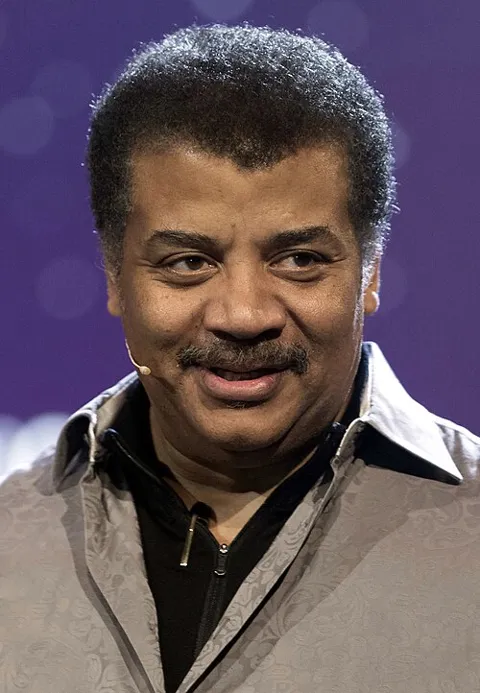
Photo: Neil deGrasse Tyson in June 2017 (cropped).jpg, Norwegian University of Science and Technology (CC BY-SA 2.0). Resized and converted to WebP.
Reviewed November 18, 2026. Original biography by PuertoRico.com. Editorial policy