Ramón Frade: biography
Early life and family
Ramón Frade was born on February 8, 1875, in Cayey to Ramón Frade Fernández, a photographer from Asturias, Spain, and Joaquina León Guzmán from Cayey. His father died in 1877. At age two he was fostered by Nemesio Laforga, a merchant from Andalusia, and his Dominican wife, who took him to Valladolid, Spain, until 1885. The family then moved to Santo Domingo, where he attended the Escuela Normal directed by Eugenio María de Hostos and the Municipal School of Drawing under Luis Desangles. He worked as assistant to photographer Julio Pou from about 1891 to 1894, learning dry-plate photography, negative retouching and hand coloring. In 1892 he met French painter Adolphe Laglande, who became his mentor. He contributed illustrations to the magazine El Lápiz. In 1896 he moved to Haiti. In 1907 he married Reparada Ortiz Uset, also from Cayey. The couple settled permanently in Cayey in 1909. 1 2
Artistic training and travels
In Haiti Frade exhibited the oil painting La volteriana at the Paris Salon in 1900. Political unrest in 1902 led him to leave for brief stays in Puerto Rico and Jamaica before settling in Havana as set designer at the Teatro Tacón and painting instructor. He traveled through Latin America, working in Venezuela with Tito Salas, Antonio Herrera Toro, Arturo Michelena and Cristóbal Rojas. Portraiture was his main focus during these years. He painted Rêverie d’Amour before returning to Puerto Rico. In 1905 he submitted El pan nuestro de cada día to the Puerto Rico Chamber of Delegates to obtain a scholarship for European study. Painter Francisco Oller evaluated it positively and the Charity Commission recommended $720, but the proposal was vetoed by U.S. Secretary Regis H. Post. In 1907 the government purchased his portraits of President Theodore Roosevelt and Governor Beekman Winthrop for $1,200, allowing the trip to Rome, Florence, Naples, Venice, Milan and Barcelona. 1
Return to Puerto Rico and style
After returning in 1909 Frade shifted from bourgeois and religious subjects to portrayals of peasant life, local landscapes and cultural identity. He continued using photography as a tool for observation and composition, a practice begun in Santo Domingo. His father had also been a photographer, and Frade painted Mi padre enfermo in 1890 over a portrait of him. Religious commissions included Virgen del Perpetuo Socorro, Santa Teresita del Niño Jesús and the Altar of Our Lady of Mercy painted in 1945 for the Church of Our Lady of the Assumption in Cayey. 1 2
Architecture and photography
From 1909 to 1913 Frade studied architecture, topographic engineering and land surveying by correspondence at the American School of Correspondence in Chicago. In 1928 he received licenses 625, 626 and 428 from the Puerto Rico Examining Board. He designed the remodeling of the Cayey Municipal Cemetery in 1917, residences in Republican style, a hardware store for the Aragunde family, houses for the Mendoza family, furniture for Farmacia Planella and a plaza dedicated to Eugenio María de Hostos. He submitted a proposal for the Columbus Lighthouse in Santo Domingo and a ceiling design for the San Juan Municipal Theater. He completed more than 75 projects, mostly in Cayey. Frade photographed colonial monuments in Santo Domingo, rural scenes, tobacco warehouses, roads and agricultural labor around Cayey. His portraits of neighbors served as studies for paintings, creating a typology of rural types that emphasized dignity. These images connected directly to works such as El pan nuestro de cada día. 1 2
Later years and legacy
Frade received the Benemerenti Medal from Pope Pius XII for religious works. He died on November 7, 1954, in Cayey from complications of generalized arteriosclerosis and was buried in the Cayey Municipal Cemetery. His works are held at the Institute of Puerto Rican Culture, Museo de Arte de Puerto Rico, University of Puerto Rico museums in Cayey and Río Piedras, the Dirección Nacional de Patrimonio Monumental in Santo Domingo and the Smithsonian American Art Museum. His painting El pan nuestro de cada día remains a cultural symbol of jíbaro dignity and Puerto Rican identity. Frade is recognized for academic realism and costumbrismo that captured early 20th-century peasant life amid Americanization. The Dr. Pío López Martínez Museum in Cayey preserves much of his output and archive. 1 2
Questions about Ramón Frade
Where is Ramón Frade from?
Ramón Frade was born in Cayey, Puerto Rico.
Why was Frade's 1905 scholarship application rejected?
The U.S. Secretary Regis H. Post vetoed the $720 subsidy for El pan nuestro de cada día, considering that the painting conveyed a nationalist message contrary to United States interests.
How did Frade use photography in his painting process?
He employed black-and-white photography as an auxiliary tool to study figures, sharpen observation and support precise drawing, a practice learned in Julio Pou's studio in Santo Domingo.
What architectural projects did Frade complete in Cayey?
He designed the 1917 remodeling of the Municipal Cemetery, multiple Republican-style residences, a hardware store for the Aragunde family, houses for the Mendoza family and furniture for Farmacia Planella.
When did Ramón Frade die?
Ramón Frade died on November 7, 1954 in Cayey, Puerto Rico.
Sources
- Wikipedia: Ramón Frade
- Enciclopedia de Puerto Rico: Ramón Frade
- Wikidata: Q7290483
- Library of Congress: Ramón Frade
- Smithsonian Institution (cited by Wikipedia)
- JSTOR (cited by Wikipedia)
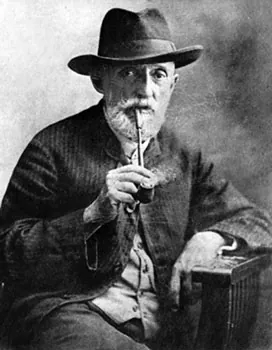
Photo: Autoretrato Ramon -Frade.png, Ramon Frade (Public domain). Resized and converted to WebP.
Reviewed November 18, 2026. Original biography by PuertoRico.com. Editorial policy