Ramón Grosfoguel: biography
Early life and education
Ramón Grosfoguel was born on May 20, 1956, in San Juan, Puerto Rico. He earned a bachelor's degree in sociology from the University of Puerto Rico in 1979. He completed a master's degree in urban studies at Temple University in 1986 with a paper that examined Puerto Rico's urbanization process between 1898 and 1980. In 1992 he received a doctorate in sociology from Temple University. His dissertation addressed Puerto Rico's industrialization, migration and housing development from 1950 to 1970. 1
Academic career
Grosfoguel began teaching in 1990 at Temple University, offering courses on race and ethnic relations, urban sociology and introductory sociology. From 1992 to 1993 he served as a visiting professor at Johns Hopkins University, where he received the Oraculum Award for Excellence in Teaching. He belongs to the Modernity/Coloniality Group. 1
Decolonial thought
Grosfoguel identifies his work with the decolonial current, which he presents as going beyond postcolonial approaches. He maintains that modernity and colonialism share a structural link. He argues that European colonialism did not end with nineteenth- and twentieth-century processes of decolonization and national independence. Its effects continue in culture and epistemology. He calls for a decolonial turn to achieve epistemological decolonization that corrects the universalist and ahistorical distortions of Eurocentrism and modernity, which he describes as in a situation of terminal crisis. His critique centers on racism and the colonial division between the human and the non-human. He supports the intersectionality of categories such as class and gender, grounded in the colonial distinction between human and non-human. His writings address epistemic racism and sexism, the geopolitics of knowledge, transmodernity, border thinking and global coloniality. 1 2
Major works and publications
His 2003 book Colonial Subjects: Puerto Ricans in a Global Perspective, published by University of California Press, analyzes Puerto Rican political economy, mass migration and modes of incorporation into the United States while comparing these experiences with other Caribbean migrations to the United States and Western Europe. He co-edited El giro decolonial: reflexiones para una diversidad epistémica más allá del capitalismo global in 2007. Additional publications address epistemic racism, the four genocides and epistemicides of the long sixteenth century, Islamophobia, museum and migration issues, and critiques of Westernized universities. He has contributed to journals such as Tabula Rasa, Human Architecture, Transmodernity, Caribbean Studies and Cultural Studies, often as author, co-author or guest editor. 1
Ties to Puerto Rico
Born in San Juan, Grosfoguel has centered Puerto Rico in much of his scholarship. His master's paper, doctoral dissertation and several articles examine the island's urbanization, industrialization, migration patterns and position within global coloniality. Books such as Colonial Subjects and chapters on the geopolitics of knowledge treat Puerto Rican experiences as key examples for understanding colonial difference and the incorporation of colonial migrants in metropolitan centers. He continues to write about Puerto Ricans in New York and the racialization of Caribbean colonial migrants. 1
Questions about Ramón Grosfoguel
When was Ramón Grosfoguel born?
Ramón Grosfoguel was born on May 20, 1956 in Puerto Rico. Ramón Grosfoguel is 70 years old.
What is Ramón Grosfoguel's main theoretical contribution?
He advocates a decolonial turn to address epistemic racism, the link between modernity and colonialism, and the persistence of coloniality after formal independence.
Which book by Grosfoguel focuses on Puerto Rican migration?
Colonial Subjects: Puerto Ricans in a Global Perspective, published in 2003, compares Puerto Rican experiences with other Caribbean migrations.
At which universities did Grosfoguel teach before Berkeley?
He taught at Temple University, Johns Hopkins University, the State University of New York at Binghamton and Boston College.
Sources
- Wikipedia: Ramón Grosfoguel
- Wikipedia (español): Ramón Grosfoguel
- Wikidata: Q19363185
- Library of Congress: Ramón Grosfoguel
- JSTOR (cited by Wikipedia)
- DOI (cited by Wikipedia)
- Yale University (cited by Wikipedia)
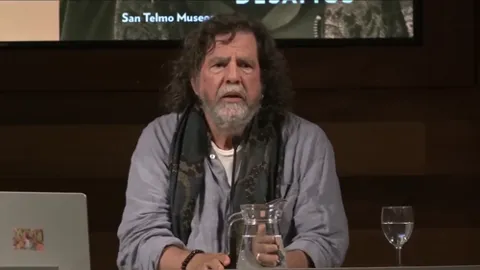
Photo: Ramón Grosfoguel en 2025.png, Ramón Grosfoguel (CC BY 4.0). Resized and converted to WebP.
Reviewed November 18, 2026. Original biography by PuertoRico.com. Editorial policy