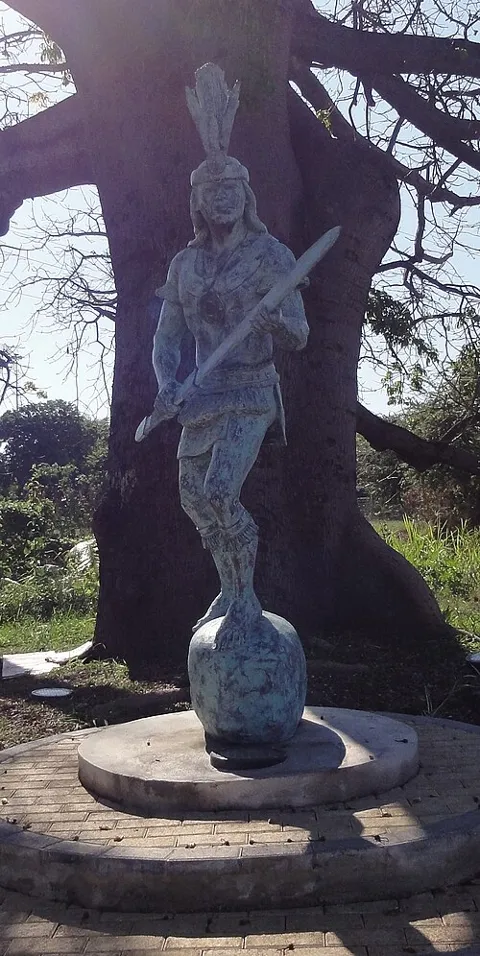
Agüeybaná II: biography
Early life and family
Agüeybaná II, born Güeybaná around 1470, was the brother of the principal cacique Agüeybaná. He lived with his tribe in Guayanilla near the river of the same name on the southern coast of the island. The name Agüeybaná translates as The Great Sun and served as a hereditary title passed through the maternal line within the ruling family that held authority over other caciques in Borinquen. All other caciques were required to obey the authority of the senior Agüeybaná even while governing their own tribes. 1 2
Arrival of the Spanish
The senior Agüeybaná received Juan Ponce de León upon his arrival in Puerto Rico in 1508. Following Taíno tradition known as guaytiao, the two men exchanged names and formed a bond of friendship. The older cacique followed his mother's advice to ally with the newcomers to avoid conflict. 1 2
Taíno rebellion of 1511
After the senior Agüeybaná died in 1510, Güeybaná succeeded as the most powerful cacique and became known as Agüeybaná II. Doubting the divine status claimed by the Spanish, he devised a test with the cacique Urayoán of Añasco. Warriors lured a Spaniard named Diego Salcedo into a river, drowned him, and watched the body for days to confirm he did not revive. Convinced the Spanish were mortal, Agüeybaná II convened secret Areytos with other caciques to plan coordinated resistance. A spy named Juan González learned of the meetings and warned Cristóbal de Sotomayor. Despite the alert, Agüeybaná II and his forces killed Sotomayor and his men, wounding González who escaped to report the events to Ponce de León in Caparra. Guarionex, cacique of Utuado, attacked the village of Sotomayor in present-day Aguada and killed eighty inhabitants. Ponce de León then launched offensives against Taíno groups that led to the decisive Battle of Yagüecas. 1
Battle of Yagüecas and death
In 1511 at Yagüecas, between 11,000 and 15,000 Taíno warriors faced 80 to 100 Spanish soldiers. Before combat began, a Spanish soldier fired an arquebus and killed a native wearing a golden necklace reserved for caciques. Historians presume the victim was Agüeybaná II. With his death the Taíno forces became disorganized and withdrew. Survivors shifted to guerrilla tactics that continued for eight years until 1519. A further wave of raids occurred in 1513 while Ponce de León explored Florida; Taíno forces allied with natives from the northeastern Antilles sacked and burned Caparra. 1 2
Aftermath and legacy
By 1520 the Taíno presence on the island had nearly ended. A 1530 census recorded only 1,148 Taínos remaining. Many survivors later died from harsh treatment or the smallpox epidemic that struck in 1519. Public sites named after him include the Cacique Agüeybana High School in Bayamón, a street in Caguas, and an avenue in the Hato Rey section of San Juan. The island once awarded annual Agüeybaná de Oro prizes comparable to the Oscars. A statue of him stands in a small park in the Caracoles sector of barrio Playa in Ponce at the intersection of PR-2 and PR-123. In 1854 the poet Daniel de Rivera wrote the poem Agüeybaná El Bravo in his honor. 1 2
Questions about Agüeybaná II
Where is Agüeybaná II from?
Agüeybaná II was born in Puerto Rico.
How did Agüeybaná II test whether the Spanish were gods?
With Urayoán he ordered warriors to drown Diego Salcedo in a river and guard the body for days to confirm it did not revive.
What happened immediately after Agüeybaná II was killed?
The Taíno forces became disorganized and withdrew. Survivors turned to guerrilla warfare that lasted until 1519.
Which modern sites in Puerto Rico bear Agüeybaná II's name?
Cacique Agüeybana High School in Bayamón, a street in Caguas, an avenue in Hato Rey, San Juan, and a statue in Ponce.
When did Agüeybaná II die?
Agüeybaná II died on 1511 in Puerto Rico.
Sources
- Wikipedia: Agüeybaná II
- Wikipedia (español): Agüeybaná II
- Wikidata: Q14789082
- Library of Congress: Agüeybaná II
- National Park Service (cited by Wikipedia)
- Periódico La Perla (cited by Wikipedia)
- Yale University (cited by Wikipedia)
Photo: Estatua de Agüeybaná II, El Bravo, en el Parque Monumento a Agüeybaná II, El Bravo, en Ponce, Puerto Rico (DSC02672C).jpg, Tito Caraballo (CC BY-SA 2.0). Resized and converted to WebP.
Reviewed November 18, 2026. Original biography by PuertoRico.com. Editorial policy