Eugenio María de Hostos: biography
Early life and family
Eugenio María de Hostos y de Bonilla was born on January 11, 1839, to a well-to-do family in the Barrio Río Cañas of Mayagüez. His parents were Eugenio María de Hostos y Rodríguez and María Hilaria de Bonilla y Cintrón. In 1852 they sent him to Bilbao, Spain, where he graduated from the Institute of Secondary Education. He then enrolled at the Complutense University of Madrid in 1857 to study law, philosophy and letters. As a student he became interested in politics. In 1863 he published La Peregrinación de Bayoán. When Spain refused to grant Puerto Rico independence under its 1869 constitution, he left for the United States. 1 2 6
Independence campaigns
During his stay in the United States he joined the Cuban Revolutionary Committee and edited the journal La Revolución. He advocated the creation of an Antillean Confederation involving Puerto Rico, Cuba and the Dominican Republic, an idea shared with Ramón Emeterio Betances and Segundo Ruiz Belvis. Disappointed by annexationist sentiments in Puerto Rico and Cuba, he traveled through the United States, France, Colombia, Peru, Chile, Argentina, Brazil, Venezuela, the Dominican Republic, Cuba and St. Thomas to promote independence and confederation. 1 2 6
After returning briefly to New York he went to Venezuela, where he married Belinda Otilia de Ayala Quintana on July 9, 1877; the wedding was officiated by the Archbishop of Caracas with Lola Rodríguez de Tió as maid of honor. The couple had six children: Eugenio Carlos, Luisa Amelia, Bayoán Lautaro, Adolfo Jose, Filipo Luis Duarte and María Angelina. 1 2 6
Educational reforms
In 1879 he returned to the Dominican Republic and in 1880 inaugurated the first normal school in Santo Domingo, serving as its director; he also established a second normal school in Santiago de los Caballeros. In 1889 he moved to Chile, directed the Liceos of Chillán and Santiago de Chile, taught law at the University of Chile. 1 2 6
He wrote essays on psychology, logic, literature, law and sociology, and is considered one of the first systematic sociologists in Latin America. Among his works are La Peregrinación de Bayoán (1863), Moral Social (1888), Lecciones de derecho constitucional (1887) and Geografía evolutiva (1895). He supported women's rights. 1 2 6
Later years, death and legacy
He joined a commission that met with President William McKinley in Washington in 1899 to request Puerto Rican independence within an Antillean confederation, but the United States instead made the island a colony under the Foraker Act of 1900. Disappointed, he relocated with his family to Santo Domingo in 1900, reorganized the educational system there, served as Director General of Education and director of the normal school. 1 2 6
He died on August 11, 1903, in Santo Domingo and is buried in the National Pantheon of the Dominican Republic, the only Puerto Rican and foreigner there. Per his wishes, his remains are to remain in the Dominican Republic until Puerto Rico becomes independent. In 1938 the 8th International Conference of America in Lima declared him Citizen of the Americas. Puerto Rico observes his birthday as an official holiday. Schools, airports, highways and monuments in Puerto Rico, the United States, Chile and the Dominican Republic bear his name, including Hostos Community College in New York and the Eugenio María de Hostos School of Law in Mayagüez. 1 2 6
Questions about Eugenio María de Hostos
When was Eugenio María de Hostos born?
Eugenio María de Hostos was born on January 11, 1839 in Mayagüez, Puerto Rico.
Why did Hostos want his remains to stay in the Dominican Republic?
Per his final wishes, his remains are to stay permanently in the Dominican Republic until Puerto Rico is completely independent, after which they are to be reinterred in his homeland.
What was Hostos's proposal for women's education in Chile?
In 1873 he gave a speech titled La Educación Científica de la Mujer in which he proposed that governments permit women in their colleges. Soon after, Chile allowed women to enter its college educational system.
Which educational institutions did Hostos found in the Dominican Republic?
In 1880 he inaugurated the first normal school in Santo Domingo and helped establish a second in Santiago de los Caballeros. He also founded the Escuela Nocturna for workers and collaborated on the Instituto de Señoritas.
When did Eugenio María de Hostos die?
Eugenio María de Hostos died on August 11, 1903 in Santo Domingo, Dominican Republic, aged 64.
Sources
- Wikipedia: Eugenio María de Hostos
- Wikipedia (español): Eugenio María de Hostos
- Wikidata: Q3543841
- Encyclopaedia Britannica: Eugenio María de Hostos
- Enciclopedia de Puerto Rico: Eugenio María de Hostos
- Enciclopedia de Puerto Rico: Eugenio María de Hostos
- Library of Congress (cited by Wikipedia)
- Fundación Nacional para la Cultura Popular (cited by Wikipedia)
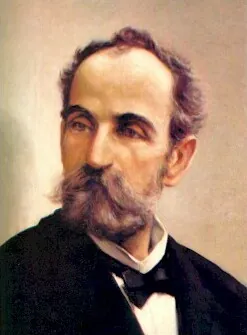
Photo: Retrato de EMdeHostos por Francisco Oller.jpg, Francisco Manuel Oller (Public domain). Resized and converted to WebP.
Reviewed November 18, 2026. Original biography by PuertoRico.com. Editorial policy