Pedro Albizu Campos: biography
Early life and family
Pedro Albizu Campos was born in Ponce, Puerto Rico. Sources differ on his birth year: official documents list 1891 while he stated 1893. 1 2
He was then raised by his maternal aunt, Rosa Campos. 1
Albizu Campos graduated from Ponce High School. In 1912 he received a scholarship to study chemical engineering at the University of Vermont and transferred to Harvard University in 1913. He volunteered for the United States Infantry during World War I, was commissioned a second lieutenant, organized a home guard in Ponce, trained at Camp Las Casas, and served in the 375th Infantry Regiment. The segregated Army assigned him to an all-Black unit. He was honorably discharged in 1919 as a first lieutenant. 1 2
Harvard years and return to Puerto Rico
At Harvard, Albizu Campos studied law, literature, philosophy, chemical engineering and military science. During this period he became involved with the Irish independence struggle and met students from other countries. Sources differ on specific meetings with figures such as Subhas Chandra Bose and Eamon de Valera; some claims lack primary citations and Harvard archives contain no records of the reunions. 1 2
In 1921 Albizu Campos returned to Puerto Rico, passed two required exams, received his law degree by mail in 1922, and was admitted to the bar in 1924. He married Peruvian biochemist Laura Meneses in 1922; they had three children: Pedro, Laura and Rosa Emilia. He also had a son, Héctor, with Carmen Lila Aponte Roubert. 1
Nationalist Party leadership and 1930s activism
Albizu Campos joined the Puerto Rican Nationalist Party in 1924 and was elected vice president. In 1927 he traveled to several Latin American countries including Santo Domingo, Haiti, Cuba, Mexico, Panama, Peru and Venezuela to seek support for Puerto Rican independence. He was elected party president on May 11, 1930. He formed the first Women's Nationalist Committee in Vieques. Under his leadership the party adopted the slogan "La Patria es valor y sacrificio." 1 2
In 1932 the Nationalist Party received slightly over 5,000 votes in legislative elections. Albizu Campos led a 1934 sugar cane workers strike through the Association of Puerto Rican Workers after declining to collaborate with the Free Federation of Workers. In 1932 he published a letter accusing American doctor Cornelius P. Rhoads of harming Puerto Rican patients; the letter sparked a scandal, investigations by Puerto Rican officials and the Rockefeller Foundation cleared Rhoads, and no evidence of mistreatment was found in later reviews. 1
Events in the 1930s included the 1935 University of Puerto Rico campus unrest known as the Río Piedras Massacre, the 1936 assassination of police chief Colonel E. Francis Riggs by two Nationalist officers, and the 1937 Ponce Massacre during a march without a permit. Albizu Campos developed a paramilitary group called the Cadets of the Republic. 1
Imprisonment, 1950 revolts and final years
In 1936 Albizu Campos and other Nationalist leaders including Juan Antonio Corretjer and Clemente Soto Vélez were charged with sedition. After a hung jury and retrial they were convicted and sentenced to federal prison in Atlanta. He became ill in 1943 and was hospitalized in New York. Congressman Vito Marcantonio criticized the trial as a frame-up. 1 2
After release Albizu Campos prepared for armed struggle against plans for commonwealth status. In 1948 the Gag Law was passed. The October 1950 Nationalist revolts, known in one location as the Grito de Jayuya, included an attack on President Harry S. Truman. Albizu Campos was convicted again and imprisoned in Puerto Rico. He suffered a stroke, was transferred to Presbyterian Hospital in San Juan under police guard, and alleged he had been subjected to radiation experiments. A Cuban doctor examined him and attributed burns to radiation. 1 2
Governor Luis Muñoz Marín pardoned Albizu Campos; the pardon was revoked after a 1954 attack on the United States House of Representatives. He died on April 21, 1965 in San Juan shortly after release. His funeral in Santa María Magdalena de Pazzis cemetery drew a large crowd. In 1994 the U.S. Department of Energy acknowledged radiation experiments on humans without consent from the 1950s to 1970s; Albizu Campos has been alleged to be one of the subjects. 1 2
Legacy and views on colonial status
Albizu Campos argued that the 1898 Treaty of Paris was invalid because Spain had granted Puerto Rico autonomy through the 1897 Carta de Autonomía, recognizing it as a sovereign nation. He maintained that the United States could not receive what Spain no longer owned. Critics stated he did not offer concrete solutions to the poor and working class and could not extend the movement to the masses. 1 2
Supporters view Albizu Campos as a major patriot of the 20th century and one of Puerto Rico's most visionary leaders. His actions are credited with raising awareness of the colonial relationship, improving labor conditions for some workers, and representing resistance to colonial rule. Social scientist Juan Manuel Carrión wrote that Albizu Campos remains a challenge to the colonial political order. FBI files released under the Freedom of Information Act document decades of surveillance of Albizu Campos and those who contacted him. 1 2
Questions about Pedro Albizu Campos
When was Pedro Albizu Campos born?
Records differ: 1891 or 1893 (records differ).
Where is Pedro Albizu Campos from?
Pedro Albizu Campos was born in Ponce, Puerto Rico.
Why did Albizu Campos argue the Treaty of Paris was invalid?
He maintained that Spain's 1897 Carta de Autonomía recognized Puerto Rico as a sovereign nation, so Spain could not transfer it to the United States.
What was the Decalogue of the Young Fascist?
A 1931 guide published by Albizu Campos for members of the Cadets of the Republic that demanded complete devotion to God and the Fatherland above family.
How many years did Albizu Campos spend in prison?
He spent a total of twenty-six years in prison at various times for his independence activities.
When did Pedro Albizu Campos die?
Pedro Albizu Campos died on April 21, 1965 in San Juan, Puerto Rico.
Sources
- Wikipedia: Pedro Albizu Campos
- Wikipedia (español): Pedro Albizu Campos
- Wikidata: Q345849
- Encyclopaedia Britannica: Pedro Albizu Campos
- Chicago Tribune (cited by Wikipedia)
- The New York Times (cited by Wikipedia)
- Centro de Estudios Puertorriqueños (cited by Wikipedia)
- NPR (cited by Wikipedia)
- Library of Congress (cited by Wikipedia)
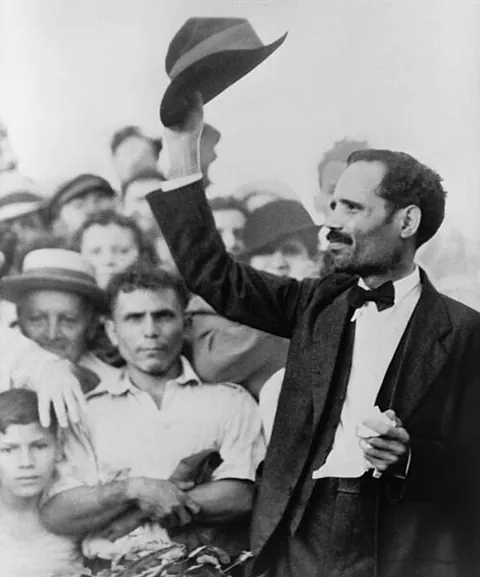
Photo: Pedro Albizu Campos raising his hat to a crowd, 1936.jpg, Associated Press (Public domain). Resized and converted to WebP.
Reviewed November 18, 2026. Original biography by PuertoRico.com. Editorial policy