Gabriella Coleman: biography
Early life and education
Enid Gabriella Coleman was born in 1973 in San Juan, Puerto Rico. She completed her high school education at St. John's School in San Juan. Coleman graduated with a Bachelor of Arts in religious studies from Columbia University in May 1996. She earned a Master of Arts in socio-cultural anthropology from the University of Chicago in August 1999. In 2005 she received her PhD in socio-cultural anthropology from the University of Chicago; her dissertation examined the social construction of freedom in free and open source software, hackers, ethics and the liberal tradition. 1 2
Academic career
Coleman held a postdoctoral fellowship at the Center for Cultural Analysis at Rutgers University. She also received the Izaak Walton Killam Memorial Postdoctoral Fellowship in the Program in Science, Technology and Society at the University of Alberta. In September 2007 she was appointed assistant professor of media, culture and communication at New York University. In January 2012 she moved to Montreal to assume the Wolfe Chair in Scientific and Technological Literacy at McGill University. That same year she spoke at Webstock 2012 in Wellington, New Zealand. 1 2
Research on hackers and hacking
Coleman's scholarship examines the ethics and politics of computer hacking. She has theorized hacker diversity through the concept of hacker genres, which refers to multiple historical genealogies and distinct ethical lessons. Her work also identifies elements that bind hackers together, especially commitment to the craft and craftiness of hacking. In 2012 she published Coding Freedom: The Ethics and Aesthetics of Hacking with Princeton University Press under a creative commons license. The book analyzes principles and paradoxes of contemporary liberalism from the perspective of free and open-source software communities. It explores productive freedom in response to changes in intellectual property law, codes of values, the poetics of hacker humor and forms of political governance developed by hackers. In 2019 she launched Hack_Curio, an online museum with short video clips on computer hacking and expert-written explanations. The project aims to challenge hacker stereotypes and highlight the role of hacking in global culture and politics. She has appeared in documentaries on hacker topics. In 2021 she co-produced and hosted a 10-part podcast series on hackers for BBC Radio 4 titled The Hackers. 1 2
Research on Anonymous
Coleman is known for her ethnographic work on the hacktivist collective Anonymous. In July 2010 she discussed the group's Operation Chanology against the Church of Scientology and introduced the trickster archetype as a central motif. She connected the trickster figure to hackers after reading Lewis Hyde's Trickster Makes This World during a hospital stay. Coleman argues that tricksters push boundaries of propriety and property, use wit for play or political ends, learn from being trapped by their cunning and remake the world technically, socially and legally. She has described Anonymous as everything and nothing at once and noted that not fully understanding who is behind the mask gives the group political power. Her multi-year research culminated in the 2014 book Hacker, Hoaxer, Whistleblower, Spy: The Many Faces of Anonymous, published by Verso Books. It charts the history, rise and impact of Anonymous while framing trolling and the group through tricksterism. In 2023 she published a comparison of Anonymous with the anonymous far right and QAnon in the journal Hau. 1 2
Publications and recognition
Coleman has published numerous articles and chapters. She co-edited a 2017 issue of Limn on hacks, leaks and breaches. Her work appears in edited volumes such as The Social Media Reader and Tactical Biopolitics. She has served as a media commentator on Anonymous and criticized some mainstream coverage for lacking specificity about hackers' attitudes toward laws and their goals. In 2019 she contributed to a special section on online anonymity in Media, Culture and Society. 1 2
Questions about Gabriella Coleman
Where is Gabriella Coleman from?
Gabriella Coleman was born in San Juan, Puerto Rico.
What is Gabriella Coleman's concept of the trickster in relation to Anonymous?
Coleman uses the trickster archetype to describe how Anonymous pushes boundaries with wit for play or political ends, learns from failures and contributes to social renewal. She distinguishes positive trickster actions that offer hope from terrifying ones exemplified by figures such as the troll weev.
Which prize did Hacker, Hoaxer, Whistleblower, Spy win?
The book received the 2015 Diana Forsythe Prize from the American Anthropological Association.
What does Coding Freedom examine?
The book analyzes how free and open-source software communities practice productive freedom against neoliberal intellectual property changes. It covers engineering traditions, licensing, ethical guidelines, hacker humor and governance forms.
Sources
- Wikipedia: Gabriella Coleman
- Wikipedia (español): Gabriella Coleman
- Wikidata: Q5516035
- Library of Congress: Gabriella Coleman
- The New York Times (cited by Wikipedia)
- BBC (cited by Wikipedia)
- Harvard University (cited by Wikipedia)
- DOI (cited by Wikipedia)
- Yale University (cited by Wikipedia)
- IMDb: Gabriella Coleman (credits)
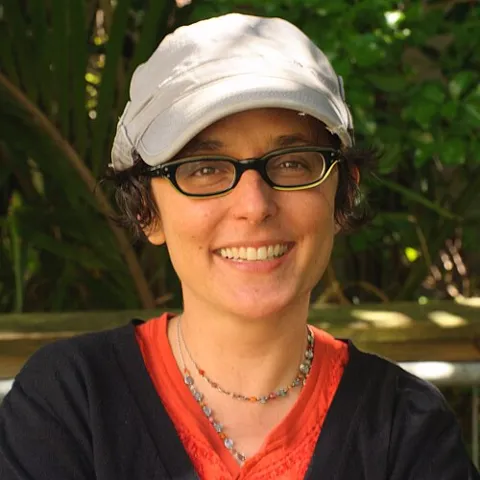
Photo: Gabriella Coleman, Feb 2012.jpg, Karora (Public domain). Resized and converted to WebP.
Reviewed November 18, 2026. Original biography by PuertoRico.com. Editorial policy