George E. Mayer: biography
Early life and family
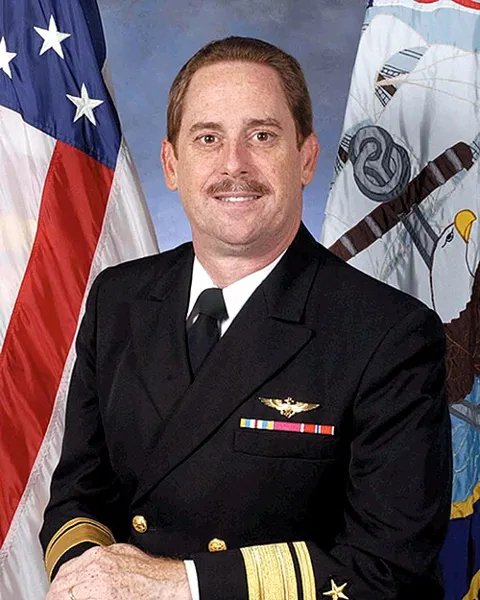
George E. Mayer was born on August 26, 1952, in San Juan, Puerto Rico. He received his primary and secondary education there. The experience sparked his interest in aviation and led him to decide on becoming a naval aviator, a path his father encouraged. 1
United States Naval Academy and flight training
He was designated a student naval aviator and began flight training. Selected for the strike pipeline, he earned his naval aviator wings in 1976 at Training Air Wing One, Naval Air Station Meridian, Mississippi. He first qualified in the A-7 Corsair II attack aircraft and later in the F/A-18 Hornet strike fighter. 1
Squadron assignments and deployments
After transitional training with Attack Squadron 122 at Naval Air Station Lemoore, California, Mayer flew the A-7E Corsair II with Attack Squadron 195, deploying with the Pacific Fleet. He later served with Attack Squadron 25 and returned to Attack Squadron 122 as an A-7 instructor pilot. Additional training took him to Attack Squadron 174 at Naval Air Station Cecil Field, Florida, followed by a deployment with Attack Squadron 105 and the Atlantic Fleet. He then transitioned to the F/A-18 Hornet and commanded Strike Fighter Squadron 83. Across his flying career he accumulated more than 4,000 flight hours and over 1,000 carrier-arrested landings. 1
Shore assignments, promotions and major commands
Mayer's shore duties included serving as executive assistant to the chief of legislative affairs, light attack and strike fighter junior officer detailer at the Bureau of Naval Personnel in Washington, D.C., attendance at the Spanish Command and Staff College in Madrid, and graduation from the U.S. Naval War College in Newport, Rhode Island, where he earned a master's degree in national security and strategic studies. Promoted to rear admiral (lower half), he first served as deputy director of operations at U.S. Central Command, MacDill Air Force Base, Florida. On September 11, 2001, he played a leadership role in planning and executing Operation Enduring Freedom. In February 2002 he was promoted to rear admiral (upper half). His command tours included the Atlantic Fleet F/A-18 Fleet Replacement Squadron (Strike Fighter Squadron 106), Carrier Air Wing Seven, Carrier Group Eight (later Carrier Strike Group Eight), and a dual assignment as commander of Navy Region South and chief of naval air training. In August 2005 he assumed command of the Naval Safety Center in Norfolk, Virginia, becoming the first Puerto Rican Commander of the Naval Safety Center. He relinquished command and retired from the Navy in October 2007. 1
BALTOPS 2003 and final command
While commanding Carrier Strike Group Eight from the flagship USS Vella Gulf, Mayer led Baltic Operations 2003. The exercise involved thirteen nations, more than 3,600 personnel, 36 ships, three submarines, over 40 aircraft and six ground forces from Allied and Partnership for Peace countries. It marked the first inclusion of combined ground troops from Russia, Poland, Denmark and the United States in the exercise's 31-year history. Ground elements conducted interoperability training that included amphibious landings in Poland and the evacuation of role-playing non-combatants from Bornholm, Denmark. As commander of the Naval Safety Center from August 2005 to October 2007, Mayer oversaw efforts to provide safety assistance and advice to the chief of naval operations, the commandant of the Marine Corps and the deputy assistant secretary of the Navy for safety. The center's mission focused on enhancing warfighting capability, preserving resources and improving combat readiness by preventing mishaps and saving lives. He has advocated for Hispanic recruitment and participation in the United States Armed Forces. 1
Recognition and awards
On October 7, 2005, Mayer received the military executive excellence award at the 17th Annual Hispanic Engineers National Achievement Awards Conference in Anaheim, California, based on his prior service as chief of naval air training and commander of the Naval Safety Center. In 2022 he was inducted into the Puerto Rico Veterans Hall of Fame. 1
Questions about George E. Mayer
When was George E. Mayer born?
George E. Mayer was born on August 26, 1952 in San Juan, Puerto Rico. George E. Mayer is 74 years old.
What role did George E. Mayer play on September 11, 2001?
While serving as deputy director of operations at U.S. Central Command he was thrust into a major leadership role during the planning and execution of Operation Enduring Freedom.
Which multinational exercise did Mayer lead in 2003?
He commanded Baltic Operations 2003 from the USS Vella Gulf, the first time the exercise included combined ground troops from Russia, Poland, Denmark and the United States.
What distinction did Mayer achieve at the Naval Safety Center?
He became the first Puerto Rican commander of the Naval Safety Center upon assuming command in August 2005.
Sources
- Wikipedia: George E. Mayer
- Wikidata: Q5538759
- U.S. Navy (cited by Wikipedia)
- U.S. Congress (cited by Wikipedia)
Photo: RADML George E. Mayer.jpg, Unknown author (Public domain). Resized and converted to WebP.
Reviewed November 18, 2026. Original biography by PuertoRico.com. Editorial policy