Luis Rafael Sánchez: biography
Early life and family
Luis Rafael Sánchez was born on November 17, 1936, in Humacao to parents Luis Sánchez Cruz, a baker, and Águeda Ortiz Tirado, a seamstress. He grew up with siblings Néstor Manuel and Elba Ivelisse in the Antonio Roig public housing development and attended local public schools including Antonia Sáez, Manuel Martínez and Juan Ponce de León. The family moved to San Juan in 1948 when he was twelve; there he lived with relatives, finished high school at Superior Central de Santurce in 1955, and encountered both nationalist leader Pedro Albizu Campos and theater director Victoria Espinosa. 3
Sánchez enrolled at the University of Puerto Rico after graduating from high school, earning a Bachelor of Arts degree. It was during his days as a student at the university that he became interested in acting. There he was taught by Victoria Espinosa. He eventually went to Madrid, Spain and earned his Doctorate in literature in 1976 from the Complutense University of Madrid. 1
Theater career
Sánchez wrote and staged his first plays while still a university student. Early titles include Los ángeles se han fatigado, Farsa del amor compradito, La hiel nuestra de cada día and O casi el alma, all produced between 1960 and 1965. His breakthrough came with La Pasión según Antígona Pérez, which premiered in 1968 at the Tapia Theater in Old San Juan as part of the Eleventh Puerto Rican Theater Festival and starred Myrna Vázquez. The tragedy reworks Sophocles' Antigone around the life of nationalist speaker Olga Viscal Garriga. 1 2 3
Other notable plays are Quíntuples (1985) and performed internationally. 1 2
Narrative and essays
Sánchez published the short-story collection En cuerpo de camisa in 1966, gathering prize-winning tales such as El trapito, Destierro and Aleluya negra that had appeared in magazines and newspapers. His first novel, La guaracha del Macho Camacho, appeared in Buenos Aires in 1976. The work unfolds to the rhythm of a guaracha and examines Americanization, political status, cultural assimilation and identity through characters stuck in a San Juan traffic jam. It was translated into English by Gregory Rabassa. 1 2 3
Subsequent novels include La importancia de llamarse Daniel Santos in 1988 and Indiscreciones de un perro gringo in 2007. 1 2
Recognition and later years
Sánchez received a Guggenheim Fellowship in 1979 and a residency at the Berlin Academy of Arts in 1985. In 1996 he was named Humanist of the Year by the Puerto Rican Endowment for the Humanities and occupied the Julio Cortázar Chair at the University of Guadalajara at the invitation of Carlos Fuentes and Gabriel García Márquez. He was awarded the Presidential Medal Eugenio María de Hostos in New York in 2012 and became a member of the Puerto Rican Academy of the Spanish Language. 2 3
The Luis Rafael Sánchez Theater Hall at the University of Puerto Rico in Humacao, opened in 2015, houses part of his personal collection. In 2016 he successfully advocated for the inclusion of the word puertorriqueñidad in the dictionary of the Real Academia Española. He remains professor emeritus at both the University of Puerto Rico and the City University of New York and continues to travel for lectures and theater projects in Europe and Latin America. 1 2 3
Ties to Puerto Rico
Sánchez has consistently addressed Puerto Rican identity, language, politics and the island's colonial relationship with the United States. His support for independence led him to sign the 2006 Panama Proclamation issued by the Puerto Rican Independence Party. The essay series Escrito en puertorriqueño, published in Claridad between 1972 and 1980, served as a notebook for his novel La guaracha del Macho Camacho and examined local culture and broader Latin American themes. 2 3
The film La guagua aérea directed by Luis Molina Casanova in 1993 was based on his texts. 2
Questions about Luis Rafael Sánchez
When was Luis Rafael Sánchez born?
Luis Rafael Sánchez was born on November 17, 1936 in Humacao, Puerto Rico. Luis Rafael Sánchez is 90 years old.
What real person inspired the character of Antigona in La Pasión según Antígona Pérez?
The character was based on Olga Viscal Garriga, a Puerto Rican Nationalist Party member, accomplished speaker and mother who served eight years in prison for refusing to recognize United States authority over Puerto Rico.
How does La guaracha del Macho Camacho reflect Puerto Rican reality?
The novel uses the rhythm of a guaracha and follows characters in a San Juan traffic jam to explore Americanization, political status, cultural assimilation and the tension between retaining Puerto Rican identity and adopting American culture.
What term did Luis Rafael Sánchez popularize in his essay La guagua aérea?
He coined the metaphor of the flying bus to describe the bipolar reality of Puerto Ricans who live between the island and the mainland United States.
Sources
- Wikipedia: Luis Rafael Sánchez
- Wikipedia (español): Luis Rafael Sánchez
- Enciclopedia de Puerto Rico: Luis Rafael Sánchez
- Wikidata: Q649054
- Fundación Nacional para la Cultura Popular (cited by Wikipedia)
- Library of Congress (cited by Wikipedia)
- El Nuevo Día (cited by Wikipedia)
- Oxford Reference (cited by Wikipedia)
- IMDb: Luis Rafael Sánchez (credits)
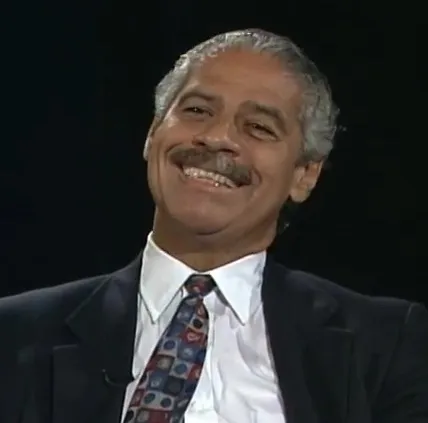
Photo: Luis Rafael Sanchez on Charlando con Cervantes (1995).jpg, CUNY TV; Charlando con Cervantes (CC BY-SA 4.0). Resized and converted to WebP.
Reviewed November 18, 2026. Original biography by PuertoRico.com. Editorial policy