Pepon Osorio: biography
Early life and education
Pepón Osorio was born in 1955 in Santurce, San Juan, Puerto Rico. He studied at the Interamerican University of Puerto Rico and at Lehman College before earning a master's degree in sociology from Columbia University in 1985. He moved to the Bronx, New York, in 1975 and began making art the following year. He currently lives in Philadelphia and teaches art education at Temple University's Tyler School of Art. 1
Early career and object-based installations
In 1985 Osorio shifted his artistic focus toward self-identity and cultural reaffirmation. Starting with La Bicicleta in 1987, he transformed ordinary inexpensive objects by adding layers of decoration that included religious figures, holy cards, plastic flowers, ribbons, photographs, dolls, swans, palm trees and other small plastic items. He described this additive process as that of an embelequero, a practice common among Puerto Ricans that reinvents what is available rather than accepting objects as given. La Bicicleta drew on memories of his own childhood bicycle and those of people he knew in Puerto Rico such as friends, an avocado vendor and a knife sharpener. El Chandelier from 1987, accompanied by the performance No Regrets with choreographer Merián Soto, honored a Puerto Rican woman from the Bronx for whom the chandelier represented one of few affordable luxuries. La Cama from the same year commemorated Juana Hernández, whom Osorio considered a second mother who had died in 1982; the piece incorporated large photographs of Soto and Osorio and served to introduce Hernández to Soto, whom he later married. Osorio frequently collaborated with Soto on performances, sets and installations. He incorporated performance and dance to portray the Latino body more directly. In La Cama the body was implied but physically absent. Installations were also shown at Ronald Feldman Gallery. 1
Addressing the AIDS pandemic and mainstream representation
In 1991 Osorio installed El Velorio – AIDS in the Latino Community inside El Museo del Barrio in New York. The work featured seven coffins representing Puerto Rican victims of AIDS; each contained personal items such as notes from family and friends, flowers and a mirror intended to help viewers connect personally with the piece. During the 1990s he began working with video, which brought him into the mainstream art world. His two-room installation Scene of the Crime (Whose Crime?) appeared in the 1993 Whitney Biennial. It presented a covered body on a living-room floor presumed to be a woman murdered by her husband, surrounded by crime-scene tape. The Latino domestic space was filled with religious figures, trophies, framed photographs, enlarged images, Puerto Rican flags, souvenirs, advertisements for Latino food products and other embellishments. A gold silk sofa was pierced by more than half a dozen souvenir machetes that say, "Puerto Rico." Walls of videotapes from Hollywood films depicting negative Latino stereotypes framed the installation. Each tape box carried statements from Latino community members Osorio had interviewed about media representation. They show our humanity not our struggles and empowerment." A welcome mat stated that years of pain had gone into gathering possessions only to see them mocked in movies. Osorio used film to remain present when he could not appear physically. After the Biennial he decided not to exhibit in mainstream museums unless the work was first shown to the Puerto Rican community. 1
Explorations of gender and community projects
In 1994 Osorio created En La Barberia, No Se Llora to examine Latino masculinity. The installation recreated a barbershop as a weekend social space for business, dominoes and haircuts where crying was forbidden as a feminine act. Sixteen video monitors showed men of various ages in different physical and emotional states of masculinity, while two color monitors displayed men crying without sound. Portraits of Latino men lined the walls, the largest depicting his father Benjamin Osorio. Women appeared in the videos to challenge the gender boundary. In 2013 Philadelphia closed Fairhill Elementary School as part of two dozen closures ordered by the Philadelphia School Reform Commission because of funding cuts. Osorio collaborated with former staff, students and parents on ReForm, an installation at Tyler School of Art at Temple University from 2014 to 2017. Assistants who called themselves the Bobcats after the school's mascot helped gather objects from the closed building with district permission. The work recreated a classroom using patterned fabric, backpacks, books, desks, chairs, video and audio drawn from the community. It drew attention to the needs of Philadelphia's public school system and the importance of correcting past shortcomings. A Fun Day event organized by the Bobcats drew 800 participants instead of the expected 200. 1
Awards and recognition
Osorio received a Bessie Award in 1985 and a MacArthur Foundation fellowship in 1999. 1
Questions about Pepon Osorio
Where is Pepon Osorio from?
Pepon Osorio was born in Santurce, San Juan, Puerto Rico.
How did Pepón Osorio use everyday objects in his art?
Osorio transformed ordinary inexpensive items by adding layers of religious figures, plastic flowers, ribbons, photographs, dolls and other small objects. He called this additive process that of an embelequero, a Puerto Rican practice of reinventing what is available.
What was the purpose of Scene of the Crime (Whose Crime?)?
The 1993 Whitney Biennial installation depicted a Latino home turned into a crime scene to critique negative Hollywood stereotypes of Puerto Ricans and Latinos as violent. Videotapes of such films and community interview statements surrounded the room.
Why did Osorio create ReForm at Temple University?
ReForm used objects from the closed Fairhill Elementary School in Philadelphia to highlight problems in the public school system. Community members including students called the Bobcats collaborated on the installation that ran from 2014 to 2017.
Sources
- Wikipedia: Pepón Osorio
- Wikidata: Q7166327
- Library of Congress: Pepon Osorio
- PBS (cited by Wikipedia)
- JSTOR (cited by Wikipedia)
- DOI (cited by Wikipedia)
- Yale University (cited by Wikipedia)
- Smithsonian Institution (cited by Wikipedia)
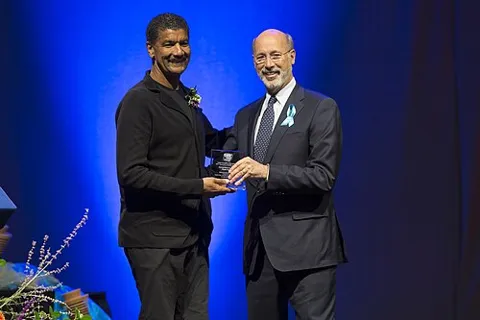
Photo: Pepón Osorio and Governor Tom Wolf - 2017 Governor’s Awards for the Arts.jpg, Governor Tom Wolf (CC BY 2.0). Resized and converted to WebP.
Reviewed November 18, 2026. Original biography by PuertoRico.com. Editorial policy