Sonia Sotomayor: biography
Early life and family
Sonia Sotomayor was born in the Bronx to parents from Puerto Rico. Her father Juan came from Santurce in San Juan and her mother Celina from Lajas. The couple met and married during World War II after Celina served in the Women's Army Corps. Juan worked as a tool and die maker with limited English while Celina worked as a telephone operator and later a nurse. Sotomayor grew up in Puerto Rican neighborhoods in the South Bronx and later the Bronxdale Houses in Soundview. The family visited Puerto Rico often in summer. She has described herself as Nuyorican. 1 6
Her mother emphasized education and purchased an encyclopedia for the children. Sotomayor attended Blessed Sacrament School where she was valedictorian and later Cardinal Spellman High School where she again graduated as valedictorian in 1972. The family later moved to Co-op City. 1 2 6
Education and early activism
Sotomayor studied history at Princeton University. She co-chaired Acción Puertorriqueña, advocated for more Latino faculty and courses on Latin American and Puerto Rican topics, and helped create a seminar on Puerto Rican history and politics. Her senior thesis examined Luis Muñoz Marín and Puerto Rico's economic and political self-determination. She graduated summa cum laude in 1976, won the Pyne Prize, and was elected to Phi Beta Kappa. She then attended Yale Law School, served as editor of the Yale Law Journal, published a note on Puerto Rican statehood and mineral rights, and earned her Juris Doctor in 1979. 1 6
Prosecutor, private practice and public boards
Sotomayor worked as an assistant district attorney in New York County from 1979 to 1984 under Robert Morgenthau. She prosecuted cases including robberies, assaults, murders, police brutality, and the 1983 conviction of the Tarzan Murderer. In 1984 she joined Pavia & Harcourt where she handled intellectual property, international arbitration, and counterfeit cases for clients such as Fendi. She became partner in 1988 and left in 1992. She served on the boards of the Puerto Rican Legal Defense and Education Fund from 1980 to 1992, the State of New York Mortgage Agency from 1987 to 1992, and the New York City Campaign Finance Board from 1988 to 1992. 1 2 6
Federal judge before the Supreme Court
President George H. W. Bush nominated Sotomayor to the U.S. District Court for the Southern District of New York in 1991. She was confirmed in 1992 and became the first Hispanic federal judge in New York State. In 1995 she issued an injunction that ended the 232-day Major League Baseball strike. President Bill Clinton nominated her to the U.S. Court of Appeals for the Second Circuit in 1997. After a lengthy confirmation process she was confirmed in 1998. On that court she heard more than 3,000 cases and authored about 380 opinions. 1 2 6
Supreme Court justice and ties to Puerto Rico
President Barack Obama nominated Sotomayor to the Supreme Court in May 2009. The Senate confirmed her in August 2009 by a 68-31 vote. She is the third woman and first justice with Puerto Rican parents to sit on the Court. She has supported the liberal bloc on issues including criminal defendants' rights and has written notable dissents on race and ethnic identity. She taught at New York University School of Law and Columbia Law School. She has served on Princeton's board. In 2013 she published her memoir My Beloved World in English and Spanish. 1 2 6
Questions about Sonia Sotomayor
When was Sonia Sotomayor born?
Sonia Sotomayor was born on June 25, 1954 in The Bronx, New York City. Sonia Sotomayor is 72 years old.
How did Sonia Sotomayor help end the 1994 Major League Baseball strike?
As a district judge she issued a preliminary injunction against the owners preventing them from using replacement players and unilaterally implementing a new collective bargaining agreement. The ruling ended the 232-day strike the day before the season was to begin.
What role did Acción Puertorriqueña play in Sotomayor's Princeton years?
She co-chaired the student organization that served as a social and political hub for Puerto Rican students. It pushed for more Latino faculty, Latin American studies courses, and greater opportunities for Puerto Rican applicants.
Which Puerto Rican political figure did Sotomayor study in her Princeton thesis?
She wrote her senior thesis on Luis Muñoz Marín and the impact of his life on the political and economic history of Puerto Rico from 1930 to 1975.
Sources
- Wikipedia: Sonia Sotomayor
- Wikipedia (español): Sonia Sotomayor
- Wikidata: Q11107
- Encyclopaedia Britannica: Sonia Sotomayor
- Supreme Court of the United States: current justices
- Enciclopedia de Puerto Rico: Sonia Sotomayor
- CNN (cited by Wikipedia)
- The New Yorker (cited by Wikipedia)
- Los Angeles Times (cited by Wikipedia)
- U.S. Courts (cited by Wikipedia)
- The Washington Post (cited by Wikipedia)
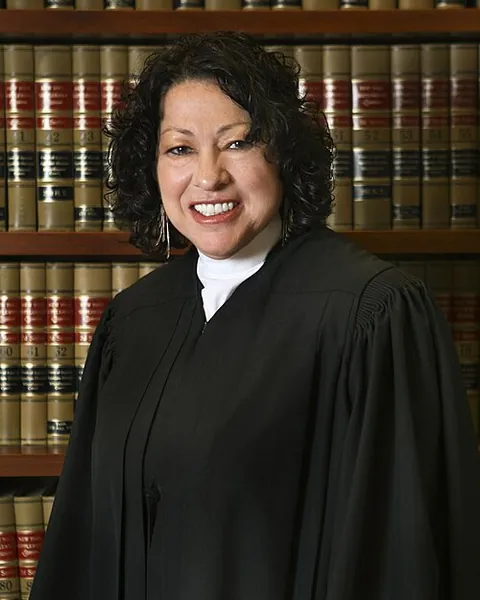
Photo: Sonia Sotomayor 7 in robe, 2009.jpg, Stacey Ilyse (CC BY 3.0). Resized and converted to WebP.
Reviewed November 18, 2026. Original biography by PuertoRico.com. Editorial policy