Víctor Manuel Blanco: biography
Early life and family
Víctor Manuel Blanco Pagán was born on March 10, 1918, in Guayama, Puerto Rico, one of nine children of Felipe Blanco, a policeman, and Adelfa Pagán de Blanco, a housewife. He completed primary and secondary schooling in Guayama. As a boy he became fascinated by the stars and constructed a backyard telescope. 1 2
World War II service
During World War II Blanco served in the US Army Air Force in the Pacific Theater. His assignment involved repairing and tuning radar detectors, work that allowed him to investigate atmospheric effects on radar waves. After discharge he received college credit for this experience and returned to the University of Chicago, where he completed a Bachelor of Science degree. 1 2
Astronomy career before Cerro Tololo
Blanco worked as an assistant professor of astrometry at the University of Puerto Rico until 1948, when he was recruited to help polish, calibrate and maintain the mirrors of the 200-inch Hale Telescope in California. He returned to the University of Puerto Rico that same year. Later he directed the Astrometry and Astrophysics Division at the United States Naval Observatory and served as an astronomer for UNESCO in Java, Indonesia. In 1959, while a professor of astrophysics at the Case Institute of Technology in Cleveland, Ohio, he discovered the open cluster centered on the blue star Zeta Sculptoris that was named Blanco 1. 1 2
With his wife Betty and colleague Martin McCarthy he carried out pioneering studies of stellar populations in the nuclear bulge of the Milky Way and in the Magellanic Clouds. Their work identified a change in the ratio of carbon stars to M-type stars between the galactic center and both the Large and Small Magellanic Clouds. Blanco also co-authored the 1961 textbook Basic Physics of the Solar System with S. W. McCuskey and published papers including "Carbon stars" in Revista Mexicana de Astronomía y Astrofísica and "Late type giants in Large Magellanic Cloud" in Nature. 1 2
Directorship of Cerro Tololo Inter-American Observatory
In July 1967 Blanco became the second director of the Cerro Tololo Inter-American Observatory in Chile, part of the National Optical Astronomy Observatory. He assembled the scientific, engineering and technical staff from the beginning. At his arrival only a 60-inch telescope was operating. 1 2
Blanco played a central role in securing support for a 4-meter telescope, the southern twin of the instrument at Kitt Peak National Observatory. He personally oversaw its alignment and calibration. The telescope opened in 1974 and became the most productive in the Southern Hemisphere. He maintained strong relations with the Chilean astronomical community and public during the presidencies of Eduardo Frei Montalva, Salvador Allende and Augusto Pinochet. Blanco remained director until 1981. 1 2
Honors, later writings and legacy
On September 8, 1995, the CTIO 4-meter telescope was dedicated as the Víctor M. Blanco Telescope in a mountaintop ceremony. A bronze plaque at the entrance bears inscriptions in Spanish and English. The telescope has been used to study cosmic acceleration. Asteroid 9550 Victorblanco, discovered in 1985 by Edward Bowell, was named in his honor; the Minor Planet Center published the citation in 2001. Blanco belonged to multiple commissions of the International Astronomical Union, including those on stellar photometry, galactic structure, stellar classification and observatory site protection. 1 2
Among his later publications was the 2001 review article "Telescopes, Red Stars, and Chilean Skies" in the Annual Review of Astronomy and Astrophysics. Víctor Manuel Blanco died on March 8, 2011, in Vero Beach, Florida. He was survived by his wife of 42 years, Betty Blanco, a son Daniel Blanco, a stepson David Mintz and a stepdaughter Elizabeth Vitell. 1 2
Questions about Víctor Manuel Blanco
When was Víctor Manuel Blanco born?
Víctor Manuel Blanco was born on March 10, 1918 in Guayama, Puerto Rico.
What is the Víctor M. Blanco Telescope?
The 4-meter telescope at Cerro Tololo Inter-American Observatory in Chile that was named in his honor in 1995. It is the southern twin of the instrument at Kitt Peak and has been used to study cosmic acceleration.
How did Blanco contribute to the study of the Magellanic Clouds?
With his wife Betty and Martin McCarthy he conducted pioneering research on stellar populations and discovered the change in the ratio of carbon stars to M-type stars between the galactic bulge and both the Large and Small Magellanic Clouds.
Which universities did Blanco attend for his degrees?
He studied at the University of Puerto Rico, the University of Chicago for his bachelor's degree, and the University of California, Berkeley for his master's and doctorate in astronomy completed in 1949.
When did Víctor Manuel Blanco die?
Víctor Manuel Blanco died on March 8, 2011 in Vero Beach, Florida, aged 92.
Sources
- Wikipedia: Víctor Manuel Blanco
- Wikipedia (español): Víctor Manuel Blanco
- Wikidata: Q7944674
- The New York Times (cited by Wikipedia)
- NASA (cited by Wikipedia)
- Library of Congress (cited by Wikipedia)
- U.S. Navy (cited by Wikipedia)
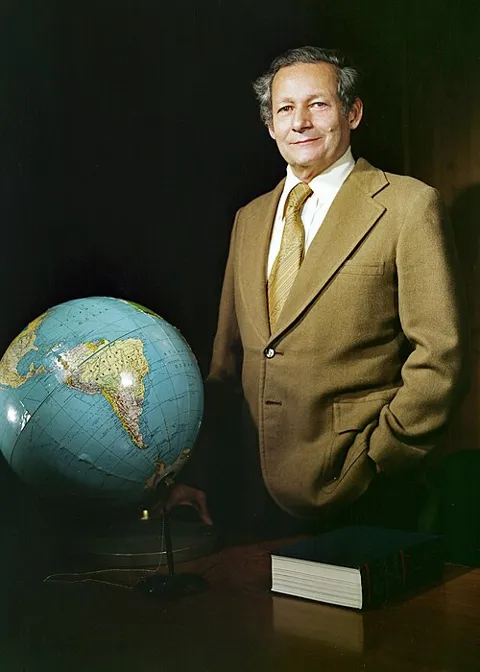
Photo: Victor Blanco with a globe.jpg, NOIRLab/NSF/AURA (CC BY 4.0). Resized and converted to WebP.
Reviewed November 18, 2026. Original biography by PuertoRico.com. Editorial policy