Luis Muñoz Rivera: biography
Early life and family
Luis Muñoz Rivera was born on July 17, 1859, in Barranquitas to Luis Muñoz Barrios and Monserrate Rivera Vázquez. He was the first of several children in a family whose paternal line held political positions in several towns. By ten he had finished the local school at the head of his class and continued studies with private tutors in Spanish, French and music. He read works by Miguel de Cervantes, especially Don Quixote, along with Spanish Golden Age poets. When he was twelve his mother died, leaving him to help raise younger siblings while assisting in his father's store and handling legal papers for the local church. His father refused to send him abroad for university study, so he remained in Barranquitas managing family business. 1 5
Literary beginnings and entry into politics
Muñoz Rivera began writing poetry as a young man but did not publish until age twenty-three. His first accepted poem, Adelante, appeared in the newspaper El Pueblo in 1882. An editor encouraged him to focus on science and politics rather than love themes. He soon wrote on the need for an autonomous government for Puerto Rico. Although his father belonged to the Conservative Party, Muñoz Rivera joined the Liberal Party in 1883, following his uncle's example. He opened a store with Quintín Negrón Sanjurjo and rose within the party to become president of the Barranquitas committee and a member of the municipal council. In 1885 he ran unsuccessfully for the Provincial Assembly from Juana Diaz and began publishing poems and articles in several papers. His published poetry included titles such as Retamas, Tropicales, Horas de Fiebre, El paso del déspota, and Poemas Liricos. In 1887 he attended the convention in Coamo that reorganized the Liberal Party into the Autonomist Party and met Román Baldorioty de Castro, who became his mentor. 1 5
Campaign for autonomy under Spain
Muñoz Rivera helped build the Autonomist Party's support among the rural population through writings and speeches. In 1889 he won election as delegate from the Caguas district. He founded the party newspaper La Democracia in Ponce in 1890, which mixed political commentary with poetry and stories by Puerto Rican writers. In 1893 he married Amalia Marín in Ponce Cathedral and traveled to Spain to study its political system. There he allied with Práxedes Mateo Sagasta, whose Fusion Party promised autonomy for Puerto Rico. When Sagasta became prime minister, the promised autonomous government was granted in 1897. Muñoz Rivera served as Secretary of Grace, Justice and Government and Chief of the Cabinet in that short-lived administration. 1 5
Transition to U.S. rule and later career
Returning to Puerto Rico, he helped create the Union of Puerto Rico party in 1904. Elected to the House of Delegates, he ran for Resident Commissioner in 1910 and served in Washington from 1911 until his death. In a 1916 speech he expressed that Puerto Ricans would prefer U.S. citizenship if the island disappeared but favored Puerto Rican citizenship while the island existed. He fell ill with an infection and returned to Puerto Rico, dying in San Juan on November 15, 1916. His funeral procession crossed the island and drew thousands, including many rural residents. 1 5
Literary works and family legacy
Among his best-known poems are Nulla est redemptio, Paréntesis, Sísifo, Vox Populi and Quia nominor Leo. He also published the allegorical dialogue Las dos musas, the collections Retamas, Tropicales and La disolución, and his complete works appeared posthumously. His son Luis Muñoz Marín later founded the Popular Democratic Party and became the first elected governor of Puerto Rico. Sixteen schools in Puerto Rico carry his name, and a plaza in Ponce was renamed Plaza Muñoz Rivera with a statue erected in 1923. 1 5
Questions about Luis Muñoz Rivera
When was Luis Muñoz Rivera born?
Luis Muñoz Rivera was born on July 17, 1859 in Barranquitas, Puerto Rico.
What newspapers did Luis Muñoz Rivera found?
He founded La Democracia in Ponce in 1890, El Territorio, El Diario in San Juan, and the bilingual Puerto Rico Herald in New York.
How did Luis Muñoz Rivera contribute to the Jones-Shafroth Act?
As Resident Commissioner from 1911 to 1916 he participated in drafting the legislation and proposed amendments before its approval in 1917.
What was Luis Muñoz Rivera's position in the 1897 autonomous government?
He served as Secretary of Grace, Justice and Government and as Chief of the Cabinet under the autonomous government granted by Spain.
When did Luis Muñoz Rivera die?
Luis Muñoz Rivera died on November 15, 1916, aged 57.
Sources
- Wikipedia: Luis Muñoz Rivera
- Wikipedia (español): Luis Muñoz Rivera
- Wikidata: Q734445
- Encyclopaedia Britannica: Luis Muñoz Rivera
- Enciclopedia de Puerto Rico: Luis Muñoz Rivera
- Biographical Directory of the U.S. Congress (cited by Wikipedia)
- Library of Congress (cited by Wikipedia)
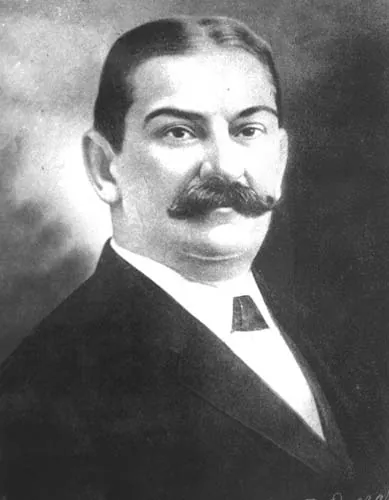
Photo: Luis Munoz Rivera.jpg, http://en.wikipedia.org/wiki/User:Jmoliver (Public domain). Resized and converted to WebP.
Reviewed November 18, 2026. Original biography by PuertoRico.com. Editorial policy