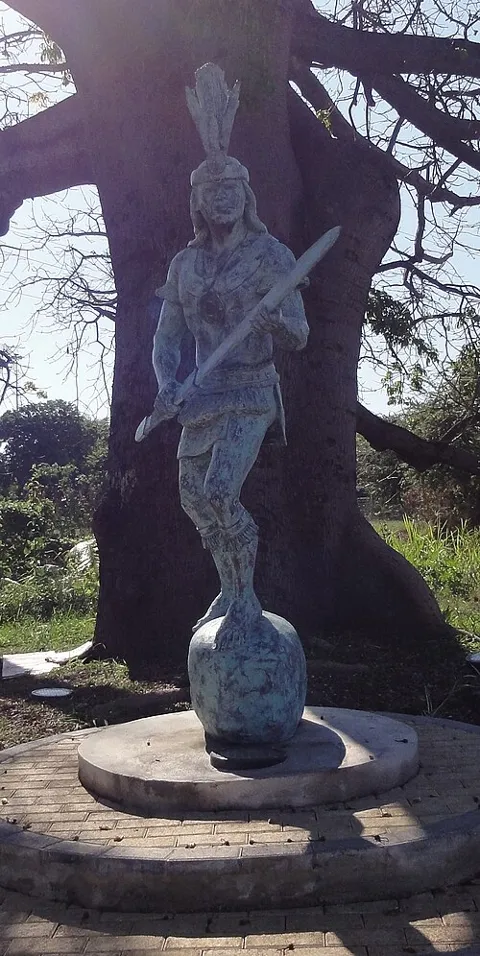
Agüeybaná: biography
Early life and family
The title Agüeybaná, interpreted by later authors as meaning "The Great Sun," functioned as a hereditary designation passed through the maternal line within the ruling family that governed a theocratic monarchy over other regional chiefs. Spanish chroniclers such as Juan de Castellanos and Gonzalo Fernández de Oviedo y Valdés referred to the holder of this title as Rey Agüeybana, drawing a parallel to European kings. By the 19th century, local and Spanish writers used the terms king and cacique interchangeably, though 20th-century interest in indigenous history favored the native term. 1
Encounter with the Spanish
In 1508 Agüeybaná welcomed the Spanish conquistador Juan Ponce de León and his men. Following an old Taíno custom known as guaitiao, the two men exchanged names as a sign of friendship. Ponce de León baptized the cacique's mother and gave her the Christian name Inés. Agüeybaná then joined Ponce de León in exploring the island. Afterward he traveled with the conquistador to La Española, where Governor Nicolás de Ovando received him well. These actions contributed to an initial period of peace between the Taíno and the Spanish settlers. 1 2
Conquest and death
The friendly reception extended by Agüeybaná and other Taíno leaders allowed the Spanish to establish control over the island. Soon afterward the Taíno were compelled to labor in gold mines and to build forts. Many died from the harsh conditions imposed on them. Agüeybaná died in 1510. His brother, known as Agüeybaná II or Güeybaná, succeeded him as the most powerful cacique and later led an armed revolt against the Spanish in 1511. The Taíno forces were defeated at the Battle of Yagüecas. By 1520 the Taíno presence on the island had sharply declined. A census conducted in 1530 recorded only 1,148 Taíno remaining. 1
Aftermath and genetic legacy
Following the Spanish victory, many Taíno either left the island, were enslaved, or died from violence and disease, including a smallpox epidemic that struck in 1519. Until recent decades this sequence of events was understood as the complete extinction of the Taíno people in Puerto Rico. Genetic studies published between 2018 and 2019 demonstrated that Taíno ancestry persists in the modern Puerto Rican genome. These analyses indicate that assimilation, migration to neighboring islands, and survival through the genetic bottleneck occurred rather than total extinction. 1
Legacy and ties to Puerto Rico
Agüeybaná is remembered in Puerto Rico for his efforts to maintain peace with the arriving Spanish while leading his people. Several public sites carry his name. The city of Bayamón named a high school after him. A street in Caguas and an avenue in the Hato Rey section of San Juan also honor the cacique. For many years Puerto Rico presented an annual music award called the Agüeybaná de Oro, modeled after the Grammy. Poets including Juan Antonio Corretjer have written songs and poems about him. 1
Questions about Agüeybaná
Where is Agüeybaná from?
Agüeybaná was born in Puerto Rico, Puerto Rico.
What was the guaitiao ritual that Agüeybaná performed with Juan Ponce de León?
It was a traditional Taíno friendship ceremony in which the two men exchanged names.
How did Agüeybaná's death affect the Taíno leadership?
His brother Agüeybaná II succeeded him and led the Taíno rebellion against the Spanish in 1511.
What modern evidence shows Taíno survival in Puerto Rico?
Genetic studies from 2018-2019 found Taíno ancestry in the genomes of contemporary Puerto Ricans.
When did Agüeybaná die?
Agüeybaná died on 1510 in Puerto Rico, Puerto Rico.
Sources
- Wikipedia: Agüeybaná I
- Wikipedia (español): Agüeybaná
- Wikidata: Q399673
- Yale University (cited by Wikipedia)
- National Park Service (cited by Wikipedia)
We did not find a freely licensed photo we could use, so we show initials instead.
Reviewed November 18, 2026. Original biography by PuertoRico.com. Editorial policy