William Carlos Williams: biography
Early life and family
Born in Rutherford, New Jersey, in 1883, Williams grew up in a household where Spanish was the primary language. His mother, Raquel Hélène Hoheb, came from Mayagüez, Puerto Rico, and was of French extraction. Scholars note that the Caribbean culture of the family home had an important influence on Williams. 1 2
He received primary and secondary schooling in Rutherford until 1897. He then spent two years at a school near Geneva and attended the Lycée Condorcet in Paris. Upon returning to the United States he studied at the Horace Mann School in New York City. In 1902 he entered the University of Pennsylvania medical school, graduating in 1906. He completed internships at French Hospital and Child's Hospital in New York before traveling to Leipzig for advanced pediatrics training. 1 2
Medical practice
Williams was a pediatrician in Rutherford from 1910 to 1951. He practiced both pediatrics and general medicine. From 1924 until his death he served as chief of pediatrics at Passaic General Hospital, now known as St. Mary's General Hospital. The hospital later placed a memorial plaque that reads "We walk the wards that Williams walked". 1 2
Literary career
He published his first collection, Poems, in 1909; only four copies sold. His second book, The Tempers, appeared with assistance from Ezra Pound. Early friendships with Pound and H.D. drew him briefly to imagism, but he soon moved toward a style rooted in American speech and immediate surroundings. In 1920 he published the experimental Kora in Hell: Improvisations, which drew sharp criticism from peers including Pound and H.D. 1 2
Spring and All appeared in 1923, containing "The Red Wheelbarrow" and "By the road to the contagious hospital." That same period saw T.S. Eliot's The Waste Land overshadow his own approach. Williams later wrote that the poem set him back twenty years by returning poetry to the classroom instead of the local. He preferred colloquial American English over Eliot's intellectual style and foreign allusions. 1
From 1946 to 1958 he published the five volumes of Paterson, an epic that used the city in New Jersey as its subject. The work mixes poetry, prose and collage while exploring the role of the poet in American society. He summarized his method with the repeated phrase "No ideas but in things." He also wrote short stories, novels, essays and plays, often at night after seeing patients. 1 2
Visual arts and influences
Williams maintained a lifelong interest in painting, influenced by his mother who had trained as a painter in Paris. He produced his own early paintings and wrote art criticism. He associated with the New York group known as The Others and formed close friendships with painters Charles Demuth and Charles Sheeler. Demuth's 1928 painting I Saw the Figure 5 in Gold directly responded to Williams's poem "The Great Figure." Williams dedicated Spring and All to Demuth and later wrote "The Crimson Cyclamen" in his memory. 1
He launched the magazine Contact in 1920 with Robert McAlmon to promote work grounded in direct American experience rather than European models. He experimented with the "variable foot" and triadic-line structures to capture rhythms of American speech. Later he mentored younger poets including Allen Ginsberg, whose letters appear in Paterson and whose first book he introduced. 1
Awards, legacy and ties to Puerto Rico
He received the first National Book Award for Poetry in 1950 for the third volume of Paterson and Selected Poems. In 1953 he won the Bollingen Prize. Posthumously he was awarded the 1963 Pulitzer Prize for Pictures from Brueghel and Other Poems and the gold medal for poetry of the National Institute of Arts and Letters. The Poetry Society of America presents an annual William Carlos Williams Award for books from small presses. His Ridge Road house in Rutherford was added to the National Register of Historic Places in 1973 and he was inducted into the New Jersey Hall of Fame in 2009. 1
Puerto Rican writer Marta Aponte Alsina later published the novel La muerte feliz de William Carlos Williams, which examines the relationship between the poet and his mother from Mayagüez and the broader ties between the United States and Puerto Rico. 1 2
Questions about William Carlos Williams
When was William Carlos Williams born?
William Carlos Williams was born on September 17, 1883 in Rutherford, New Jersey.
How did William Carlos Williams's Puerto Rican background influence his work?
His mother came from Mayagüez and the family spoke Spanish at home. Caribbean culture shaped his early consciousness even though he wrote in English.
What is the meaning of "No ideas but in things" in his poetry?
The phrase, repeated in Paterson, summarizes his method of grounding poetry in concrete everyday objects rather than abstract concepts.
Which painters did William Carlos Williams collaborate with or inspire?
He maintained close friendships with Charles Demuth and Charles Sheeler. Demuth painted I Saw the Figure 5 in Gold in response to Williams's poem "The Great Figure".
When did William Carlos Williams die?
William Carlos Williams died on March 4, 1963 in Rutherford, New Jersey, aged 79.
Sources
- Wikipedia: William Carlos Williams
- Wikipedia (español): William Carlos Williams
- Wikidata: Q178106
- Encyclopaedia Britannica: William Carlos Williams
- The New York Times (cited by Wikipedia)
- Poetry Foundation (cited by Wikipedia)
- Library of Congress (cited by Wikipedia)
- CBS News (cited by Wikipedia)
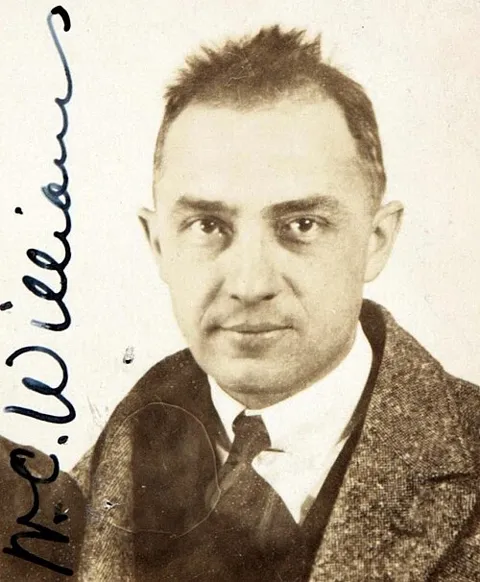
Photo: William Carlos Williams passport photograph 1921.jpg, Unknown author (Public domain). Resized and converted to WebP.
Reviewed November 18, 2026. Original biography by PuertoRico.com. Editorial policy